Sturnus vulgaris
Common Starling (Sturnus vulgaris)
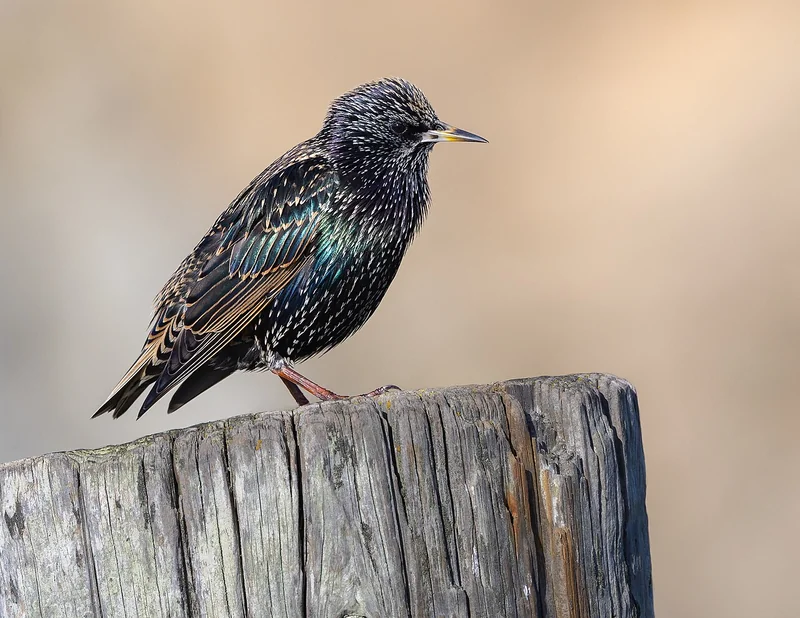 Featured photocommon-starling.jpg
Sturnus vulgaris, the common starling, is a medium-sized Sturnidae starling native to Europe, North Africa, and western Asia. Adults are 19 to 23 cm long with a wingspan of 31 to 44 cm and weigh 58 to 100 g. Adults are glossy black with strong purple and green iridescence and pale spots in winter; the bill turns yellow in the breeding season. The IUCN lists the species as Least Concern globally, although several long-monitored European populations have declined by more than half since the 1980s.
Quick facts
- Habitat
- Almost any open or semi-open landscape: farmland, urban centres, parks, lawns, and grasslands. Pure forest and pure desert are avoided.
- Range
- Native to most of Europe, North Africa, and western Asia. Established by deliberate or accidental introduction across North America, southern Africa, Australia, New Zealand, and many oceanic islands. The species is among the most successful invasive birds globally, with an introduced range now exceeding the native range.
- Size
- 19–23 cm body · 31–44 cm wingspan · 58–100 g
- Plumage
- Adults in breeding plumage are glossy black with strong purple, green, and bronze iridescence and a yellow bill. Winter plumage is heavily spotted with pale buff or white tips on each feather, giving a speckled appearance — the spots wear off through abrasion to reveal the glossy spring plumage. Juveniles are uniformly grey-brown.
- Song
- A long, varied jumble of clicks, whistles, mimicry, and rattles, sometimes including imitations of other birds, mechanical sounds, and human speech. Mozart famously kept a pet starling whose mimicked phrases appeared in his compositions.
- Migration
- Partial migrant. Northern populations move south in autumn; western European and most introduced populations are sedentary. Migrating flocks can number in the millions and form spectacular pre-roost murmurations.
- Conservation
- Least Concern (LC)
Overview
Sturnus vulgaris is the type species of the family Sturnidae. The species is among the most successful invasive birds globally — the entire North American population descends from approximately one hundred birds released in Central Park, New York City in 1890–91 by Eugene Schieffelin's American Acclimatization Society. Within fifty years the species had spread coast to coast and now numbers in the hundreds of millions across North America.
Murmurations
Pre-roost flocks of common starlings perform some of the most spectacular collective movements in the animal kingdom — synchronized aerial displays known as murmurations involving tens of thousands to over a million individuals. Each starling tracks the position of approximately seven nearest neighbours; the local rules generate global patterns that flow, fold, and split without a leader. The phenomenon is studied as a benchmark of self-organized collective behaviour in physics and biology.
Population trends
Despite the global Least Concern listing, several long-monitored European populations have declined by half or more since the 1980s. Drivers proposed include changes in farmland management reducing soil-invertebrate availability, loss of cavity nest sites in modern building stock, and pesticide impacts on prey. The North American introduced population remains very large and broadly stable.
Sources & further reading (2)
- iucn-red-list — accessed 2026-04-29
- encyclopedia — accessed 2026-04-29
Frequently asked questions
Is the starling native to North America?
No. The species was introduced to Central Park, New York City in 1890 and 1891 by Eugene Schieffelin's American Acclimatization Society — one of several attempts at the time to release every bird mentioned in the works of Shakespeare into the United States. From approximately one hundred founding birds, the population spread across the continent within fifty years and now numbers in the hundreds of millions.
How does a starling murmuration work?
Field studies and 3-D tracking show that each starling tracks the position and motion of approximately its seven nearest neighbours. There is no leader; the local interaction rules cause global flock patterns to flow and fold coherently. The result is one of the canonical examples of self-organized collective behaviour and is studied across physics, biology, and applied mathematics.
Why are starling spots seasonal?
The pale spots visible on winter starlings are the buff or white feather tips of fresh autumn-moulted plumage. The spots are not pigment changes; they wear off through abrasion as the feather tips break in the months between moult and breeding. By spring the wear has revealed the glossy iridescent black underlying plumage, and the breeding-season starling appears nearly unspotted.