Corvus corax
Common Raven (Corvus corax)
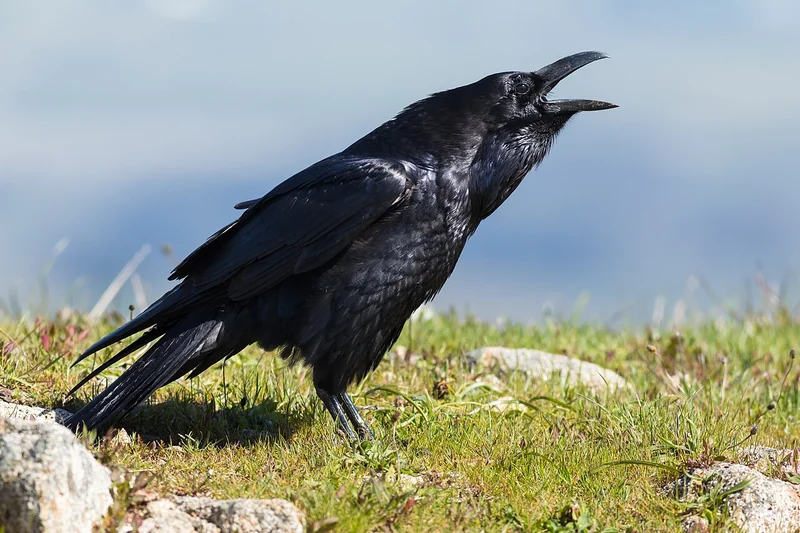 Featured photocommon-raven.jpg
Corvus corax, the common raven, is the largest member of the order Passeriformes and one of the most widely distributed birds on Earth. Adults are 54 to 67 cm long with a wingspan of 115 to 130 cm and weigh 0.7 to 2 kg. The plumage is glossy black throughout, with shaggy throat feathers and a heavy bill. The IUCN lists the species as Least Concern. Ravens are among the most cognitively studied birds, with documented social play, deceptive caching, and use of multi-step planning.
Quick facts
- Habitat
- Mountain forest, sea cliffs, arctic tundra, deserts, and increasingly suburbs and farmland. The species occupies one of the broadest habitat ranges of any bird.
- Range
- Holarctic — across most of North America (south to Mexico and Central America), Europe (excluding lowland farmland in places), North Africa, and across temperate and arctic Asia. The range covers a wider latitudinal span than almost any other bird.
- Size
- 54–67 cm body · 115–130 cm wingspan · 0.7–2 kg
- Plumage
- Adults are uniformly glossy black with strong purple, blue, and green iridescence in good light. The throat feathers are elongated and shaggy — visible when the bird is calling — and the tail is wedge-shaped in flight, distinguishing the species from the smaller fan-tailed crows.
- Song
- A deep, resonant croaking 'kraa' or 'gronk', with a wide repertoire of additional calls including knocking, bell-like, and metallic phrases. Captive ravens mimic human speech.
- Migration
- Sedentary across nearly the entire range. Local movements occur in response to food availability and harsh winters but no regular migration.
- Conservation
- Least Concern (LC)
Overview
Corvus corax is the type and largest species of the genus Corvus. The species' Latin name is the source of the family name Corvidae. Common ravens occupy the broadest geographic and ecological range of any corvid — from the high arctic to North African deserts, sea cliffs to mountain forests. Eight subspecies are currently recognized, differing slightly in size and bill proportions across the Holarctic range.
Cognition
Common ravens are one of the canonical avian cognition models. Documented behaviours include multi-step problem solving, future planning (caching food not for immediate consumption but for anticipated future need), deceptive caching (modifying behaviour when observed by potential thieves), social play, and gestural communication — Bavarian field studies showed adult ravens using visible bill-pointing to direct partners' attention to objects. Cognitive performance in some tasks rivals great apes.
Cultural history
The common raven figures heavily in Northern Hemisphere mythology — Norse Hugin and Munin, Native American trickster Raven, Edgar Allan Poe's poem. The Tower of London famously keeps captive ravens; British tradition holds that the kingdom will fall if the ravens leave. The species' ecological role as a carrion-following companion of wolves and humans is the likely origin of the deep cross-cultural mythological footprint.
Sources & further reading (2)
- iucn-red-list — accessed 2026-04-29
- encyclopedia — accessed 2026-04-29
Frequently asked questions
What's the difference between a raven and a crow?
Ravens are larger (54-67 cm vs. 40-53 cm) with a heavier bill, shaggy throat feathers, and a wedge-shaped tail in flight (vs. fan-shaped in the crow). Voice differs sharply — ravens give a deep croaking 'kraa' or 'gronk', crows a clear 'caw'. Ravens are typically solitary or in pairs and often soar in flight; crows form larger groups and usually flap continuously.
Can ravens really plan for the future?
Field and laboratory studies suggest yes. Ravens cache food for retrieval days or weeks later, modify caching behaviour when observed by other ravens (consistent with theory-of-mind reasoning), and in laboratory tests will choose tools that they will only need to use later. Performance on some forward-planning tasks rivals that of great apes — a striking parallel given the 320-million-year separation between corvid and primate lineages.
Why are there ravens at the Tower of London?
British tradition holds that the kingdom will fall if the ravens ever leave the Tower. The current captive population dates to formal post-Second-World-War provision, but the legend itself is older and connects to deeper Northern European mythological associations between ravens and royal sovereignty (Hugin and Munin, Norse Odin's ravens). The Tower keeps a small flock with their flight feathers selectively trimmed.