Chordeiles minor
Common Nighthawk (Chordeiles minor)
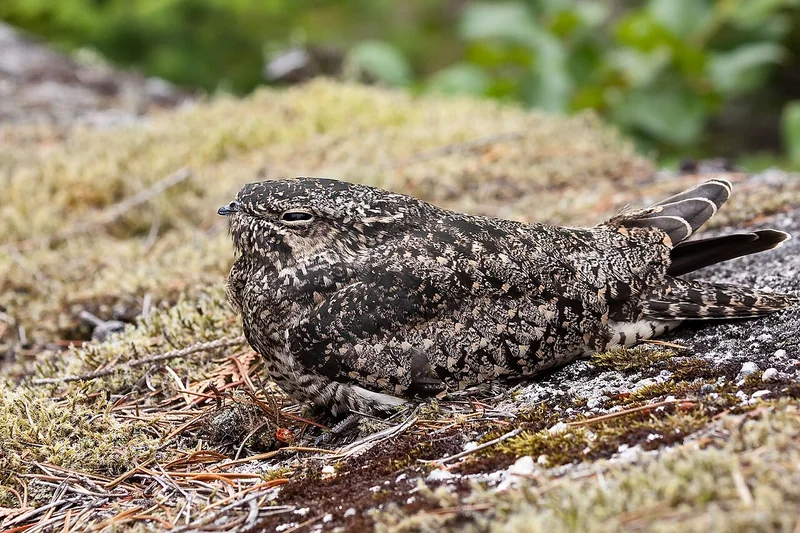 Featured photocommon-nighthawk.jpg
Chordeiles minor, the common nighthawk, is a medium-sized nightjar relative of the family Caprimulgidae breeding across North America and wintering in South America. Adults are 22 to 25 cm long with a wingspan of 51 to 61 cm and weigh 55 to 98 g. The species is cryptically plumaged but recognised in flight by white wing patches and a nasal 'peent' call. The IUCN lists the species as Least Concern but populations have declined significantly since the 1960s.
Quick facts
- Habitat
- Breeds in open and semi-open habitats across North America — including forest clearings, open shrubland, rocky outcrops, beaches, agricultural land, and flat rooftops in urban areas. Migrates through and winters in open grasslands and forest edges in South America. Highly adaptable in terms of nesting substrate.
- Range
- Breeds across North America from southern Canada to Panama, and throughout the United States. Winters in South America, primarily in Argentina, Bolivia, and Brazil. One of North America's longest-distance migrants, wintering up to 10,000 km from breeding grounds.
- Size
- 22–25 cm body · 51–61 cm wingspan · 55–98 g
- Plumage
- Cryptically patterned in grey, brown, black, and buff — producing excellent camouflage on bark, rock, and gravel. In flight, a bold white bar across the outer primaries is the most visible field mark. Males have a white throat patch and white tail band; females are buff-throated without a tail band. The large, flat head and huge gape for aerial insect capture are characteristic.
- Song
- A loud, nasal 'peent' or 'bzeent' given in flight — repeated steadily at dusk and dawn and occasionally throughout the night. Males performing courtship dives produce a booming sound as air rushes through the outer primary feathers at the bottom of the dive — a sound called the 'boom'.
- Migration
- Long-distance migrant. Departs North American breeding grounds in late summer and travels to South America, with the entire population wintering south of the equator. Migration routes pass through Central America; large concentrations can form at stopover sites.
- Conservation
- Least Concern (LC)
Overview
Chordeiles minor is a member of the family Caprimulgidae — the nightjars and nighthawks — a group of crepuscular and nocturnal aerial insectivores with cryptic plumage, large eyes, and a wide gape. Despite the name 'nighthawk', the species is not a hawk and is most closely related to the nightjars and whip-poor-wills. The common nighthawk is one of North America's most widespread aerial insectivores, breeding from the boreal forest edge to Central America. The species adapted readily to urban environments, nesting on the flat, gravel-covered rooftops of North American cities — a habit that made it a familiar urban bird through much of the 20th century.
The booming courtship dive
Male common nighthawks perform a spectacular courtship dive in which the bird dives steeply toward the ground (or toward a perched female) and then pulls up sharply at low altitude. At the moment of pull-out, air rushing through the bent outer primary feathers produces a loud booming or whooshing sound. This 'booming' is one of the most characteristic sounds of North American summer evenings near open habitats and rooftop-nesting colonies. The boom is generated purely by aerodynamic forces — not by the vocal apparatus — making it analogous to the sounds produced by snipe in their display dives. The display serves both to attract females and to signal territory.
Population declines and rooftop nesting
The common nighthawk has declined significantly across North America since the 1960s, with breeding bird survey data showing long-term population decreases in many regions. Suspected causes include reductions in flying insect prey (linked to pesticide use and light pollution), changes in rooftop materials (from gravel to smooth or rubberised surfaces unsuitable for nesting), and habitat loss on wintering grounds in South America. The species adapted historically to urban flat rooftops as an alternative to natural bare ground or rocky outcrops — but modern 'green roof' and smooth membrane rooftop trends have reduced available nesting sites in cities. The species remains classified as Least Concern globally but is a species of conservation concern in parts of its North American range.
Sources & further reading (2)
- iucn-red-list — accessed 2026-05-07
- encyclopedia — accessed 2026-05-07
Frequently asked questions
Is the common nighthawk a hawk?
No — the common nighthawk is not related to hawks or falcons. It is a member of the family Caprimulgidae (nightjars), which is most closely related to swifts and hummingbirds in the broader avian tree. The 'hawk' in the name refers to its hawking behaviour — catching insects in the air — not to any taxonomic relationship with true hawks (Accipitridae).
What causes the booming sound in nighthawk courtship dives?
The booming sound produced by male common nighthawks during their courtship dive is created aerodynamically, not vocally. As the male pulls up steeply at the bottom of the dive, air flowing over the bent outer primary feathers causes them to vibrate rapidly, producing the characteristic boom. This is analogous to the 'drumming' of snipe tail feathers during display flights — both are examples of non-vocal sound production using wing or tail feathers.
Why is the common nighthawk declining across North America?
The common nighthawk has declined significantly since the 1960s across much of its North American range. The primary suspected causes are: reduction in flying insect prey from pesticide use and habitat change; light pollution affecting insect availability and navigation; changes in rooftop materials that reduce urban nesting sites; and habitat loss on South American wintering grounds. The species was once a common city bird that nested on gravel rooftops; modern smooth or rubberised membrane rooftops are unsuitable for nesting.