Grus grus
Common Crane (Grus grus)
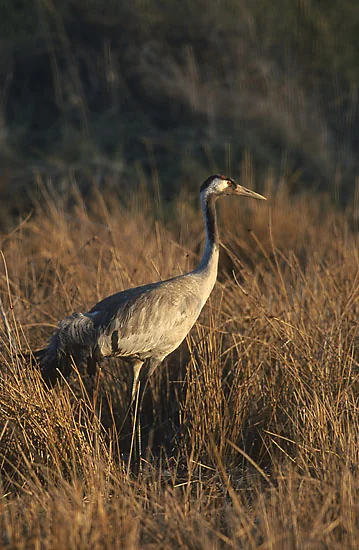 Featured photocommon-crane.jpg
Grus grus, the common crane, is a large crane of the family Gruidae, the most widespread crane of the Palearctic. Adults are 100 to 130 cm long with a wingspan of 180 to 222 cm and weigh 3.7 to 6.1 kg. The species is recognised by its grey body, white cheek-stripe, black head, and red crown patch, and by its loud bugling flight call heard at great distances. The IUCN lists the species as Least Concern, following significant population recoveries across Europe.
Quick facts
- Habitat
- Breeds in boreal wetlands, marshy forest clearings, and peatbogs of the Palearctic. Winters on agricultural plains, river floodplains, coastal wetlands, and traditional roosting areas in Spain, the Sahel, Ethiopia, and India. Uses large open agricultural fields for foraging in winter.
- Range
- Breeds from Scandinavia and western Europe east through Russia and Siberia to eastern China. Winters in Iberia (Spain and Portugal hold the largest European wintering concentration), sub-Saharan Africa (Sudan, Ethiopia), and South Asia (India).
- Size
- 100–130 cm body · 180–222 cm wingspan · 3700–6100 g
- Plumage
- Adults are grey overall (lighter on the upper back, darker on the flight feathers), with a black head and neck, a white cheek-stripe from the eye to the upper neck, and a bare red crown patch. The bustle of elongated inner tertial feathers drapes over the tail. Juveniles are brown-grey with a fully feathered, pale buff-brown head. Sexes are similar.
- Song
- A loud, far-carrying bugling 'kroor-kroor' or 'kronk' call — one of the most evocative sounds of European autumn migration. Pairs and flocks call almost continuously in flight. The bugling is produced by an elongated trachea coiled within the breastbone.
- Migration
- Long-distance migrant. Scandinavian and central European populations winter in Spain; Russian and Siberian populations winter in Africa and South Asia. Migrates in large V-formation skeins audible from the ground at night.
- Conservation
- Least Concern (LC)
Overview
Grus grus is one of fifteen crane species in the family Gruidae, a family of ancient origin with a fossil record extending back approximately 37 million years. The common crane has recovered significantly from mid-20th-century population lows across Europe — recolonising Britain as a breeding species (after an absence since the 17th century) in the 1990s and expanding the British breeding population with the 2010–2014 reintroduction of crane eggs from Germany. Spanish wintering populations have grown to over 300,000 individuals — one of the largest crane concentrations in Europe.
Bugling calls and the elongated trachea
The far-carrying bugling call of the common crane is produced by an unusually elongated trachea that coils within a cavity in the breastbone before connecting to the lungs — a structure that acts as a resonating chamber and amplifies the call. The elongated trachea develops progressively as the bird matures, which is why juvenile cranes produce softer, less resonant calls than adults. This tracheal coiling is shared with several other crane species and with the whooping crane (Grus americana). The bugling contact calls of migrating flocks are one of the most evocative sounds of Palearctic autumn migration.
European recovery and reintroduction
Common cranes recolonised Britain as breeding birds in the Norfolk Broads in the 1980s–90s after an absence of approximately 400 years (last bred in 17th-century East Anglia, extirpated by drainage and hunting). A Great Crane Project was launched in 2010, using eggs from wild crane nests in Germany to establish a new population in Somerset — the first successful crane reintroduction in Britain. By 2026 the British breeding population stood at over 60 pairs. Similar reintroduction projects have been completed in France and Ireland, with birds sourced from Sweden and Germany.
Sources & further reading (2)
- iucn-red-list — accessed 2026-05-07
- encyclopedia — accessed 2026-05-07
Frequently asked questions
Why does the crane's call carry so far?
The common crane's bugling call is amplified by a coiled trachea that loops through a cavity in the breastbone, acting as a resonating chamber. The trachea of an adult common crane is approximately 130 cm long — coiled within the sternum to fit inside the bird's body. This extended resonating structure produces the species' powerful, far-carrying bugling call, which can be heard several kilometres away on a still day. The same structure develops progressively with age, which is why juvenile calls are quieter.
How do common cranes navigate during migration?
Common cranes navigate using a combination of visual landmarks, magnetic sensitivity, and the position of the sun and stars — as do most long-distance migrant birds. Juveniles make the first migration accompanied by their parents, learning the route through direct experience. Subsequent migrations are guided by memorised landmarks and the magnetic map. Cranes also appear to communicate route information within the flock through their continuous bugling calls, and experienced individuals may lead naive birds along established flyways.
When did common cranes stop breeding in Britain?
Common cranes bred in Britain until the 17th century — historical records reference crane nesting in the East Anglian fens and other wetlands. They were extirpated by a combination of systematic wetland drainage for agriculture and direct hunting (cranes were a prestigious food for feasts). The species recolonised naturally in the Norfolk Broads in the 1980s and 1990s, and reintroduction projects in Somerset and other areas have expanded the breeding population significantly since 2010.