Fringilla coelebs
Common Chaffinch (Fringilla coelebs)
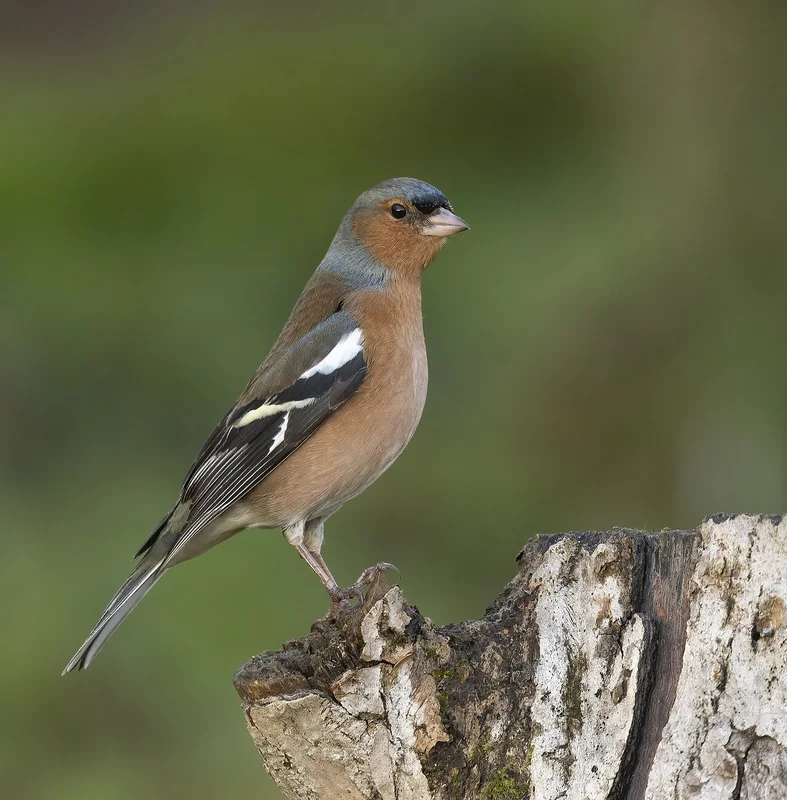 Featured photocommon-chaffinch.jpg
Fringilla coelebs, the common chaffinch, is a small Fringillidae finch of Europe, North Africa, and western Asia. Adults are 14 to 16 cm long with a wingspan of 24.5 to 28.5 cm and weigh 18 to 29 g. Adult males are striking — blue-grey crown and nape, chestnut back, pinkish underparts, and bold white wing bars — while females are duller olive-brown. The IUCN lists the species as Least Concern, with a continental population estimated by BirdLife at over one hundred million pairs.
Quick facts
- Habitat
- Mixed and deciduous woodland, hedgerows, parks, and gardens. The species occupies almost any well-treed habitat across the temperate Palaearctic.
- Range
- Across Europe from Iberia and the British Isles east to the western Russian taiga, south to North Africa and the Middle East. Populations on Atlantic islands (Madeira, the Canaries, the Azores) are isolated and morphologically distinct.
- Size
- 14–16 cm body · 24.5–28.5 cm wingspan · 18–29 g
- Plumage
- Adult males show a slate-blue crown and nape, chestnut back, peach-pink face and breast, white belly, and conspicuous white double wing bars and white outer tail feathers. Females are uniformly olive-brown with the same striking white wing bars — the wing pattern is the most reliable field mark for the species in either sex.
- Song
- A short, accelerating, descending phrase ending in a final flourish — sometimes paraphrased as 'pretty, pretty, pretty, sweetie'. The species' song is one of the textbook examples of birdsong dialects, with regional variants documented from the British Isles to the Caucasus.
- Migration
- Partial migrant. Northern populations move south in autumn — historically forming single-sex flocks (males wintering further north than females) that gave the species its scientific name 'coelebs', Latin for 'bachelor'.
- Conservation
- Least Concern (LC)
Overview
Fringilla coelebs is one of three Fringilla species (with the brambling F. montifringilla and the Atlantic-island F. teydea complex). The species is among the most numerous breeding birds in Europe, with a continental population estimated by BirdLife International at over one hundred million breeding pairs. The chaffinch's song is the textbook example of geographic dialect variation in songbirds, with distinct regional song types preserved through cultural transmission.
Distribution
The species occurs across Europe, North Africa, and the Middle East. Populations on the Macaronesian islands (the Azores, Madeira, and the Canaries) have differentiated into distinct subspecies and one or more full species (the Tenerife blue chaffinch, the Gran Canaria blue chaffinch). Long-distance vagrants reach North America regularly enough that the species is on the ABA Checklist as a casual visitor.
Sex-segregated migration
Linnaeus named the species 'coelebs' (Latin for 'bachelor') after observing that winter flocks in his native Sweden were composed almost entirely of males — females and juveniles had moved further south. Sex-segregated migration (with males wintering closer to the breeding range than females) is documented in several northern European populations and persists today, though its extent has declined as winters have warmed.
Sources & further reading (2)
- iucn-red-list — accessed 2026-04-29
- encyclopedia — accessed 2026-04-29
Frequently asked questions
Why is the chaffinch called Fringilla coelebs?
Linnaeus named the species 'coelebs' — Latin for 'bachelor' — after noting that winter flocks in his native Sweden contained almost entirely males. Female and juvenile chaffinches migrated further south, leaving the wintering males in apparent solitude. The behaviour persists today in northern populations, though warming winters have reduced its extent.
Why is the chaffinch's song used in dialect studies?
Chaffinches learn their song from older males during the first year of life. Regional song types — distinct phrase orderings and final flourishes — are preserved by cultural transmission and persist over decades. Recorded chaffinch dialects from the British Isles, central Europe, and the Caucasus are textbook examples of bird-song dialect variation in introductory ornithology and animal-behaviour curricula.
Are island chaffinches different species?
Several Macaronesian island populations have differentiated significantly. The Tenerife blue chaffinch (Fringilla teydea) and the Gran Canaria blue chaffinch (F. polatzeki) are now treated as separate species, both with very small ranges and threatened conservation status. The Azores, Madeira, and other Canary populations remain Fringilla coelebs subspecies.