Turdus merula
Common Blackbird (Turdus merula)
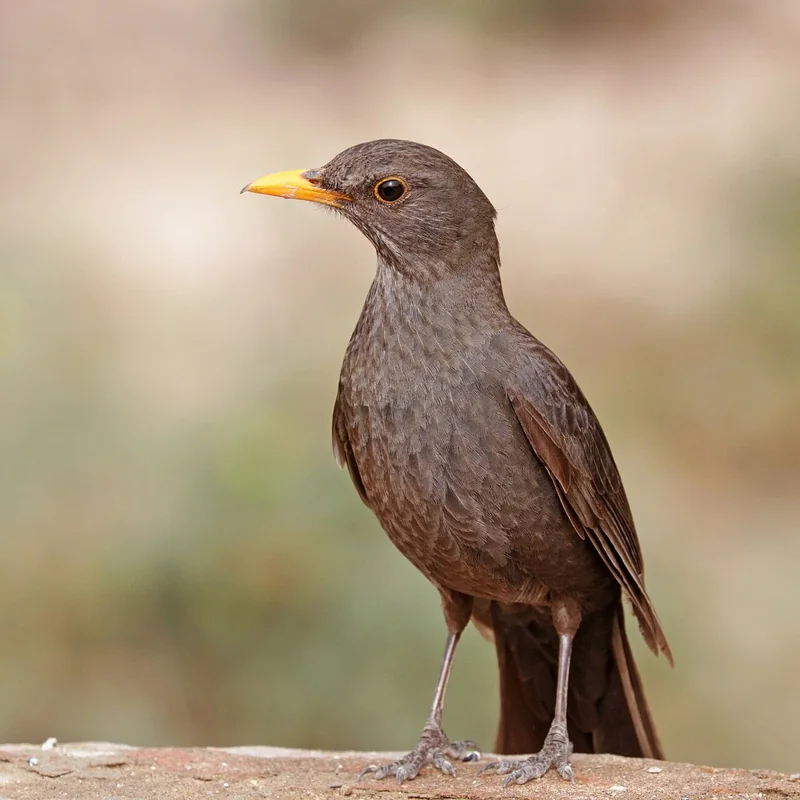 Featured photocommon-blackbird.jpg
Turdus merula, the common blackbird, is a medium-sized thrush native to Europe, North Africa, and parts of Asia. Adults are 23.5 to 29 cm long with a wingspan of 34 to 38.5 cm and weigh 80 to 125 g. Adult males are uniformly glossy black with a bright orange-yellow bill and yellow eye-ring; females are warm chocolate brown with a paler throat. The IUCN lists the species as Least Concern. The blackbird's mellow flute-like song is one of the most familiar dawn-chorus voices across temperate Europe.
Quick facts
- Habitat
- Woodland, hedgerows, scrubby farmland, parks, and gardens. The species adapted to human-modified landscapes early — urban populations now reach densities far above any natural woodland.
- Range
- Most of Europe, North Africa, the Caucasus, and west to the western edge of Asia. Introduced and established in Australia and New Zealand. Some northern and eastern populations migrate; western European populations are largely resident.
- Size
- 23.5–29 cm body · 34–38.5 cm wingspan · 80–125 g
- Plumage
- Adult males are uniformly glossy black with a bright orange-yellow bill and a thin yellow eye-ring; first-winter males are duller black with a horn-coloured bill. Adult females are warm chocolate-brown with a paler streaked throat and a darker bill. Juveniles are spotted rich brown and reddish — the spotted pattern is the ancestral thrush condition.
- Song
- A leisurely, mellow, fluty warble of varied phrases, often with a quiet sub-song coda. The alarm call is a hard, repeated 'chink-chink-chink'.
- Migration
- Partial migrant. Northern European populations move south for winter; British and southern European populations are largely resident, with northern visitors topping up local numbers in winter.
- Conservation
- Least Concern (LC)
Overview
Turdus merula is the largest and most widespread Eurasian Turdus thrush. The species is closely related to the American robin (T. migratorius) and the song thrush (T. philomelos), and the genus underwent rapid radiation across Eurasia and the New World during the Pliocene and Pleistocene. The blackbird is among Europe's most numerous breeding songbirds, with a continental population estimated by BirdLife at over eighty million pairs.
Distribution
The native range covers most of Europe, North Africa, the Caucasus, and parts of western Asia. Nineteenth-century introductions established the species in Australia and New Zealand; both populations are now widespread and locally common. Across the native range, the blackbird has shifted from a primarily woodland species to a successful urban exploiter, with city-park densities far above any forest baseline.
Behaviour
Common blackbirds defend territories during the breeding season and form loose flocks at autumn berry crops. The dawn song carries far on still mornings and is among the earliest voices of the spring chorus. Urban populations sing at higher pitch than rural neighbours, a documented adaptation to low-frequency traffic noise.
Sources & further reading (2)
- iucn-red-list — accessed 2026-04-29
- encyclopedia — accessed 2026-04-29
Frequently asked questions
Why is the male blackbird's bill yellow?
The bright orange-yellow bill of the adult male contrasts dramatically against the jet-black plumage and is a sexually selected ornament. Bill colour intensity correlates with male condition and is influenced by carotenoid intake during the moult. Females routinely prefer males with brighter bills, and bill colour shifts measurably with diet quality through the year.
Are urban blackbirds different from rural ones?
Yes — measurably. Urban blackbird populations are denser than rural ones, sing at a higher pitch (an adaptation to low-frequency traffic noise), start their dawn song earlier (responding to street lighting), and breed slightly earlier in spring than woodland populations. The species is one of the most studied examples of urban evolution in songbirds.
Why is it called 'blackbird' when only the male is black?
The English name dates to a period when 'bird' referred specifically to small game-sized birds — anything larger than a sparrow but smaller than a goose — and 'black bird' meant 'the small black-coloured one'. The visually striking male was the namesake; the brown female was named by association. The convention is retained even though many other species are entirely black.