Pygoscelis antarcticus
Chinstrap Penguin (Pygoscelis antarcticus)
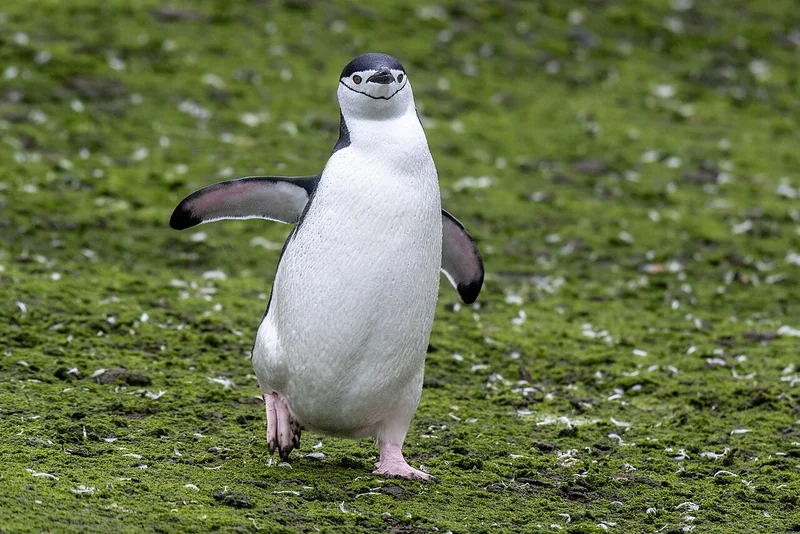 Featured photochinstrap-penguin.jpg
Pygoscelis antarcticus, the chinstrap penguin, is a medium-sized antarctic penguin of the family Spheniscidae. Adults are 68 to 76 cm long and weigh 3 to 6 kg. The plumage is the classic 'tuxedo' pattern with the diagnostic narrow black line running under the chin from ear to ear (the 'chinstrap' that gives the species its English name). The IUCN lists the species as Least Concern. Chinstrap penguins are among the most numerous penguins in the antarctic peninsula and the South Sandwich Islands.
Quick facts
- Habitat
- Antarctic peninsula and subantarctic islands. Breeds on rocky beaches and slopes; spends the non-breeding season in the open Southern Ocean and on pack-ice edges.
- Range
- Breeds on the antarctic peninsula and the South Sandwich Islands, plus several other subantarctic islands (South Orkney, South Shetland, Bouvet, Balleny). The total breeding population is estimated at over seven million pairs.
- Size
- 68–76 cm body · 65–80 cm wingspan · 3–6 kg
- Plumage
- Adults show a glossy black head, back, and wings, pure white face and underparts, and the diagnostic narrow black line running from the back of the head under the chin and back to the other ear (the 'chinstrap'). The bill is black, the eyes dark, and the legs pink. Both sexes look alike. Chicks are uniformly soft grey down for several weeks after hatching.
- Song
- Adults give loud trumpeting and braying calls during territorial display and pair-bonding at the colony. The colony soundscape during the breeding season is one of the most acoustically intense in the antarctic seabird fauna.
- Migration
- Migrates to the antarctic pack-ice during winter when the breeding islands become inaccessible. Non-breeding-season foraging ranges across the Southern Ocean.
- Conservation
- Least Concern (LC)
Overview
Pygoscelis antarcticus is one of three Pygoscelis penguins (with the Adélie penguin P. adeliae and the gentoo penguin P. papua). The species was historically named 'Pygoscelis antarctica' but the gendered ending was corrected in modern taxonomy. The Latin epithet 'antarcticus' references the species' antarctic distribution. The English name 'chinstrap' directly references the diagnostic narrow black line running under the chin.
Distribution and population
The breeding range is concentrated on the antarctic peninsula and the South Sandwich Islands, with smaller populations on several other subantarctic islands. The total breeding population is estimated at over seven million pairs — making chinstrap penguins one of the most numerous penguin species worldwide. Population trends vary regionally: some western antarctic peninsula populations have declined sharply (driven by reduced krill availability under regional climate warming), while colonies on the South Sandwich Islands remain stable.
Krill specialization
Chinstrap penguins are essentially obligate Antarctic krill specialists during the breeding season — over 95 per cent of their diet is krill at most colonies. The species' close coupling to krill availability makes it highly sensitive to climate-driven changes in the Southern Ocean food web. Sea-ice loss in the western antarctic peninsula has reduced krill availability, and chinstrap populations there have correspondingly declined by 50 per cent or more at some colonies over recent decades. The species is one of the most-studied penguins in climate-change ecology.
Sources & further reading (2)
- iucn-red-list — accessed 2026-04-30
- encyclopedia — accessed 2026-04-30
Frequently asked questions
Why is it called the 'chinstrap' penguin?
The species' diagnostic field mark is a narrow black line running from the back of the head under the chin and back to the other ear — exactly like a chinstrap on a helmet. The dark line is consistent across all individuals and is the most reliable way to separate chinstrap from the closely similar Adélie penguin (which has a fully black head with no chinstrap line). The English name directly references this distinctive plumage feature.
Why are chinstrap populations declining in the antarctic peninsula?
Western antarctic peninsula chinstrap populations have declined by 50 per cent or more at some colonies over recent decades. The driver is reduced Antarctic krill availability under regional climate warming — sea-ice loss has reduced the krill spawning and overwintering habitat that supports the krill population the chinstraps depend on. The species' near-obligate krill specialization makes it highly sensitive to krill-population changes; the broader pattern is one of the textbook examples of climate-driven food-web disruption in Southern Ocean ecology.
How do chinstraps differ from Adélie penguins?
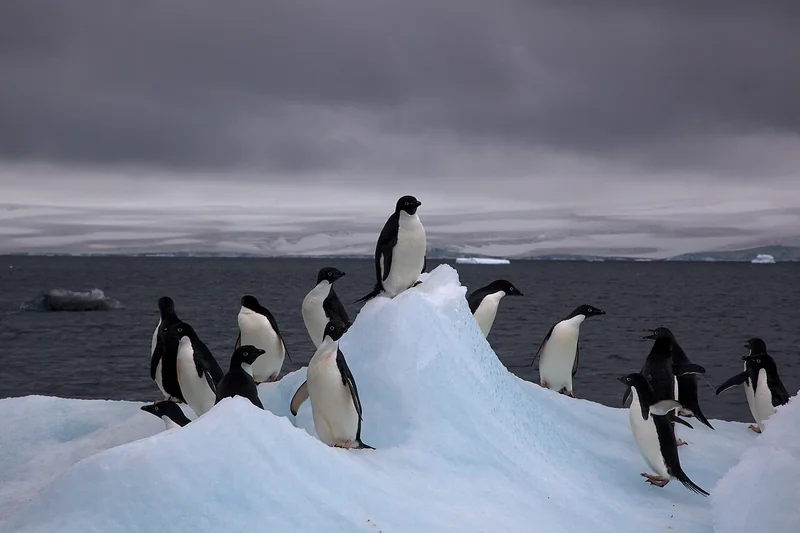
The two species look very similar — both are medium-sized black-and-white antarctic penguins. Key field marks: chinstrap has the diagnostic narrow black line under the chin (Adélie has a fully black head with no chinstrap line); chinstrap has a white face with the black cap stopping above the eye (Adélie has the black cap extending below the eye); chinstrap has a slightly smaller bill. Both species often nest on the same colonies and the differences are easily seen at close range.