Bombycilla cedrorum
Cedar Waxwing (Bombycilla cedrorum)
 Featured photocedar-waxwing.jpg
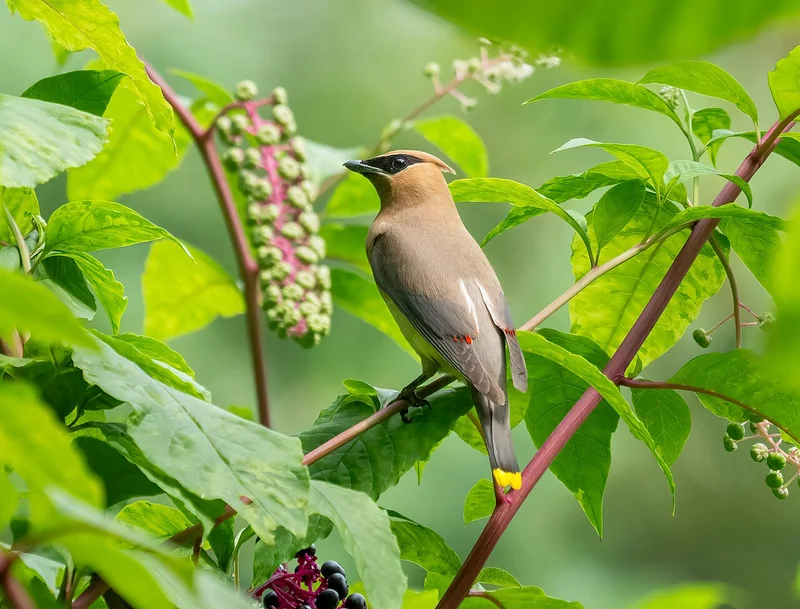
Bombycilla cedrorum, the cedar waxwing, is a medium-small songbird of the family Bombycillidae, distributed across North America. Adults are 14 to 17 cm long with a wingspan of 22 to 30 cm and weigh 30 to 35 g. Plumage is silky cinnamon-brown above shading to soft pale yellow underparts, with a black mask, jaunty crest, yellow tail-tip band, and bright red wax-like secondary tips. The IUCN lists the species as Least Concern. Cedar waxwings are highly nomadic and travel in tight flocks tracking ripe fruit crops.
Quick facts
- Habitat
- Open woodland, woodland edges, orchards, hedgerows, and suburban parks with fruit trees. The species follows fruit crops more than fixed habitat boundaries.
- Range
- Across most of North America from southern Canada south through the contiguous United States. Winter range extends through Mexico and Central America to northern South America. Both nomadic and migratory; movements are erratic and tied to fruit crop availability.
- Size
- 14–17 cm body · 22–30 cm wingspan · 30–35 g
- Plumage
- Both sexes show a silky cinnamon-brown head, breast, and back shading to soft pale yellow on the belly, a sharp black mask through the eye, a pointed crest, and a yellow band at the tip of the grey tail. The signature feature — the bright red waxy tips on the secondary feathers — is present on most adults but variable, and may have aged-male signalling functions.
- Song
- A high, thin, lisping 'see-see-see' or 'tsree-tsree-tsree', often delivered by flocks in flight. The species has no loud territorial song; the high lisping flock call is by far the most heard vocalization.
- Migration
- Highly nomadic. Movements track fruit crop availability rather than calendar; flocks may winter in any area with abundant berries.
- Conservation
- Least Concern (LC)
Overview
Bombycilla cedrorum is one of three Bombycilla waxwings worldwide (with the larger Bohemian waxwing B. garrulus and the Japanese waxwing B. japonica). The family is small and morphologically distinctive — silky plumage, sleek crested heads, and the unique waxy red secondary tips. The species is the smallest of the three waxwings and is the most numerous waxwing in North America.
Distribution
The breeding range covers most of forested North America from southern Canada south to the central United States. Wintering birds reach the Gulf Coast, Mexico, and northern South America. Movements are nomadic — flocks track fruit availability rather than fixed migration routes — so winter occurrence in any given area varies enormously between years.
Behaviour
Cedar waxwings are intensely social. Flocks of dozens to hundreds move together through forests and orchards stripping ripe fruit; the famous 'fruit-passing' behaviour at the centre of a flock — birds passing berries down a row of perched neighbours — has been recorded since the nineteenth century. Pairs sometimes engage in mutual fruit-passing during courtship. Mass intoxication of cedar waxwings on fermented overripe berries is documented annually somewhere in the range.
Sources & further reading (2)
- iucn-red-list — accessed 2026-04-29
- encyclopedia — accessed 2026-04-29
Frequently asked questions
What are the red 'wax tips' on the wings?
The red waxy droplets on the secondary feather tips are flattened extensions of the feather shaft pigmented with carotenoid-derived astaxanthin. The number and intensity of the tips vary among individuals and may signal age and condition — older waxwings carry more and brighter wax tips, and pair-bonded birds tend to be matched in tip count. The biological function of the wax tips remains under study.
Why do cedar waxwings sometimes get drunk?
Cedar waxwings feed heavily on fruit, and overripe winter berries can ferment into low-percentage alcohol. Flocks consuming large quantities of fermented berries — most often after a freeze-thaw cycle on mountain ash or hawthorn crops — show clear ataxia, fly into windows, and occasionally die. Mass cedar-waxwing intoxication is documented annually somewhere in the species' range and is a fairly common cause of localized waxwing die-offs.
Why are cedar waxwings such nomads?
The species' near-total reliance on fruit means populations track fruit crops rather than calendar dates. Where mountain ash, hawthorn, juniper, or other key crops are abundant, flocks settle for weeks; where crops fail, flocks move on. Wintering occurrences in any given area therefore vary enormously between years, and individual waxwings ringed in one location may not return the following year.