Thryothorus ludovicianus
Carolina Wren (Thryothorus ludovicianus)
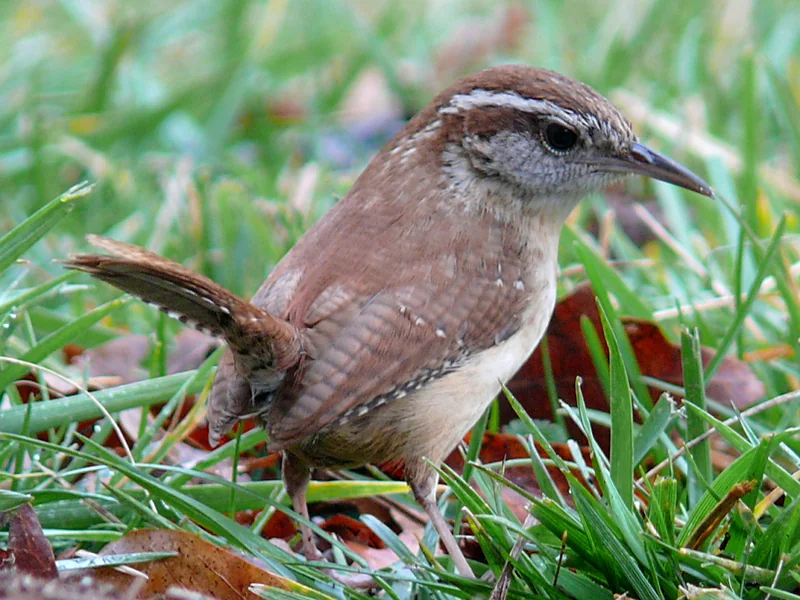 Featured photocarolina-wren.jpg
Thryothorus ludovicianus, the Carolina wren, is a medium-sized wren of the family Troglodytidae, distributed across the southeastern United States and into northeastern Mexico. Adults are 12.5 to 14 cm long with a wingspan of 29 cm and weigh 18 to 22 g. The plumage is rich rufous-brown above with a bold white supercilium and warm buff underparts. The IUCN lists the species as Least Concern, and the species has expanded its range steadily north over the last several decades.
Quick facts
- Habitat
- Mixed and deciduous woodland, dense brush, suburban gardens with low cover. The species favours dense low vegetation for nesting and skulks in the understorey while foraging.
- Range
- Southeastern half of the United States from southern New England west to Iowa and south to the Gulf Coast and northeastern Mexico. The northern range edge has advanced steadily over the last fifty years, tracking warmer winters.
- Size
- 12.5–14 cm body · 29 cm wingspan · 18–22 g
- Plumage
- Both sexes are warm rufous-brown above with fine dark barring on the wings and tail; the underparts are buff to cinnamon, and a bold white supercilium runs from the bill back along the side of the head. The tail is often held cocked upward, the textbook wren posture.
- Song
- An exceptionally loud, ringing 'tea-kettle, tea-kettle, tea-kettle' delivered from a high perch — among the loudest songs of any small North American songbird relative to the bird's size. Both sexes vocalize, often in coordinated duets.
- Migration
- Resident year-round throughout the range; no regular migration. Severe winter cold causes mortality at the northern range edge and temporarily reverses the species' northward advance.
- Conservation
- Least Concern (LC)
Overview
Thryothorus ludovicianus is the largest North American wren and the only Thryothorus species in the United States — the rest of the genus is Neotropical. The species' loud song and bold plumage make it one of the most familiar small woodland birds across the southeastern US. Pairs are socially monogamous, hold year-round territories, and often duet — the female contributes the chatter notes after the male's main song phrase.
Range expansion
The Carolina wren's breeding range has shifted steadily north since the late nineteenth century, with sustained northward advances since the 1960s. The expansion is not monotonic: severe winter cold-snap events (the 1976-77 winter, several recent polar vortex events) cause heavy mortality at the leading edge and temporary range contractions, but the species recovers and advances again over subsequent mild winters.
Behaviour and song
Carolina wrens are exceptionally vocal — both sexes sing year-round, and pairs often duet with the male delivering the main song and the female adding a buzzy chatter. The species is one of the loudest small North American songbirds in absolute decibel terms. Nests are placed in cavities, hanging plant baskets, mailboxes, and any sheltered nook; the species is a familiar nuisance-but-charming garden tenant across the South.
Sources & further reading (2)
- iucn-red-list — accessed 2026-04-29
- encyclopedia — accessed 2026-04-29
Frequently asked questions
Why has the Carolina wren's range moved north?
The northern range edge has advanced steadily since the late nineteenth century, with sustained gains since the 1960s. The likely driver is warming winter minima reducing cold-induced mortality. The advance is interrupted by severe cold winters (the 1976-77 winter, recent polar vortex events) that produce heavy population crashes at the leading edge, but the species recovers and resumes its advance over subsequent mild winters.
Why is the Carolina wren so loud?
Loud song is a feature of many wrens — the family is named for the burst-of-sound quality of the song relative to body size. Carolina wrens hold year-round territories in dense vegetation that absorbs sound rapidly, so high amplitude carries the territorial signal further. Both sexes sing; the male's song is the main phrase, the female adds a buzzy chatter coda.
Do Carolina wrens pair for life?
Pairs are socially monogamous and hold year-round territories together. The bond often persists across multiple breeding seasons, and the same pair returns to the same territory year after year. Divorces and re-pairings are documented but are less frequent than in many migratory songbirds. The continuous co-presence of mate and territory likely supports the species' year-round duetting behaviour.