Ploceus capensis
Cape Weaver (Ploceus capensis)
 Featured photocape-weaver.jpg
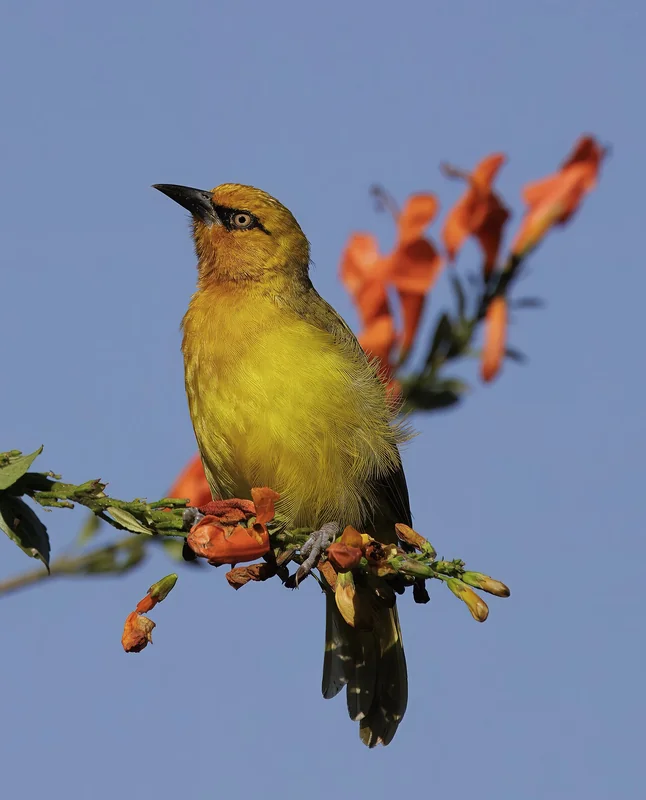
Ploceus capensis, the cape weaver, is a colonial songbird of the family Ploceidae, endemic to southern Africa. Adult males are about 17 cm long with a wingspan of 25 to 27 cm and weigh 30 to 38 g. Breeding males are brilliant golden-yellow with a chestnut wash on the face, white eyes, and a bold olive-green back — one of southern Africa's most striking small birds. The IUCN lists the species as Least Concern. The cape weaver is famous for the pendulous woven nests the male constructs to attract mates.
Quick facts
- Habitat
- Subtropical and temperate shrubland, farmland, riparian woodland, and suburban gardens of South Africa. Strongly associated with water — breeds colonially in trees or reeds overhanging rivers, dams, and wetlands.
- Range
- Endemic to southern Africa: South Africa and Lesotho, with range extensions into southwestern Namibia and southern Zimbabwe. Found throughout the Western and Eastern Cape and across much of the interior.
- Size
- 15–17 cm body · 25–27 cm wingspan · 30–38 g
- Plumage
- Breeding males show brilliant golden-yellow body plumage with a chestnut-orange wash on the face and throat, olive-green streaked upperparts, a pale white iris, and a sturdy conical bill. Non-breeding males are more olive-yellow and duller. Females and juveniles are olive-green above and yellowish-buff below, with a dark eye-stripe.
- Song
- A harsh, grating 'swizzling' chatter and nasal 'che-che-che' calls, interspersed with clicks and whirring sounds. Males call persistently from the nest entrance during the breeding season to attract females.
- Migration
- Sedentary or locally nomadic. The species is largely resident in southern Africa, with some seasonal movement toward wetland breeding areas.
- Conservation
- Least Concern (LC)
Overview
Ploceus capensis is one of over 60 weaver species in the genus Ploceus, most of which occur in Africa. The cape weaver is endemic to southern Africa — its range does not extend north of Zimbabwe — making it one of the defining birds of the Cape Floristic Region and Karoo biomes. The species is highly social year-round and typically found in mixed flocks, often alongside red-billed queleas and other weavers at roost and foraging sites.
Nest construction and female choice
Male cape weavers construct elaborate kidney-shaped pendant nests of woven grass, suspended from the tips of drooping branches over water — a position that limits access by snakes and other nest predators. The male begins weaving the outer ring structure, and if a female shows interest, he completes the interior chamber and entrance tube. Females inspect multiple nests and choose their mate based on nest quality — males with older, less neat nests may have them rejected and must rebuild. A single male may construct several nests per breeding season and can build up to 20 nests across his lifetime.
Colonial breeding and kleptoparasitism
Cape weavers breed in dense colonies of tens to several hundred nests, typically in willows, eucalyptus, or large acacia trees overhanging water. Colonial breeding reduces individual predation risk through collective vigilance. The species is polygynous — a successful male may attract multiple females to nests in the same tree. Cape weavers have been documented as occasional crop pests in cereal-growing areas; however, their primary diet consists of wild grass seeds rather than cultivated grain.
Sources & further reading (2)
- iucn-red-list — accessed 2026-05-07
- encyclopedia — accessed 2026-05-07
Frequently asked questions
How does the female judge a male cape weaver's nest?
Female cape weavers are highly selective nest inspectors. They enter incomplete and complete nests, pull at the woven grass strips to test structural integrity, and assess the symmetry and neatness of the weave. A male whose nest fails inspection will be abandoned and must rebuild — sometimes tearing down his own nest and starting fresh with fresher, greener grass strips. Studies show females prefer nests woven from fresher grass, which may indicate male condition and nest-building ability.
Why do cape weavers nest over water?
Nesting over open water creates a physical barrier to nest predators, particularly snakes. A pendant nest suspended from a drooping branch tip over a river or dam is difficult for most ground-based or climbing predators to reach without swimming or falling into the water. The collective alarm response of a large colony also provides early warning of approaching predators.
Are cape weavers crop pests?
Cape weavers are occasionally noted as crop pests in cereal-growing areas, but their primary diet is wild grass seeds rather than cultivated grain. Their impact on agriculture is generally much less severe than that of the red-billed quelea — Africa's most agriculturally damaging bird — and the species is not subject to organised control programmes.