Branta canadensis
Canada Goose (Branta canadensis)
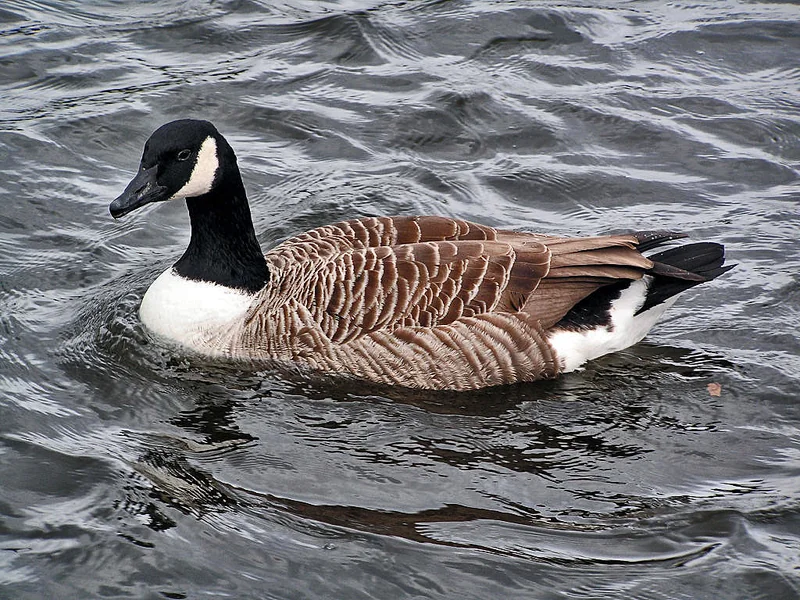 Featured photocanada-goose.jpg
Branta canadensis, the Canada goose, is a large goose of the family Anatidae, native to North America and introduced to several other continents. Adults are 75 to 110 cm long with a wingspan of 127 to 185 cm and weigh 2.5 to 6.5 kg. Plumage is grey-brown with a long black neck and head, a bold white chinstrap, and a pale breast. The IUCN lists the species as Least Concern. Canada geese have expanded both range and numbers dramatically over the last fifty years, and resident urban populations now reach problematic densities in many cities.
Quick facts
- Habitat
- Lakes, rivers, parks, golf courses, agricultural fields, and any open landscape with both water and grazing. The species adapted exceptionally well to suburban environments — manicured lawns next to ponds are textbook habitat.
- Range
- Most of North America from the Arctic south through Canada and the United States. Introduced and naturalized in Britain, parts of Europe, and New Zealand. The species' continental population in North America is now estimated at over five million.
- Size
- 75–110 cm body · 127–185 cm wingspan · 2.5–6.5 kg
- Plumage
- Adults show a long jet-black neck and head, a bold white chinstrap from cheek to cheek, grey-brown back and wings, paler underparts, and a black tail above a white rump. Both sexes are alike. Geographic variation is substantial — there are seven recognized subspecies, with the smallest (the cackling goose, formerly subspecies but now treated as a separate species B. hutchinsii) about half the size of the largest.
- Song
- A loud, deep 'honk' or 'a-honk' delivered both in flight and on the ground. Migrating V-formations vocalize continuously; the call is among the most familiar autumn migration sounds in temperate North America.
- Migration
- Partial migrant. Subarctic and northern populations make spectacular long-distance V-formation migrations south to the southern United States and Mexico; central and southern populations are increasingly resident year-round, especially in suburban settings with year-round food availability.
- Conservation
- Least Concern (LC)
Overview
Branta canadensis is one of six Branta geese worldwide. The species was historically split into seven subspecies; the smaller subspecies were lumped under cackling goose (B. hutchinsii) in 2004 and are now treated as a separate species. The remaining Canada goose comprises the larger subspecies (giant, interior, Atlantic, western, dusky, Vancouver). Population trends across most of the range are strongly increasing.
Range expansion and resident populations
Canada goose populations have expanded dramatically over the last fifty years. The 'giant Canada goose' subspecies (B. c. maxima), once thought extinct, was rediscovered in the 1960s and intensively re-established through reintroduction programmes; many of those reintroductions stayed sedentary and now form the resident urban populations seen on suburban ponds and golf courses across the eastern and central United States. The combination of mild urban winters, abundant lawn grass, and limited predation has produced extraordinarily dense resident populations.
V-formation flight
Canada geese migrate in the canonical V-formation, with a lead bird at the apex and flanking birds slightly behind and to either side. The arrangement is aerodynamically efficient: each bird (except the leader) flies in the upwash from the wingtip vortex of the bird ahead, reducing the energetic cost of flight. The lead position rotates through the flock. The vocalization in flight is partly thought to coordinate position-changing within the formation.
Sources & further reading (2)
- iucn-red-list — accessed 2026-04-29
- encyclopedia — accessed 2026-04-29
Frequently asked questions
Why do Canada geese fly in V-formation?
The V-formation is aerodynamically efficient. Each bird (except the leader) positions slightly behind and to one side of the bird ahead, riding the upwash from that bird's wingtip vortex. The energetic cost of flight is measurably lower for each follower than for solo flight. Lead position is rotated through the flock during long migrations, sharing the burden of breaking the air.
Why are urban Canada goose populations so large?
Several factors combine. The 'giant Canada goose' subspecies was once thought extinct; reintroduction programmes since the 1960s re-established populations across the eastern and central United States, many of which became sedentary in suburban environments. Manicured lawn grass provides abundant food, ponds in parks and golf courses provide water and roost sites, and predation is minimal. Many reintroduced populations stopped migrating entirely and now reach dense year-round occupancies.
Is the cackling goose really a separate species?
Yes — the cackling goose (Branta hutchinsii) was split from Canada goose in 2004 on molecular and morphological grounds. The smaller subspecies (cackling, Aleutian, Taverner's, Richardson's) form a distinct lineage from the larger Canada goose subspecies (giant, interior, Atlantic, western, dusky, Vancouver). The two species hybridize occasionally but remain genetically and ecologically distinct.