Callipepla californica
California Quail (Callipepla californica)
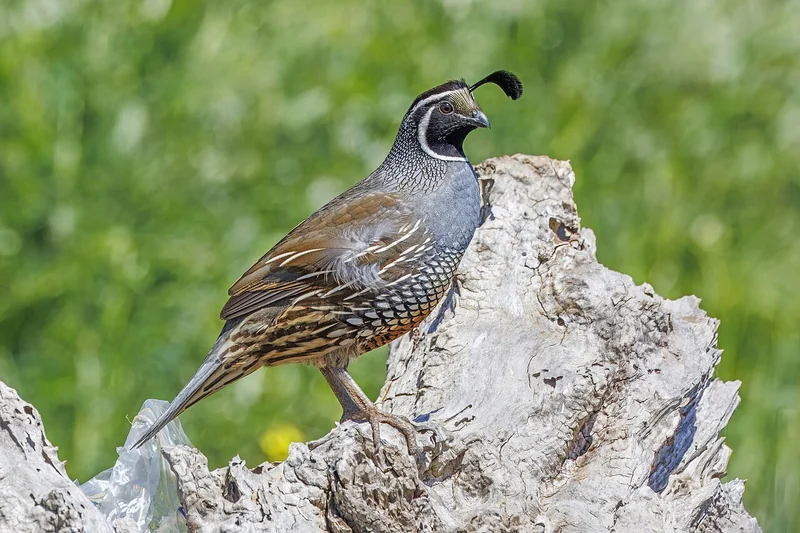 Featured photocalifornia-quail.jpg
Callipepla californica, the California quail, is a small New World quail of the family Odontophoridae, native to the western United States and Baja California. Adults are 24 to 27 cm long with a wingspan of 33 to 36 cm and weigh 140 to 230 g. The plumage is grey-brown above with a scaly belly pattern and a forward-curving black topknot of feathers above the eye. The IUCN lists the species as Least Concern. The species is the state bird of California.
Quick facts
- Habitat
- Brushy hillsides, chaparral, oak woodland edges, parks, suburban gardens with low cover, and agricultural margins across the western United States. The species favours dense low cover for roosting and forages in adjacent open ground.
- Range
- Native to coastal and inland California, southern Oregon, Baja California (Mexico), and parts of Nevada and Utah. Introduced and established in Hawaii, parts of New Zealand, and several other locations.
- Size
- 24–27 cm body · 33–36 cm wingspan · 140–230 g
- Plumage
- Adult males show a black face and throat outlined with white, a chestnut crown, grey upperparts, scaly grey-and-buff underparts, and the diagnostic forward-curving black topknot of feathers (actually six small feathers held tightly together) above the eye. Females are duller, with a tan-brown face replacing the male's bold black-and-white pattern, but share the same topknot — smaller and less bold. The scaly belly pattern is shared by both sexes.
- Song
- A loud three-syllable 'chi-CA-go' call delivered from a high perch — the textbook California quail vocalization. Various softer chirps and chattering calls accompany social interactions in coveys.
- Migration
- Resident year-round throughout the range; no regular migration. Local altitudinal movements between summer and winter habitat occur in mountain populations.
- Conservation
- Least Concern (LC)
Overview
Callipepla californica is one of four Callipepla quail species — the others (Gambel's, scaled, elegant) are distributed across the southwestern US and northern Mexico. The species was adopted as the California state bird in 1931. The forward-curving topknot is one of the most distinctive plumage features of any North American gamebird and is shared with the closely related Gambel's quail (C. gambelii) of the desert Southwest.
Distribution
The native range covers California, southern Oregon, parts of Nevada and Utah, and northern Baja California. Introduced populations are established in Hawaii (where the species is widespread) and New Zealand (where it is locally common in some North Island regions). The native population is one of the most-watched gamebirds in California; introduced populations have generally been stable since establishment.
Social behaviour
California quails are highly social outside the breeding season, forming coveys of ten to two hundred birds that move and forage together. Coveys roost communally in dense low cover, with sentinels posted on slightly higher perches to watch for predators. The 'chi-CA-go' call advertises covey location and serves as a contact call when group members become separated. The covey structure dissolves as pairs form for breeding in spring.
Sources & further reading (2)
- iucn-red-list — accessed 2026-04-30
- encyclopedia — accessed 2026-04-30
Frequently asked questions
What is the topknot made of?
The forward-curving black topknot of California and Gambel's quails is composed of six small feathers held tightly together by the connecting feather barbs. From a distance it looks like a single curved plume, but close inspection shows the multi-feather structure. The trait is shared between the two related species and is a useful field identification mark for the genus Callipepla.
Why do California quails travel in large groups?
Outside the breeding season, California quails form coveys of ten to two hundred birds that forage and roost together. The covey structure provides predator defence — each bird's chance of being targeted is reduced, and sentinels posted on higher perches warn of hawks. The covey dissolves in spring as pairs form for breeding and reassembles in autumn after the broods fledge.
Why is the California quail the state bird?
The California quail was officially adopted as California's state bird in 1931. The species is endemic to the state's general region (extending into Oregon, Nevada, and Baja California), is conspicuous and well-known across California's brushy and chaparral habitats, and the male's vivid plumage and topknot made it a popular candidate. The species had been informally regarded as 'California's quail' for decades before the official designation.