Athene cunicularia
Burrowing Owl (Athene cunicularia)
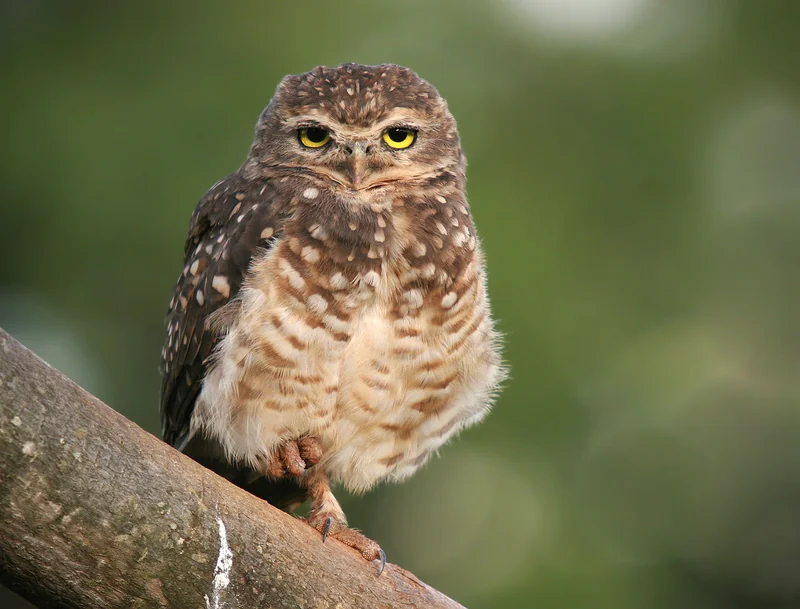 Featured photoburrowing-owl.jpg
Athene cunicularia, the burrowing owl, is a small owl distributed across open habitats of the Americas. Adults are 19 to 28 cm long with a wingspan of 51 to 61 cm and weigh 140 to 240 g. The plumage is sandy brown above with bold white underparts streaked with brown. The IUCN lists the species as Least Concern. Burrowing owls are unique among North American owls in living in underground burrows, often on prairie-dog towns, and in foraging both day and night.
Quick facts
- Habitat
- Open grasslands, prairies, deserts, and agricultural margins across the Americas. The species depends on the burrows excavated by mammals (prairie dogs in North America, viscachas in South America) for nesting and roosting; the owl rarely excavates its own burrows.
- Range
- Western and central North America from southern Canada south to Mexico, plus much of South America from the Caribbean basin south to Tierra del Fuego. Florida holds an isolated breeding population. Some northern populations migrate; southern populations are largely resident.
- Size
- 19–28 cm body · 51–61 cm wingspan · 140–240 g
- Plumage
- Adults show sandy brown upperparts heavily spotted with white, bold white underparts heavily streaked with brown, white throat patch, white eyebrows, bright yellow eyes, and unusually long legs for an owl (an adaptation for ground-running and standing tall at the burrow entrance). Both sexes look alike; juveniles show a clean unmarked buff breast that develops adult streaking through the first autumn moult.
- Song
- Males give a soft 'coo-COO-cooo' two-note call from the burrow entrance during the breeding season — quite different from the hooting calls of most owls. Disturbed birds at the burrow give a rattling buzzy call that closely mimics the warning rattle of the prairie rattlesnake — a documented example of acoustic mimicry deterring predators.
- Migration
- Partial migrant. Northern populations move south for winter; central and southern populations are largely resident. The Florida population is non-migratory year-round.
- Conservation
- Least Concern (LC)
Overview
Athene cunicularia is one of about a dozen Athene owls worldwide. The Latin epithet 'cunicularia' means 'miner' or 'burrower', a direct reference to the species' underground nesting habit. Burrowing owls are unique among North American owls in living in underground burrows, foraging during the day, and depending heavily on burrowing-mammal hosts to excavate the burrows the owls then occupy.
Burrow nesting
Burrowing owls almost never excavate their own burrows — they occupy the abandoned burrows of prairie dogs, ground squirrels, badgers, foxes, and tortoises. Pair occupancy of a burrow can extend over several breeding seasons and across multiple owl generations. The species' decline across the western United States is closely tied to the decline of prairie-dog towns from rodenticide treatment and habitat conversion: where prairie dogs are absent, burrowing owls cannot persist long-term.
Rattlesnake mimicry
Disturbed burrowing owls in the burrow produce a rattling buzzy call that closely mimics the warning rattle of the prairie rattlesnake (Crotalus viridis), with which the species shares much of its grassland habitat. Field experiments have shown that potential predators (badgers, foxes) approach burrows reluctantly when the rattle-call is heard. The acoustic mimicry is one of the textbook examples of acoustic Batesian mimicry in vertebrates.
Sources & further reading (2)
- iucn-red-list — accessed 2026-04-30
- encyclopedia — accessed 2026-04-30
Frequently asked questions
Do burrowing owls really live underground?
Yes — burrowing owls almost exclusively nest, roost, and rear chicks in underground burrows. The species rarely excavates its own burrows; it occupies the abandoned burrows of prairie dogs, ground squirrels, badgers, foxes, and tortoises. Pairs can occupy a single burrow for several breeding seasons. The underground habit is unique to this species among North American owls.
Do burrowing owls really mimic rattlesnakes?
Yes. Disturbed burrowing owls in the burrow produce a rattling buzzy call that closely resembles the warning rattle of the prairie rattlesnake. Field experiments have shown that potential predators approach burrows reluctantly when the rattle-call is heard. The mimicry is one of the textbook examples of acoustic Batesian mimicry in vertebrates and is a key defence for chicks left in the burrow during parental absences.
Why have burrowing owl populations declined?
Burrowing owls have declined across most of the western United States over recent decades. The primary driver is the loss of prairie-dog towns — burrowing owls almost exclusively nest in abandoned prairie-dog burrows, and prairie-dog populations have been reduced by 90 per cent or more across the western US through rodenticide treatment, habitat conversion, and direct shooting. Where prairie dogs are absent, burrowing owls cannot persist long-term.