Toxostoma rufum
Brown Thrasher (Toxostoma rufum)
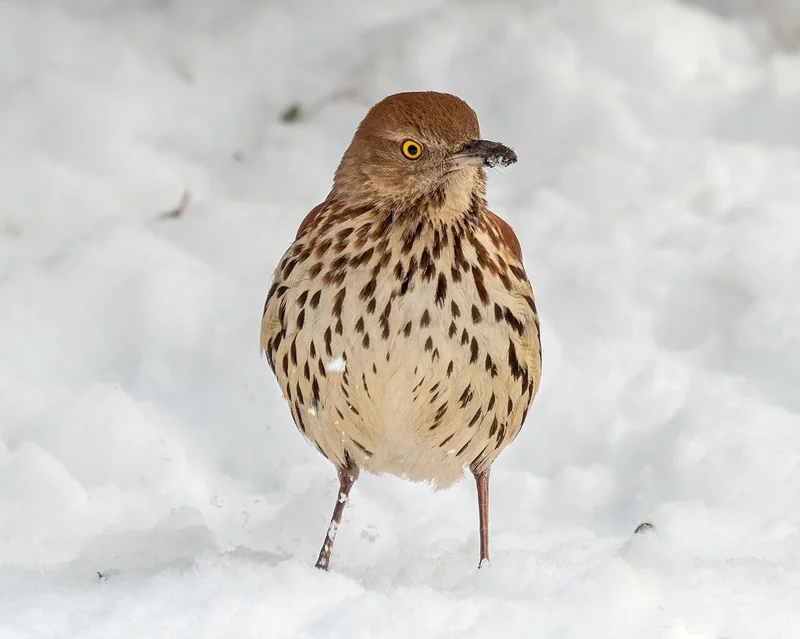 Featured photobrown-thrasher.jpg
Toxostoma rufum, the brown thrasher, is a large thrasher of the family Mimidae, distributed across the eastern half of North America. Adults are 23 to 30 cm long with a wingspan of 29 to 33 cm and weigh 61 to 89 g. The plumage is bright reddish-brown above with heavily streaked white underparts and bright yellow eyes. The IUCN lists the species as Least Concern. The brown thrasher has the largest documented song repertoire of any North American bird — over 1,100 distinct song types have been recorded from individual males.
Quick facts
- Habitat
- Dense brushy thickets, woodland edges, hedgerows, and overgrown old fields across the eastern half of North America. The species requires dense low cover for foraging and nesting and is rarely found in open habitat or dense forest.
- Range
- Breeds across the eastern half of North America from southern Canada south to the Gulf Coast and west to the Great Plains. Northern populations migrate; central and southern populations are largely resident.
- Size
- 23–30 cm body · 29–33 cm wingspan · 61–89 g
- Plumage
- Adults show bright reddish-brown (rufous-cinnamon) upperparts, white underparts heavily streaked with dark brown, two clear white wing-bars, a long graduated tail, a long downcurved bill, and bright yellow eyes. Both sexes look alike. Juveniles are similar but with paler streaking and grey-brown eyes. The species' size, long tail, and bright eye colour make it unmistakable in eastern North American thickets.
- Song
- An astonishingly varied series of paired phrases — each phrase typically delivered twice in succession before moving to the next. Field studies have documented over 1,100 distinct song types from individual males, the largest documented song repertoire of any North American bird. Mimicked phrases of other species are frequent.
- Migration
- Partial migrant. Northern populations move south for winter to the southeastern United States; central and southern populations are largely resident.
- Conservation
- Least Concern (LC)
Overview
Toxostoma rufum is one of about ten Toxostoma thrashers worldwide and the only Toxostoma in eastern North America (the rest are western or Mexican). The species is in the family Mimidae alongside the catbirds and mockingbirds — the same group of accomplished mimics. The brown thrasher is the state bird of Georgia and is one of the most familiar large songbirds across the southeastern United States.
Largest song repertoire
Brown thrashers have the largest documented song repertoire of any North American bird. Field studies of individual marked males have catalogued over 1,100 distinct song types from a single bird's repertoire across a single breeding season. The exact upper limit is unclear because the bird continues to introduce new phrases with extended observation. The species is one of several Mimidae mimids known for vocal versatility, but the brown thrasher's repertoire substantially exceeds the related northern mockingbird and grey catbird.
Foraging
The species' English name 'thrasher' comes from the bird's habit of thrashing the leaf litter with its long downcurved bill, exposing arthropod prey hidden underneath. The technique is similar to but more vigorous than the eastern towhee's double-foot scratch. Brown thrashers feed primarily on the ground in dense brushy thickets and are often heard by the rustling sound of their leaf-litter foraging before they are seen.
Sources & further reading (2)
- iucn-red-list — accessed 2026-04-30
- encyclopedia — accessed 2026-04-30
Frequently asked questions
How many songs can a single brown thrasher sing?
Field studies of individual marked males have catalogued over 1,100 distinct song types from a single bird's repertoire across a single breeding season — the largest documented song repertoire of any North American bird. The exact upper limit is unclear because the bird continues to introduce new phrases with extended observation. The species substantially exceeds the related northern mockingbird and grey catbird in vocal versatility.
Why is it called a 'thrasher'?
The English name comes from the bird's habit of thrashing the leaf litter with its long downcurved bill, exposing arthropod prey hidden underneath. The action is loud and energetic — the rustling sound of a thrasher foraging in dense thickets is often the first identification cue, before the bird itself is seen. The technique is similar to but more vigorous than the eastern towhee's double-foot scratch.
How is the brown thrasher related to the mockingbird?
Both species are in the family Mimidae alongside the grey catbird and the various other thrashers and tropical mockingbirds. The Mimidae are the textbook avian vocal mimics in North America — northern mockingbirds, brown thrashers, and grey catbirds all incorporate mimicked phrases of other species into their own songs. The brown thrasher's song repertoire substantially exceeds the mockingbird's, though the mockingbird is the more familiar bird in many southern US habitats.