Pelecanus occidentalis
Brown Pelican (Pelecanus occidentalis)
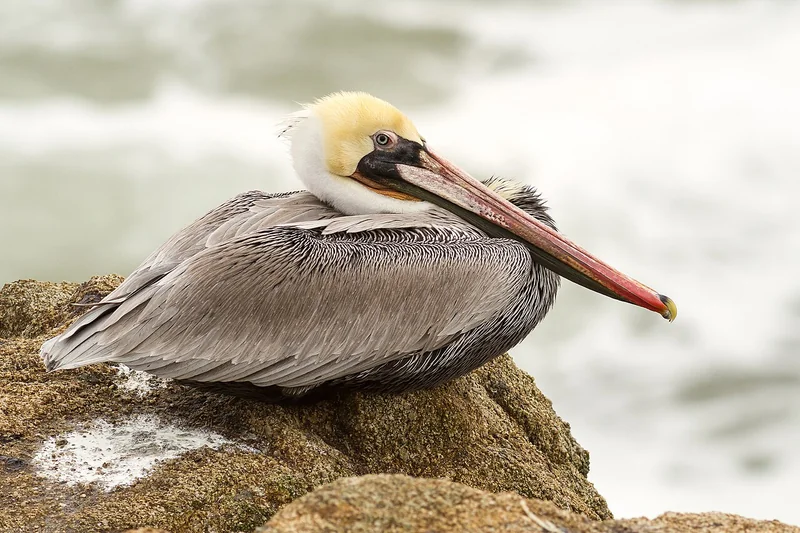 Featured photobrown-pelican.jpg
Pelecanus occidentalis, the brown pelican, is a medium-large pelican of American coasts. Adults are 1.06 to 1.37 m long with a wingspan of 1.83 to 2.5 m and weigh 2.75 to 5.5 kg. The plumage is mostly grey-brown with white head and neck details (yellow on the breeding crown). The IUCN lists the species as Least Concern after a famous twentieth-century recovery from DDT-driven eggshell thinning. The brown pelican is the only pelican species that fishes by plunge-diving from height into the sea.
Quick facts
- Habitat
- Strictly coastal — shallow seas, estuaries, mangroves, and protected bays. The species rarely appears on inland water and is replaced inland by the larger American white pelican.
- Range
- Pacific and Atlantic coasts of the Americas, from the southern United States south to northern Chile (Pacific) and southern Brazil (Atlantic), plus the Caribbean and the Galápagos Islands.
- Size
- 106–137 cm body · 183–250 cm wingspan · 2.75–5.5 kg
- Plumage
- Adults show grey-brown body and wings, a white neck, and a yellow forehead and crown. During the breeding season the back of the neck turns dark chestnut-brown and the bill pouch becomes bright red. Juveniles are uniformly grey-brown with darker wings and white underparts; full adult plumage develops over three to four years.
- Song
- Mostly silent. At breeding colonies, low grunts and hisses are exchanged. Plunge-diving brown pelicans make a loud splashing impact that carries far across calm water.
- Migration
- Largely sedentary on the breeding range. Some northern populations make short-distance autumn movements; long-distance migration is absent.
- Conservation
- Least Concern (LC)
Overview
Pelecanus occidentalis is the smallest of the eight Pelecanus species worldwide and the only one that plunge-dives from height into the sea — every other pelican species fishes by surface scooping. The species' aerial diving has parallels to the unrelated gannets and boobies, and brown pelicans have evolved subcutaneous air sacs that absorb the impact and prevent injury during the high-speed plunges.
Conservation history
Brown pelican populations crashed across the eastern and Gulf coasts of the United States through the mid-twentieth century from DDT-driven eggshell thinning. The species was added to the US Endangered Species List in 1970. The 1972 ban on DDT, combined with active colony protection and reintroduction programmes, drove a strong recovery. The species was downlisted to Threatened in 1985 and fully delisted in 2009.
Plunge-diving
Brown pelicans hunt by plunge-diving — the only Pelecanus species that does so. The bird soars at three to twenty metres above the water, spots a school of fish, folds its wings, and dives bill-first at high speed. Subcutaneous air sacs cushion the impact, and the bill pouch closes around captured fish on contact. The technique is shared in form with gannets and boobies but evolved independently in pelicans, a textbook example of convergent evolution.
Sources & further reading (2)
- iucn-red-list — accessed 2026-04-30
- encyclopedia — accessed 2026-04-30
Frequently asked questions
How does a brown pelican survive plunge-diving?
Brown pelicans dive bill-first into the sea at high speed from heights of three to twenty metres. Subcutaneous air sacs along the underside of the body absorb the impact, the closing nictating membrane protects the eyes, and a slight twist as the bird hits the water reduces the impact along the spine. Without these adaptations, the impact at this speed would be lethal — and the technique evolved independently in pelicans, gannets, and boobies.
How much water can a brown pelican's bill pouch hold?
About ten litres — the largest pouch capacity of any pelican relative to body size. After the dive, the pelican floats at the surface, lets the captured water drain out the sides of the bill, and swallows the trapped fish whole. Other birds (gulls, frigatebirds) often hover nearby waiting to steal fish from the pouch before swallowing — a frequent kleptoparasitism observed at brown pelican fishing grounds.
Why aren't brown pelicans found inland?
Brown pelicans are obligate marine specialists — their plunge-diving technique works only in deep open water, and their fish prey (anchovies, menhaden, mullet) is exclusively marine. The species rarely strays more than a few kilometres inland from the coast. The much larger American white pelican (P. erythrorhynchos), which forages by cooperative surface herding, fills the inland-water niche across North America.