Poecile hudsonicus
Boreal Chickadee (Poecile hudsonicus)
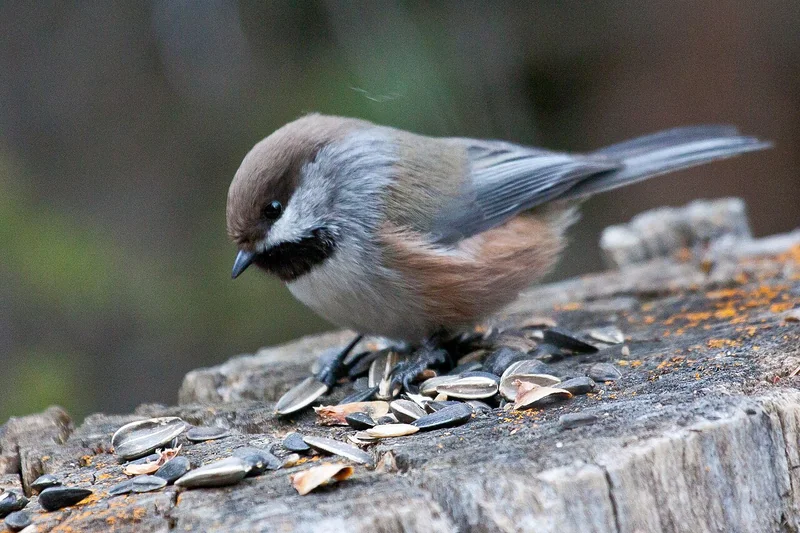 Featured photoboreal-chickadee.jpg
Poecile hudsonicus, the boreal chickadee, is a small Paridae of the spruce-fir boreal forest of Canada and the northern United States. Adults are 12 to 14 cm long with a wingspan of about 20 cm and weigh 7 to 12.4 g. The plumage shows a warm brown cap and rich rust-brown flanks. The IUCN lists the species as Least Concern. The species is an obligate boreal-conifer specialist and one of the few chickadees adapted to subarctic winter conditions.
Quick facts
- Habitat
- Boreal spruce-fir and pine forest across Canada and the northernmost United States. The species avoids deciduous forest and is rarely found outside the spruce-dominated belt.
- Range
- Across the boreal forest of Canada from the western maritime provinces through the Yukon and into Alaska, plus the northernmost United States (northern Maine, parts of New York's Adirondacks, northern Minnesota, and the northern Rockies).
- Size
- 12–14 cm body · 19–21 cm wingspan · 7–12.4 g
- Plumage
- Both sexes show a warm chocolate-brown crown (the diagnostic field mark — most chickadees have black caps), a black bib on the throat, white cheeks, soft grey upperparts, and rich rust-cinnamon flanks. The brown cap is unique among North American chickadees and is the easiest field separation from the much more widespread black-capped chickadee.
- Song
- A husky 'tsick-a-dzee-dzee' that sounds like a slightly hoarser version of the black-capped chickadee's call. The whistled song is rare and quiet; the species relies more on the chatter call than the typical Poecile fee-bee whistle.
- Migration
- Largely resident year-round. Some southern movements in irruption years follow boreal seed-crop failures but no regular migration.
- Conservation
- Least Concern (LC)
Overview
Poecile hudsonicus is one of the most northerly distributed of the seven North American chickadees and the only one with a brown rather than black cap. The Latin epithet 'hudsonicus' references Hudson Bay, the northern water body bordering the centre of the species' range. The species is one of the most cold-tolerant Passerines in North America, surviving extended sub-zero winters across the boreal forest.
Distribution
The breeding range covers the boreal spruce-fir forest of Canada from the maritime provinces through to Alaska, plus a few northern US fingers in Maine, New York, Minnesota, and the northern Rockies. Some southern populations have declined as boreal forest is converted or modified, but the broader Canadian range remains stable. The species is one of the most reliable indicators of intact boreal conifer forest.
Cold tolerance
Boreal chickadees survive winter temperatures of −40 °C and below through several adaptations shared with their black-capped relatives — dense seasonal plumage, regulated nocturnal hypothermia (lowering body temperature about 10 °C overnight to conserve energy), winter-cached food, and communal roost cavities. The species' cold tolerance and cached-food strategy are among the most extreme of any small songbird worldwide.
Sources & further reading (2)
- iucn-red-list — accessed 2026-04-30
- encyclopedia — accessed 2026-04-30
Frequently asked questions
Why does the boreal chickadee have a brown cap?
Among North American chickadees, only the boreal chickadee and the closely related chestnut-backed chickadee of the Pacific coast have brown rather than black caps. The brown is melanin-pigmented like the black caps of other chickadees but with a lower density of black melanin. The colour does not appear to have a strong functional explanation and likely reflects phylogenetic divergence within the genus Poecile.
Where does 'hudsonicus' in the name come from?
The Latin epithet refers to Hudson Bay — the large northern Canadian water body at the centre of the species' range. The boreal chickadee was first described scientifically from specimens collected near Hudson Bay in the eighteenth century, and the place name was incorporated into the binomial. The naming convention is shared with several other North American boreal birds (Hudsonian godwit, Hudsonian whimbrel).
How do boreal chickadees survive −40 °C winters?
Several adaptations work together. Dense winter plumage provides excellent insulation; regulated nocturnal hypothermia lowers body temperature about 10 °C overnight to conserve energy through long sub-zero nights; cached food (gathered in autumn and stored across hundreds of locations) is recovered through winter using spatial memory; and communal roost cavities allow several birds to share warmth. The species is among the most cold-tolerant Passerines anywhere.