Setophaga fusca
Blackburnian Warbler (Setophaga fusca)
 Featured photoblackburnian-warbler.jpg
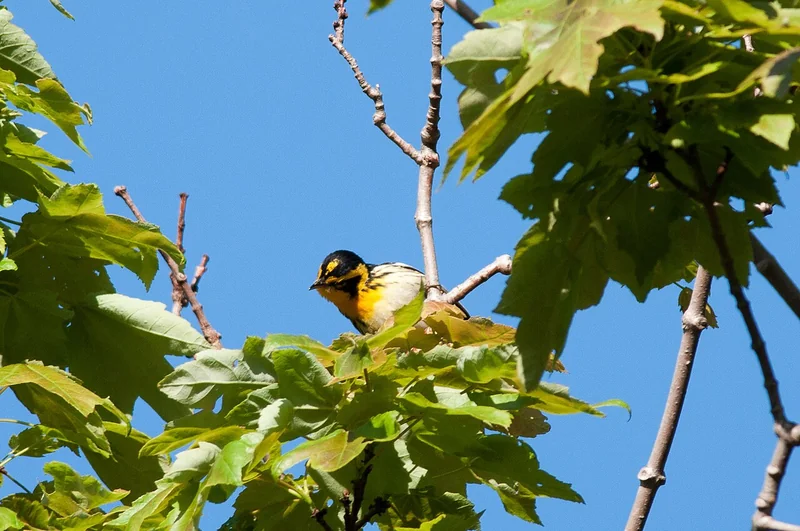
Setophaga fusca, the Blackburnian warbler, is a small Parulidae warbler distributed across mature coniferous forests of eastern North America. Adults are 11 to 13 cm long with a wingspan of 20 to 22 cm and weigh 8 to 13 g. Adult males show a brilliant flame-orange throat unmatched among North American songbirds, set against a black-and-white striped head and back. The IUCN lists the species as Least Concern. The species is a strict canopy specialist of mature conifer forest and is named for the eighteenth-century English botanist Anna Blackburne.
Quick facts
- Habitat
- Mature coniferous and mixed forest with tall trees, especially old-growth hemlock, spruce, and fir. The species is a strict canopy forager and is rarely found in young or disturbed forest.
- Range
- Breeds across the eastern boreal forest of Canada and the northeastern United States, plus the southern Appalachians. Winters across the northern Andes from Colombia to Peru and parts of Central America.
- Size
- 11–13 cm body · 20–22 cm wingspan · 8–13 g
- Plumage
- Adult males in breeding plumage show a brilliant flame-orange throat, face, and breast — one of the most saturated orange plumages of any North American songbird. The crown and back are black with bold white stripes; the wings show conspicuous white wing-patches. Females and non-breeding males are duller, with yellow replacing the orange and grey replacing the black.
- Song
- A high, thin, ascending series of notes ending in a high-pitched zip — among the highest-pitched songs of any North American warbler. The song is so high that some older birders have difficulty hearing it.
- Migration
- Long-distance Neotropical migrant. Breeds in eastern North American conifer forest; winters in the northern Andes (Colombia, Ecuador, Peru) and parts of Central America. The migration is one of the longer warbler movements between breeding and wintering grounds.
- Conservation
- Least Concern (LC)
Overview
Setophaga fusca was named after Anna Blackburne (1726-1793), an English botanist and ornithologist who corresponded with Linnaeus and built one of the most extensive private collections of natural-history specimens in eighteenth-century England. The species' English name reflects this naming history — the male's spectacular orange plumage made it a memorable specimen in Blackburne's collection. The Latin epithet 'fusca' is misleading; it means 'dark' or 'dusky', a reference to the male's black-and-orange contrast rather than any dull colouration.
Distribution
The breeding range covers the eastern boreal zone and the southern Appalachian highlands. The species is a strict canopy specialist of mature conifer and mixed forest — old-growth hemlock-spruce-fir is the textbook habitat. Hemlock decline from the introduced hemlock woolly adelgid has caused localized population declines in the southern Appalachians; northern boreal populations remain relatively stable.
High-canopy specialization
Blackburnian warblers forage almost exclusively in the upper canopy of mature conifer forest, often 20 metres or more above the ground. The species' high-canopy niche separates it ecologically from other warblers in the same forests (yellow-rumped, black-throated green) that occupy lower canopy strata. The textbook within-warbler vertical niche partitioning at MacArthur's classic 1958 study sites in northeastern New England featured Blackburnian as the canopy-top species.
Sources & further reading (2)
- iucn-red-list — accessed 2026-04-30
- encyclopedia — accessed 2026-04-30
Frequently asked questions
Who was Blackburn that the species is named for?
Anna Blackburne (1726-1793) was an English botanist and ornithologist who corresponded with Carl Linnaeus and built one of the most extensive private collections of natural-history specimens in eighteenth-century England. The species name honours her contribution to natural history. Several other species (Blackburn's lark, Blackburn's owl) bear her name.
How can the male's throat be so bright orange?
The brilliant flame-orange of the breeding male is produced by carotenoid pigments deposited unchanged into the throat feathers during the late-winter and early-spring moult. The colour intensity is diet-dependent — birds with access to carotenoid-rich insect prey during the moult develop more vivid orange — and is sexually selected. Females consistently choose males with the most saturated orange, making the trait a signal of male foraging skill and condition.
Why does the species need mature conifer forest?
Blackburnian warblers are strict canopy-top specialists of mature conifer or mixed conifer-and-deciduous forest. The species nests near the top of tall conifers and forages predominantly in the upper canopy. Young or recently logged forests lack the tall-tree canopy structure the species requires. Loss of mature forest — particularly old-growth hemlock from the introduced hemlock woolly adelgid — has caused localized population declines in the species' southern range.