Himantopus himantopus
Black-winged Stilt (Himantopus himantopus)
 Featured photoblack-winged-stilt.jpg
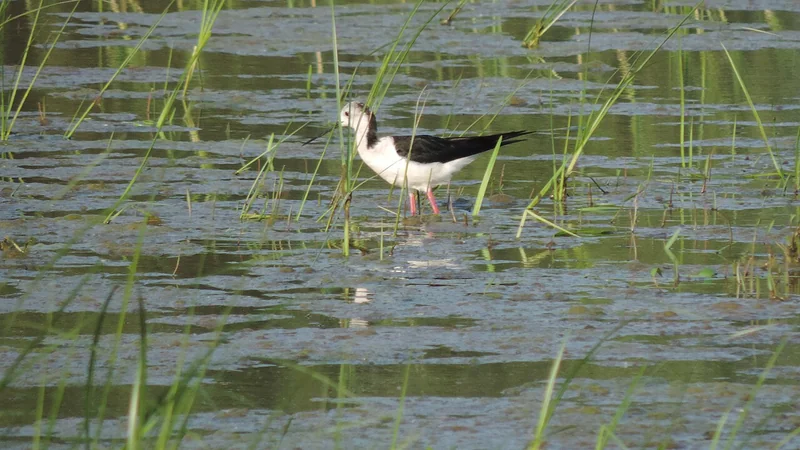
Himantopus himantopus, the black-winged stilt, is a large wader of the family Recurvirostridae, widespread across Europe, Africa, and Asia. Adults are 33 to 36 cm long with a wingspan of 67 to 83 cm and weigh 160 to 195 g. The plumage is strikingly glossy black above and white below, with extraordinarily long rose-pink legs — the second-longest relative to body size of any bird. The IUCN lists the species as Least Concern.
Quick facts
- Habitat
- Shallow freshwater and saline wetlands, mudflats, lagoons, salt pans, and flooded agricultural fields across temperate and tropical regions. Prefers open, shallow water margins with sparse emergent vegetation.
- Range
- Breeds across southern Europe, sub-Saharan Africa, South and Southeast Asia, and Australasia. Northern breeding populations winter in tropical Africa and South Asia.
- Size
- 33–36 cm body · 67–83 cm wingspan · 160–195 g
- Plumage
- Adults show glossy black upperparts, white underparts, and a white head and neck with variable black on the nape. The legs are bright rose-pink and exceptionally long. The bill is straight and black. Juveniles show brownish-tinged upperparts and paler pinkish legs.
- Song
- A persistent, sharp 'kik-kik-kik' alarm call repeated rapidly, especially around the nest. The species is highly vocal when disturbed, mob-calling intruders from aerial or ground-level threats.
- Migration
- Partially migratory. Northern European and central Asian breeding populations winter in tropical Africa and South Asia. Southern African and Australian populations are largely sedentary or nomadic.
- Conservation
- Least Concern (LC)
Overview
Himantopus himantopus is one of several species in the Himantopus stilt complex. The IOC World Bird List treats H. himantopus as covering the Palearctic, Afrotropical, and Oriental ranges. The common name references the black upperwing — a field mark separating it from the black-necked stilt (H. mexicanus) of the Americas, which has an entirely black head. The species has colonised new wetland habitats across Europe over recent decades, expanding its breeding range noticeably northward.
Extreme leg proportions
The black-winged stilt has the second-longest legs relative to body size of any bird, after flamingos. This allows wading in water up to 25 cm deep — deeper than most comparable-sized waders — to access invertebrate prey unavailable to short-legged competitors. The pink coloration intensifies during the breeding season and is thought to signal body condition to potential mates. Even on land the legs are so long that the bird must kneel awkwardly to reach ground-level items or sit on the nest.
Breeding and nest defence
The species breeds in small loose colonies on bare or sparsely vegetated ground near water. The nest is a simple scrape or a small mound of vegetation placed at the water's edge or on emergent vegetation. Both parents incubate the 3–4 eggs and are famously aggressive nest defenders — adults perform broken-wing distraction displays, mob aerial predators, and call persistently. After hatching, chicks can walk and swim within hours but remain under parental guard until fledging at 28–32 days.
Sources & further reading (2)
- iucn-red-list — accessed 2026-05-07
- encyclopedia — accessed 2026-05-07
Frequently asked questions
Why does the black-winged stilt have such long legs?
The extremely long legs — second only to flamingos relative to body size — allow the species to wade in deeper water than most comparable waders, reaching aquatic invertebrate prey unavailable to short-legged competitors. The rose-pink coloration also functions as a condition signal during courtship: brighter legs indicate a healthier individual.
Is the black-winged stilt the same species as the black-necked stilt?
No. The black-winged stilt (Himantopus himantopus) covers the Old World and Australasia, while the black-necked stilt (H. mexicanus) is a New World species with an entirely black head. The black-winged stilt has a white head with variable black on the nape. Most authorities now treat them as separate species.
How does the black-winged stilt defend its nest?
Adults are famously aggressive near the nest, performing broken-wing distraction displays to lure intruders away, mob-calling aerial predators, and dive-bombing approaching animals or humans. Both parents share incubation duty and chick guarding. Chicks can walk and swim within hours of hatching and fledge in 28–32 days.