Rynchops niger
Black Skimmer (Rynchops niger)
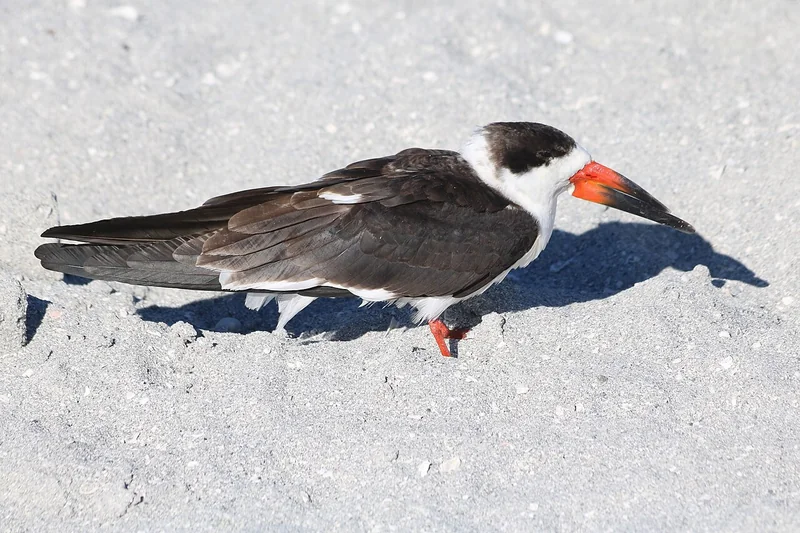 Featured photoblack-skimmer.jpg
Rynchops niger, the black skimmer, is a medium-large seabird of the family Laridae, distributed across coastal habitats of the Americas. Adults are 40 to 50 cm long with a wingspan of 1.07 to 1.27 m and weigh 220 to 415 g. The plumage is sharply pied — black above, white below — with a striking red-and-black bill in which the lower mandible is substantially longer than the upper. The IUCN lists the species as Least Concern. The species is the only bird with the lower mandible significantly longer than the upper, an adaptation for its unique skim-foraging technique.
Quick facts
- Habitat
- Coastal estuaries, lagoons, sandbars, and large freshwater lakes across the Americas. Breeds on sandy beach colonies; forages over shallow calm water.
- Range
- Coastal North America from southern New England south through the Gulf and Atlantic coasts to South America (Argentina). Inland populations occur on large rivers across South America (Amazon, Orinoco). Three subspecies span the range.
- Size
- 40–50 cm body · 107–127 cm wingspan · 220–415 g
- Plumage
- Adults show glossy black upperparts (back, head crown, wings, and tail), bright white underparts (face, neck, belly, undertail), and the diagnostic asymmetric bill — bright red-and-black above with the lower mandible 25-30 per cent longer than the upper. The legs are red. Both sexes look alike. Juveniles show heavily streaked brown-and-white plumage and a less asymmetric bill that develops adult proportions over the first year.
- Song
- A soft 'kak' or 'aap' contact call delivered both in flight and from the ground. The species is mostly silent while foraging.
- Migration
- Partial migrant. Northern populations move south for winter to the southeastern United States and the Caribbean; southern populations are largely resident.
- Conservation
- Least Concern (LC)
Overview
Rynchops niger is one of three Rynchops skimmers worldwide (with the African skimmer R. flavirostris and the Indian skimmer R. albicollis). The genus Rynchops is unique among birds for the asymmetric bill — the lower mandible is substantially longer than the upper, an adaptation for the species' unique skim-foraging technique. The asymmetric bill develops only after fledging; juveniles have nearly equal mandibles that grow into the adult asymmetry over the first year.
Skim-foraging
Black skimmers forage by skim-feeding — the bird flies just above the water surface with the bill open and the longer lower mandible slicing through the water. When the mandible contacts a fish, the upper mandible snaps shut on the prey by reflex. The technique works in calm water with abundant near-surface fish prey and is shared with the two African and Indian skimmer species. The asymmetric bill is the only adaptation of its kind among birds.
Vertical-slit pupil
Black skimmers have vertical-slit pupils — the only bird species in the world with this trait. Vertical-slit pupils are common in nocturnal mammalian predators (cats, snakes) but virtually unknown among birds, which typically have circular pupils. The vertical slit may help the species cope with the bright daytime glare during low-flying skim-foraging over bright water surfaces. The trait is one of several anatomical features unique to the small Rynchops family.
Sources & further reading (2)
- iucn-red-list — accessed 2026-04-30
- encyclopedia — accessed 2026-04-30
Frequently asked questions
Why is the lower mandible longer than the upper?
Black skimmers forage by flying just above the water surface with the open lower mandible slicing through the water — when the mandible contacts a fish, the upper mandible snaps shut on the prey. The longer lower mandible allows the bird to skim through water without the upper mandible interfering, and the asymmetric structure is one of the most specialized bill morphologies in any bird. The species is the only bird with this asymmetry.
Why do black skimmers have vertical-slit pupils?
Black skimmers are the only bird species with vertical-slit pupils — a trait common in nocturnal mammals (cats, snakes) but virtually absent in birds. The vertical slit may help the species cope with bright daytime glare during low-flying skim-foraging over bright water surfaces. The pupil is otherwise unique to this small genus and has no clear analogue in other bird groups.
How do juvenile skimmers eat before the bill becomes asymmetric?
Juvenile black skimmers hatch with nearly equal upper and lower mandibles and gradually develop the adult asymmetry over the first year. During the early juvenile period, the bird is fed by parents (small fish dropped near the chick) and does not need to skim-feed independently. As the bill grows into the adult asymmetric form, the bird transitions to skim-feeding for itself. Captive observations document the entire bill-growth sequence in detail.