Nycticorax nycticorax
Black-crowned Night Heron (Nycticorax nycticorax)
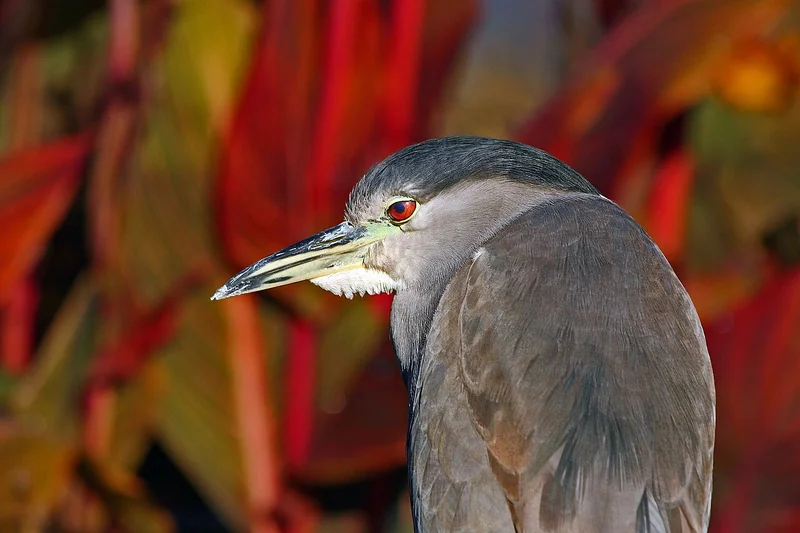 Featured photoblack-crowned-night-heron.jpg
Nycticorax nycticorax, the black-crowned night heron, is a medium-sized heron of the family Ardeidae with a near-cosmopolitan distribution. Adults are 58 to 66 cm long with a wingspan of 105 to 112 cm and weigh 727 to 1,014 g. The species is recognised by its black cap and back, pale grey wings, white underparts, and vivid red eyes. The IUCN lists the species as Least Concern.
Quick facts
- Habitat
- Wetlands of almost any type — marshes, swamps, rice paddies, river margins, estuaries, mudflats, mangroves, coastal lagoons, and lake edges — throughout tropical, subtropical, and temperate regions worldwide. Uses both freshwater and brackish habitats. Roosts in dense vegetation near water during the day.
- Range
- Breeds on every continent except Australia and Antarctica — one of the most widespread of all heron species. Present across North and South America, Europe, Africa, and Asia. Northern populations are migratory; tropical and subtropical populations are resident. Four subspecies are recognised.
- Size
- 58–66 cm body · 105–112 cm wingspan · 727–1014 g
- Plumage
- Adults have a glossy black crown and back, pale grey wings and tail, white underparts, and two or three long white plumes extending from the nape. The eyes are vivid red. The legs are yellow, turning pinkish-red during the breeding season. Immature birds are streaky brown with yellow eyes, resembling a bittern — they require three years to reach full adult plumage.
- Song
- A loud, harsh 'quok' or 'woc' given in flight — most frequently heard as flocks leave roosts at dusk. The call is distinctive and far-carrying. Colonial nesting sites produce a constant cackling and croaking.
- Migration
- Partially migratory. Northern hemisphere breeding populations (North America, Europe, central Asia) migrate to warmer latitudes in winter. Tropical and subtropical populations are largely sedentary. Migrates at night.
- Conservation
- Least Concern (LC)
Overview
Nycticorax nycticorax is the type species of the genus Nycticorax and is among the most cosmopolitan of all bird species — present as a breeding bird on every continent except Antarctica and Australia. The species name nycticorax derives from the Greek for 'night raven' — a reference to its nocturnal habits and harsh call. It is the most widespread heron on Earth, exploiting virtually any wetland habitat type across tropical to temperate latitudes. The species nests colonially, often in mixed heronries with other heron and egret species, and is highly gregarious in its roosting behaviour.
Nocturnal foraging strategy
The black-crowned night heron is primarily crepuscular and nocturnal — the large red eyes, adapted for low-light vision, allow effective foraging in conditions that exclude most daytime heron competitors. The species activates at dusk, flying from communal day roosts to foraging sites where it stands motionless at the water's edge or in shallow water, waiting to strike at fish, frogs, and invertebrates. This nocturnal niche allows it to exploit food resources that remain available after diurnal herons (great blue heron, grey heron) have ceased foraging. In colonial nesting areas with abundant food, individuals may also forage actively during the day.
Colonial nesting and colonial roosts
Black-crowned night herons are strongly colonial — they nest in mixed-species heronries with other herons, egrets, ibises, and cormorants, sometimes numbering thousands of pairs. Nests are built of sticks in dense vegetation, trees, or reed beds near water. Colonial nesting provides protection against predators through collective vigilance and mobbing. The species also maintains large communal day roosts — sometimes several hundred birds in a single dense stand of trees — from which they disperse each evening. These colonial roosts and heronries are conspicuous and are frequently monitored as indicators of wetland health.
Sources & further reading (2)
- iucn-red-list — accessed 2026-05-07
- encyclopedia — accessed 2026-05-07
Frequently asked questions
Why do young black-crowned night herons look so different from adults?
Immature black-crowned night herons are brown and heavily streaked — resembling a small bittern — and bear virtually no resemblance to the black-and-grey adult. This juvenile plumage is retained for approximately two years, with birds progressively acquiring adult features. The streaky brown juvenile plumage may provide camouflage at a life stage when the bird is less experienced at predator avoidance. It takes three years for black-crowned night herons to attain full adult plumage with the distinctive black cap and red eyes.
Are black-crowned night herons a nuisance at fish farms?
Yes — black-crowned night herons can cause significant losses at commercial fish farms and aquaculture ponds, particularly where fish are concentrated in shallow water. The species is one of the most frequently cited avian predators at aquaculture facilities in North America, Europe, and Asia. It is opportunistic and quickly learns to exploit artificial fish ponds. Management approaches include netting ponds, deterrent systems, and hazing; legal lethal control requires permits in most jurisdictions.
How does the black-crowned night heron hunt at night?
The black-crowned night heron relies primarily on large, sensitive eyes adapted to low-light conditions rather than any echolocation or other specialised sense. It hunts by adopting a still, crouched posture at the water's edge or in shallow water and waits for prey to come within range of its rapid bill strike. The bird may also wade slowly through shallow water. It is not strictly nocturnal — it forages whenever light conditions are dim enough to reduce competition from larger diurnal heron species.