Megaceryle alcyon
Belted Kingfisher (Megaceryle alcyon)
 Featured photobelted-kingfisher.jpg
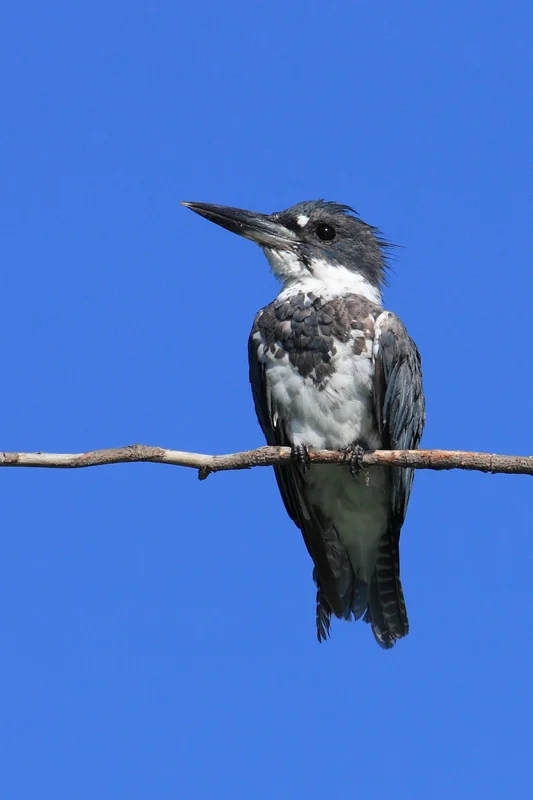
Megaceryle alcyon, the belted kingfisher, is a medium-sized kingfisher of the family Alcedinidae, distributed across most of North America. Adults are 28 to 35 cm long with a wingspan of 48 to 58 cm and weigh 140 to 170 g. The plumage is blue-grey above with a white belly, a shaggy double-pointed crest, and a heavy dagger-like bill. Females are unusually more colourful than males — both sexes show a blue-grey breast band, but females also carry a chestnut belly band absent in males. The IUCN lists the species as Least Concern.
Quick facts
- Habitat
- Streams, rivers, lakes, ponds, and coastal estuaries throughout North America. The species requires both clear shallow water for diving and earthen banks for nest excavation.
- Range
- Most of North America from southern Alaska and Canada south through the United States to Mexico. Winters in the southern half of the United States south to Mexico, Central America, and northern South America.
- Size
- 28–35 cm body · 48–58 cm wingspan · 140–170 g
- Plumage
- Adults show blue-grey upperparts, a white collar, a blue-grey breast band, and white underparts. Females additionally show a chestnut belly band below the blue-grey breast band — making females the more colourful sex, an unusual reverse plumage dimorphism among birds. The bill is heavy, dark, and dagger-like; the head carries a shaggy double-pointed crest. The blue-grey colour is structural in part and varies in tone with the angle of light.
- Song
- A loud, dry, mechanical rattle delivered both in flight and from a perch. The call is one of the most familiar waterway sounds across North America and announces the bird's presence at substantial distances. Both sexes call.
- Migration
- Partial migrant. Northern populations move south for winter to ice-free water; southern populations are largely resident. The species follows ice-out timing in spring as it returns to northern breeding rivers.
- Conservation
- Least Concern (LC)
Overview
Megaceryle alcyon is one of four Megaceryle kingfishers worldwide. The species is the largest North American kingfisher and one of the few bird species in which the female is more colourfully plumaged than the male — the female's chestnut belly band is absent from the male's plumage. The reverse plumage dimorphism is unusual among birds and the functional explanation is debated.
Distribution
The breeding range covers most of forested and partly forested North America wherever streams, rivers, lakes, or ponds provide both clear shallow water for diving and earthen banks for nest excavation. The species nests in burrows excavated horizontally into vertical earthen banks (riverbanks, road cuts, sand pits) — typically 1-2 metres deep with a slight upward slope to keep meltwater from flooding the nest chamber. The species is one of the few North American birds that excavates its own nest tunnels.
Plunge-diving
Belted kingfishers hunt by perching above clear shallow water, watching for fish, then either diving directly from the perch or hovering briefly above the target before plunging. The strike is delivered head-first with the wings folded, breaking the surface at speed and seizing the fish in the bill. The captured fish is carried back to a perch and stunned by repeated slamming against the perch surface before being swallowed whole. Both adults teach fledged young the technique, with parents dropping captured fish into the water for chicks to practice retrieving.
Sources & further reading (2)
- iucn-red-list — accessed 2026-04-30
- encyclopedia — accessed 2026-04-30
Frequently asked questions
Why are female belted kingfishers more colourful than males?
Female belted kingfishers carry a chestnut belly band below the blue-grey breast band that males lack — making the female the more colourfully plumaged sex. The reverse dimorphism is unusual among birds, and the functional explanation is debated. Possibilities include female-female competition for high-quality territories, mate choice operating on male-mate selection of the more colourful females, or simply phylogenetic legacy. The trait is documented across the species' range and across many years of observation.
Do kingfishers really dig their own burrows?
Yes. Belted kingfishers excavate horizontal nesting burrows into vertical earthen banks (riverbanks, road cuts, sand pits) using both bill and feet. The burrows are typically 1-2 metres deep with a slight upward slope that keeps meltwater from flooding the nest chamber. Both parents share the excavation. The species is one of the few North American birds that excavates its own nest tunnels and is therefore dependent on the availability of suitable earthen banks near waterways.
How do kingfishers see fish underwater?
Kingfishers have specialized retinas with two foveae per eye — one for binocular vision in air and one for accurate close-range hunting underwater. The combination allows the bird to acquire the fish target from above the water surface, then maintain accurate aim through the dive as the visual properties of water (refraction, reduced light) change the apparent fish position. The dual-fovea retina is one of the canonical anatomical adaptations for plunge-diving in birds.