Hirundo rustica
Barn Swallow (Hirundo rustica)
 Featured photobarn-swallow.jpg
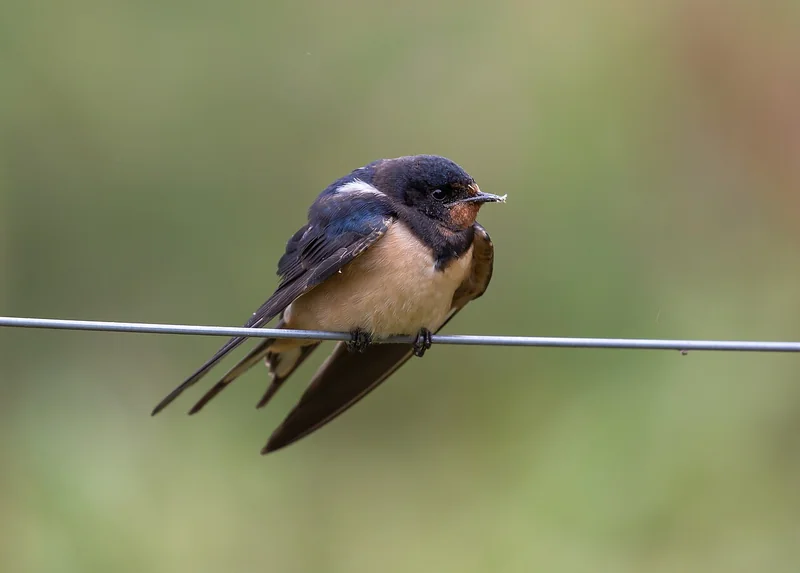
Hirundo rustica, the barn swallow, is a small swallow of the family Hirundinidae and one of the most widely distributed passerines in the world. Adults are 17 to 19 cm long (including tail streamers) with a wingspan of 32 to 35 cm and weigh 16 to 24 g. The plumage shows a glossy steel-blue back and crown, rust-red forehead and throat, and pale buff to chestnut underparts. The IUCN lists the species as Least Concern. The deeply forked outer tail feathers are diagnostic and are sexually selected — males with longer tail streamers attract more mates.
Quick facts
- Habitat
- Open country with available mud for nest construction — farmland, marshes, lake shores, suburban yards, and historically open caves. Modern populations are heavily tied to human-built structures (barns, bridges, road culverts).
- Range
- Breeds across nearly all of the Northern Hemisphere — Europe, Asia, North America, and northern Africa. Winters in the Southern Hemisphere — South America, southern Africa, southern Asia, and Australia. The species is among the most widely distributed wild birds in the world.
- Size
- 17–19 cm body · 32–35 cm wingspan · 16–24 g
- Plumage
- Adults show a glossy steel-blue back and crown, a rust-red forehead and throat, and pale buff to chestnut underparts (rufous in North American populations, buff in European). The deeply forked tail with elongated outer streamers is diagnostic; males have substantially longer streamers than females. Juveniles show much shorter tail streamers and duller plumage.
- Song
- A long, twittering musical chatter delivered from a perch or in flight, with frequent dry rattle notes. The call is a sharp 'vit' or 'witt'.
- Migration
- Long-distance Trans-equatorial migrant. North American breeders winter from Mexico south to Argentina; European breeders winter in sub-Saharan Africa; East Asian breeders reach southern Asia and northern Australia.
- Conservation
- Least Concern (LC)
Overview
Hirundo rustica is the type species of the genus Hirundo and one of the most cosmopolitan land birds on Earth, with a breeding range covering nearly all of the Northern Hemisphere. The species has shown a strong association with human structures since at least classical antiquity — Greek and Roman writings reference barn swallows nesting in human dwellings — and modern populations are largely or wholly dependent on human-built structures (barns, bridges, culverts) for nesting.
Distribution
The breeding range covers Europe, Asia, North America, and parts of northern Africa. Six subspecies are recognized, differing in plumage saturation and migration distance. Wintering grounds span the Southern Hemisphere — barn swallows from a single breeding population in Britain may winter as far south as the Cape of Good Hope. The species is among the longest-distance migratory songbirds in the world.
Sexual selection
Male barn swallows have substantially longer outer tail streamers than females. Field studies in Denmark by Anders Pape Møller and colleagues showed that experimentally lengthening male tail streamers increased pairing success and reproductive output, while shortening them reduced both. Streamer length correlates with parasite resistance, condition, and offspring survival, making the trait one of the textbook examples of sexual selection on a viability-linked ornament in birds.
Sources & further reading (2)
- iucn-red-list — accessed 2026-04-29
- encyclopedia — accessed 2026-04-29
Frequently asked questions
Why do male barn swallows have such long tail streamers?
The deeply forked outer tail feathers are an extreme sexual ornament. Field experiments in Denmark showed that lengthening a male's tail streamers increased mating success and reproductive output, while shortening them reduced both. Streamer length correlates with parasite resistance and male condition, making the trait one of the canonical avian examples of female mate choice for a viability-indicator ornament.
How far do barn swallows migrate?
Among the longest of any songbird. European populations winter in sub-Saharan Africa; North American populations winter from Mexico south to Argentina; East Asian populations reach southern Asia and northern Australia. Individual barn swallows ringed in northern Europe have been recovered as far south as Cape Town, a one-way migration of over ten thousand kilometres twice each year.
Why is the species so closely tied to human buildings?
The species' ancestral nesting habitat was likely caves and rocky overhangs near open feeding habitat. Once humans began building structures with sheltered overhangs (barns, bridges, eaves, road culverts), barn swallows colonized them rapidly and became almost wholly dependent on human structures across their breeding range. Wild cave-nesting populations remain in parts of Eurasia but make up a small minority of the global total.