Tyto alba
Barn Owl (Tyto alba)
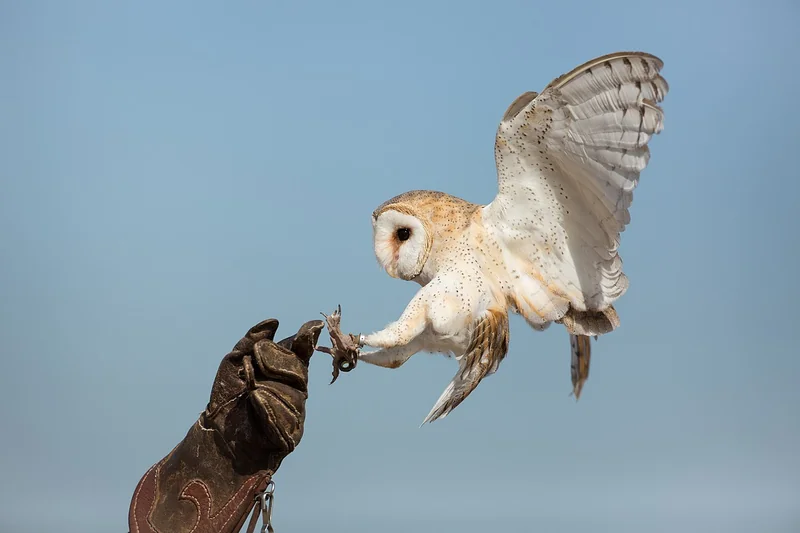 Featured photobarn-owl.jpg
Tyto alba, the barn owl, is a medium-sized owl of the family Tytonidae and one of the most widely distributed birds in the world. Adults are 32 to 40 cm long with a wingspan of 80 to 95 cm and weigh 224 to 710 g. The plumage is pale buff and white with fine grey and tawny mottling above; the heart-shaped facial disc is the species' diagnostic feature. The IUCN lists the species as Least Concern. Barn owls have one of the most accurate auditory hunting systems documented in any vertebrate.
Quick facts
- Habitat
- Open and semi-open country with old barns, ruined buildings, hollow trees, or cliff ledges for roosting and nesting — agricultural land, grasslands, savanna, marshes, and edges of human settlement.
- Range
- Cosmopolitan. Found on every continent except Antarctica, with breeding populations from Europe through Asia, Africa, the Americas, and Australia. Many regional subspecies have been described, and several have recently been split as separate species (American barn owl T. furcata, eastern barn owl T. javanica).
- Size
- 32–40 cm body · 80–95 cm wingspan · 224–710 g
- Plumage
- Adults show pale golden-buff upperparts with fine grey and tawny mottling, pure white underparts (often unmarked or finely spotted), and the diagnostic heart-shaped white facial disc bordered by a ruff of tawny feathers. The eyes are dark brown — unusual among owls, which mostly have yellow or orange irises. Sexes are alike but females average slightly darker.
- Song
- A long eerie shriek or scream — quite unlike the hooting of typical owls. Calls also include hissing and chattering near the nest. The species is far more silent than most owls.
- Migration
- Sedentary across nearly the entire range. Some individuals make short-distance dispersal movements when prey collapses, but no regular migration.
- Conservation
- Least Concern (LC)
Overview
Tyto alba is the type species of the genus Tyto and the family Tytonidae — a family distinct from the typical owls (Strigidae). Until recently treated as a single cosmopolitan species, modern taxonomic treatments split T. alba into the western barn owl (T. alba sensu stricto, Europe and Africa), the American barn owl (T. furcata, Americas), and the eastern barn owl (T. javanica, southern Asia and Australia).
Auditory hunting
Barn owls have one of the most accurate auditory localization systems documented in any vertebrate. The asymmetrical ear openings (one slightly higher than the other on the skull) provide vertical sound-source localization without needing to move the head. The heart-shaped facial disc functions as a parabolic dish, focusing sound onto the ear openings. Laboratory studies show captive barn owls can locate and capture mice in complete darkness with positional accuracy of about one degree.
Distribution and range splits
The barn owl is one of the most widely distributed land birds. Modern molecular evidence has split the historical 'Tyto alba sensu lato' into at least three separate species: the western barn owl (T. alba) of Europe, the Middle East, and Africa; the American barn owl (T. furcata) of the Americas; and the eastern barn owl (T. javanica) of southern Asia and Australia. Local plumage and call differences support the splits, though field guides vary in how quickly they have adopted the new taxonomy.
Sources & further reading (2)
- iucn-red-list — accessed 2026-04-29
- encyclopedia — accessed 2026-04-29
Frequently asked questions
How accurate is barn owl hearing?
Barn owls can locate prey by sound alone with positional accuracy of about one degree — among the most precise auditory localization documented in any vertebrate. Two adaptations work together: asymmetrical ear openings on the skull (one slightly higher than the other) provide vertical localization without head movement, and the heart-shaped facial disc functions as a parabolic dish focusing sound onto the ear openings. Captive barn owls can capture mice in complete darkness.
Are American and European barn owls the same species?
Until recently treated as one species (Tyto alba). Modern molecular treatments split them: the western barn owl (T. alba sensu stricto) covers Europe, Africa, and the Middle East; the American barn owl (T. furcata) covers the Americas; the eastern barn owl (T. javanica) covers southern Asia and Australia. Plumage, vocalizations, and genetics support the splits, though older guides still list all three as subspecies of T. alba.
Why is the barn owl's facial disc shaped like a heart?
The white heart-shaped facial disc is bordered by a ruff of stiff tawny feathers that function together as a parabolic sound reflector, focusing incoming sound onto the asymmetrical ear openings hidden within the disc. The shape is functional, not decorative — it is the textbook example of an auditory parabolic dish in vertebrate anatomy. Other Tyto species share the same disc shape and similar hearing precision.