Coereba flaveola
Bananaquit (Coereba flaveola)
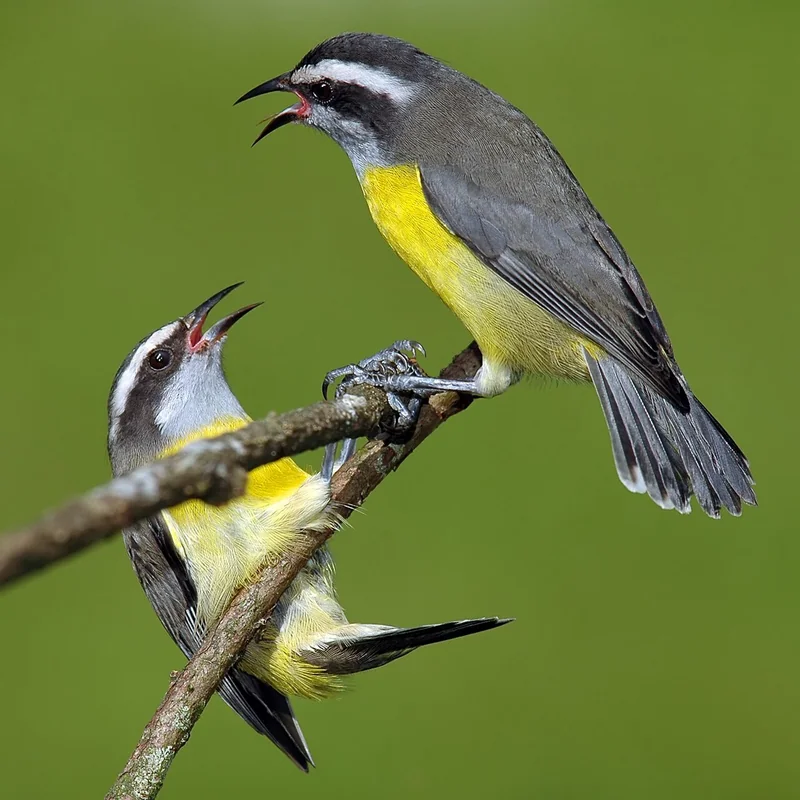 Featured photobananaquit.jpg
Coereba flaveola, the bananaquit, is a small nectarivorous passerine widespread throughout the Caribbean islands, Central America, and northern South America. Adults are 10 to 11 cm long with a wingspan of 13 to 15 cm and weigh 7 to 12 g. The species is immediately recognisable by its black-and-yellow body, white supercilium, and distinctive decurved bill. The IUCN lists the species as Least Concern. The bananaquit is the most widespread and common small landbird of the Caribbean island chain.
Quick facts
- Habitat
- Tropical and subtropical lowland forest edges, secondary growth, gardens, orchards, and open woodland throughout the Neotropics. Highly adaptable — thrives in urban gardens wherever flowering plants provide nectar. Avoids dense closed forest interior.
- Range
- Caribbean island chain from the Bahamas through the Greater and Lesser Antilles; Central America from Mexico to Panama; northern South America from Venezuela and Colombia through the Guianas to Bolivia and Brazil. Introduced to some Pacific islands.
- Size
- 10–11 cm body · 13–15 cm wingspan · 7–12 g
- Plumage
- Adults show blackish-grey to black upperparts, a bold white supercilium (eyebrow stripe), bright yellow underparts (intensity varies by island subspecies), a white rump, and a small white wing-spot. The bill is short and noticeably decurved. Many island subspecies differ subtly in yellow intensity and crown colour.
- Song
- A buzzy, wheezy 'tseee-tseee' or a rapid, high-pitched chattering delivered near flowers or at the nest. Also gives a 'tsip' contact call used frequently in flight.
- Migration
- Sedentary. The species is resident year-round throughout its range with no regular migration.
- Conservation
- Least Concern (LC)
Overview
Coereba flaveola is classified in its own monotypic family Coerebidae by some authorities, or placed within Thraupidae (tanagers) by others — its precise phylogenetic position remains debated. The species exhibits remarkable variation across its range, with over 40 named subspecies — more than any other Caribbean bird. Island subspecies differ in the intensity of yellow underparts and crown colour. Despite this variation, the basic black-and-yellow pattern with white supercilium is consistent across the entire range.
Nectar-robbing strategy
The bananaquit is a habitual nectar-robber — it typically pierces the base of flower tubes with its bill to extract nectar without entering the flower and picking up pollen. This allows the bird to access nectar from flowers whose tube length is longer than the bill, bypassing the plant's pollination mechanism. On short-tubed or open flowers the bird may act as a legitimate pollinator. The frequent robbing behaviour means the bananaquit often confers little or no pollination benefit to the plants it visits — an ecological relationship significantly different from the obligate mutualism between hummingbirds and their floral hosts.
Caribbean ubiquity and human association
The bananaquit is the most commonly encountered small bird across the Caribbean, appearing in virtually every garden, hotel terrace, and outdoor restaurant from the Bahamas to Trinidad. The species has little fear of humans and is famous for approaching tables to feed on sugar, jam, and fruit placed outdoors. In many Caribbean islands it is called 'sugar bird' for this behaviour. The English name 'bananaquit' likely derives from an early European corruption of a local indigenous name, though the species does not specifically prefer banana plants.
Sources & further reading (2)
- iucn-red-list — accessed 2026-05-07
- encyclopedia — accessed 2026-05-07
Frequently asked questions
Why is it called 'sugar bird'?
In many Caribbean islands, the bananaquit is called 'sugar bird' because of its habit of visiting tables, cafes, and kitchens to eat sugar, syrup, and jam. The bird has little fear of humans and will land directly on a sugar bowl or piece of fruit within arm's reach of a seated person. This behaviour exploits the same nectarivorous adaptations the bird uses on wild flowers, transferred to the most concentrated and abundant sugar source available — human food.
Does the bananaquit pollinate flowers?
Sometimes, but often not. The bananaquit frequently pierces the base of flower tubes to steal nectar without entering the flower and picking up pollen — a behaviour called nectar-robbing. When it visits short-tubed or open flowers, it may legitimately transfer pollen and act as a pollinator. Studies across the Caribbean have shown that bananaquits are net nectar-robbers on most plant species they visit, conferring little pollination benefit, though they are legitimate pollinators on a minority of plant species.
How many subspecies of bananaquit are there?
Over 40 named subspecies have been described, differing primarily in the intensity of yellow underparts, crown colour (blackish vs dark grey), and bill shape. This makes the bananaquit one of the most subspecifically variable birds in the Caribbean region, reflecting isolation and divergence across dozens of island populations. Some authorities have proposed that the bananaquit complex represents multiple species, but a broad species concept is currently maintained.