Icterus galbula
Baltimore Oriole (Icterus galbula)
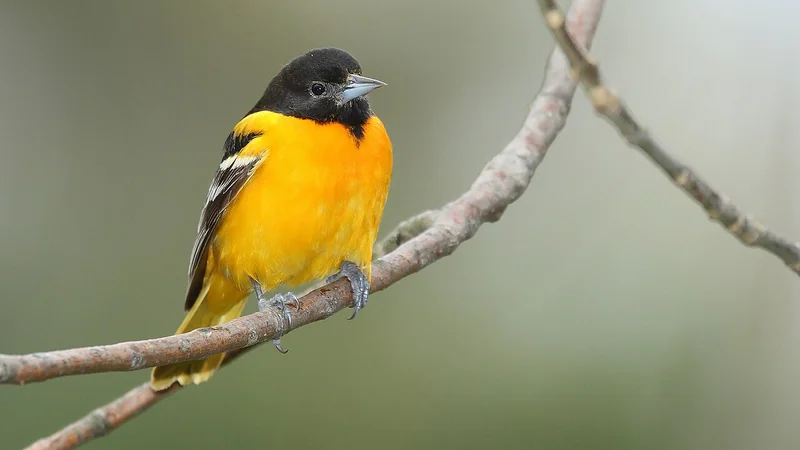 Featured photobaltimore-oriole.jpg
Icterus galbula, the Baltimore oriole, is a medium-sized icterid distributed across the eastern half of North America. Adults are 17 to 19 cm long with a wingspan of 23 to 30 cm and weigh 22 to 42 g. Adult males are vivid flame-orange with a black head, back, wings, and tail; females are warm yellow with a paler face. The IUCN lists the species as Least Concern. The species is named for the seventeenth-century Lord Baltimore — the oriole's orange-and-black colour scheme matched the Baltimore family heraldic colours.
Quick facts
- Habitat
- Open deciduous woodland, woodland edges, parks, and large gardens. Tall scattered trees with open canopies are the textbook nesting setting; dense forest is largely avoided.
- Range
- Breeds across the eastern half of North America from southern Canada south to the Gulf Coast and west to the Great Plains. Winters from Mexico south to northern South America. Long-distance Neotropical migrant; vagrants regularly reach the western United States and occasionally Europe.
- Size
- 17–19 cm body · 23–30 cm wingspan · 22–42 g
- Plumage
- Adult males show fiery orange underparts, rump, and shoulder patches; jet-black head, back, wings, and tail; and bold white wing-bars. Adult females are warm yellow below and olive-yellow above with darker wings and white wing-bars. First-year males resemble females with patchy black on the throat developing by the second autumn.
- Song
- A loud, clear, fluty whistled phrase of variable length — each male has a unique signature. The call note is a sharp 'cheek' or rolled chatter.
- Migration
- Long-distance Neotropical migrant. Breeds across eastern North America; winters from Mexico south through Central America to northern South America.
- Conservation
- Least Concern (LC)
Overview
Icterus galbula was named for George Calvert, the first Baron Baltimore (1579-1632), whose family heraldic colours were orange and black — the same colour scheme as the male oriole. The Maryland colony took the colours from the Baltimore family, and the bird in turn took its name from the colony. The species is the state bird of Maryland and is the namesake of Baltimore's Major League Baseball team.
Distribution
The breeding range covers the eastern half of North America. The species was historically lumped with the western Bullock's oriole (I. bullockii) into a single 'northern oriole' species (I. galbula) following the 1973 American Ornithologists' Union decision; the lump was reversed in 1995 after molecular and ecological evidence showed they remain reproductively distinct despite a narrow Great Plains hybrid zone.
Nesting
Baltimore orioles build one of the most distinctive nests of any North American bird — a tightly woven hanging pouch of grasses, plant fibres, and animal hair suspended from the tip of a high deciduous branch. The nest hangs ten to twenty centimetres below the supporting twig and sways freely in the wind. The whole structure is constructed by the female alone and takes about a week to weave.
Sources & further reading (2)
- iucn-red-list — accessed 2026-04-29
- encyclopedia — accessed 2026-04-29
Frequently asked questions
Why is the species called 'Baltimore' oriole?
The species was named for George Calvert, the first Baron Baltimore (1579-1632), whose family heraldic colours of orange and black matched the male oriole's plumage. The Maryland colony adopted the same colours, and through a chain of associations both the colony's and the bird's name link back to the original Baltimore peerage. The bird is the state bird of Maryland and inspired the name of the city's baseball team.
Are Baltimore and Bullock's orioles the same species?
No, they are sister species. From 1973 to 1995 the American Ornithologists' Union lumped them as a single 'northern oriole' species after observing hybridization in the Great Plains. The lump was reversed in 1995 when molecular and behavioural evidence showed the two retain reproductive distinctness despite the narrow hybrid zone — they are now treated as Icterus galbula (Baltimore) and Icterus bullockii (Bullock's).
Why hang nests from such precarious branches?
The hanging-pouch nest, suspended from the slender outer twigs of a high branch, is largely inaccessible to typical nest predators such as snakes, raccoons, and crows that operate from sturdy support. The trade-off is exposure to wind and rain, which the dense weave handles well. The nest design is convergent with several unrelated tropical icterids in the genera Cacicus and Psarocolius.