Haliaeetus leucocephalus
Bald Eagle (Haliaeetus leucocephalus)
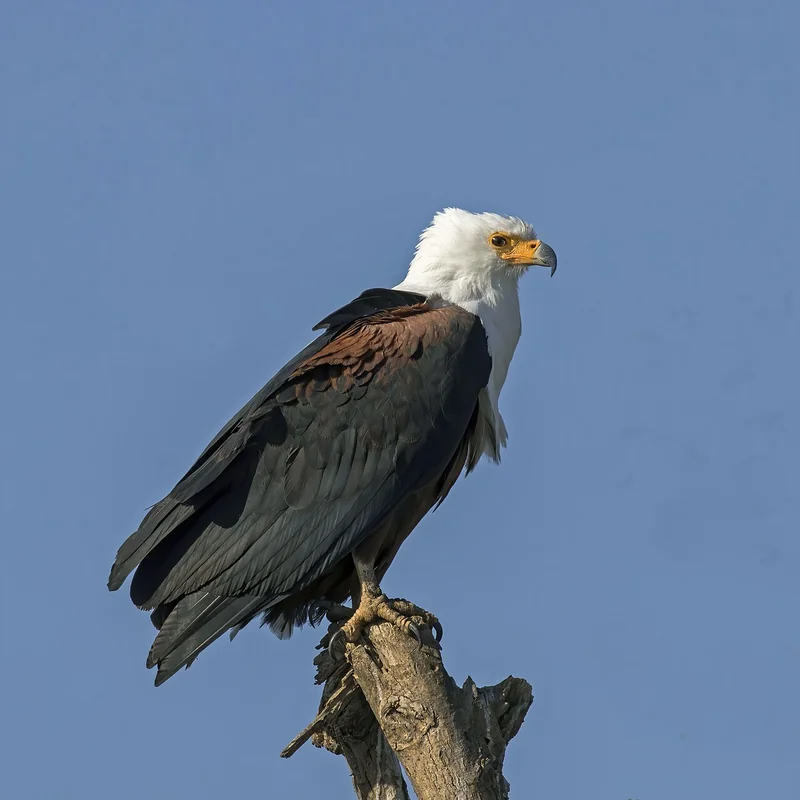
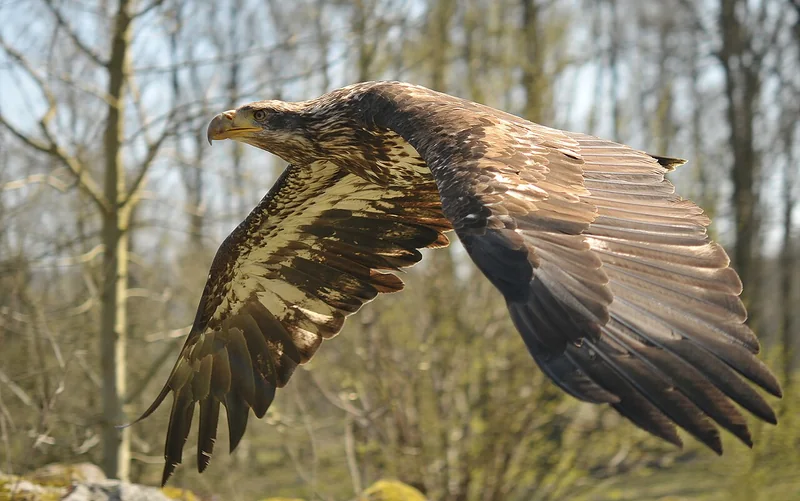 Featured photobald-eagle.jpg
Haliaeetus leucocephalus, the bald eagle, is a large sea eagle of the family Accipitridae, distributed across most of North America. Adults are 70 to 102 cm long with a wingspan of 1.8 to 2.3 m and weigh 3 to 6.3 kg. Adult plumage is dark brown with a brilliant white head and tail; juveniles are dark brown overall and acquire adult plumage over four to five years. The IUCN lists the species as Least Concern after a famous mid-twentieth-century recovery from DDT-driven near-extinction. The bald eagle is the national bird of the United States.
Quick facts
- Habitat
- Coastal and inland waters with abundant fish — coasts, large lakes, rivers, and estuaries. Wintering concentrations form on rivers below dams where fish are concentrated.
- Range
- Most of North America from northern Alaska and Canada south through the contiguous United States to northern Mexico. The species was extirpated from many central states by the 1960s but has since recolonized; current populations occur in every contiguous US state.
- Size
- 70–102 cm body · 180–230 cm wingspan · 3–6.3 kg
- Plumage
- Adults (5+ years) show a bright white head and tail set against a dark chocolate-brown body; the bill, legs, and irises are bright yellow. Juveniles are uniformly dark brown with variable white mottling; full adult plumage develops over four to five years through staged moults. Both sexes are alike; females average about 25% larger than males.
- Song
- A surprisingly weak high-pitched chittering whistle 'kweek kweek' or chirping series — at odds with the species' large size and fierce reputation. Hollywood films routinely overdub bald eagle calls with the dramatic scream of the unrelated red-tailed hawk.
- Migration
- Highly variable. Northern populations migrate; southern populations are resident; many adults make short-distance autumn movements to ice-free fishing waters.
- Conservation
- Least Concern (LC)
Overview
Haliaeetus leucocephalus is one of eight Haliaeetus sea eagles worldwide. The species was adopted as the national bird of the United States by the Continental Congress in 1782, against Benjamin Franklin's preference for the wild turkey. The species name 'leucocephalus' is Greek for 'white-headed'; 'bald' in the English name uses an archaic sense meaning 'white' rather than 'hairless'.
Conservation history
Bald eagle populations declined sharply through the mid-twentieth century. Pesticide-driven eggshell thinning (DDT bioaccumulating in fish prey) caused widespread reproductive failure; lead-shot poisoning and shooting added further mortality. The 1972 US ban on DDT, combined with Endangered Species Act protection, captive-breeding releases, and decades of habitat protection, drove a strong recovery. The species was downlisted from US Endangered to Threatened in 1995 and fully delisted in 2007; current population is over 70,000 nesting pairs in the contiguous United States, with many more in Alaska and Canada.
Behaviour
Bald eagles are primarily fish predators but routinely scavenge carrion (winter concentrations on Pacific Northwest salmon-spawning rivers can reach hundreds of birds) and steal prey from ospreys, other eagles, and gulls. Pairs are socially monogamous and may use the same nest for decades, adding material each year — the largest documented nest reached over three metres deep and weighed two tonnes.
Sources & further reading (2)
- iucn-red-list — accessed 2026-04-29
- encyclopedia — accessed 2026-04-29
Frequently asked questions
Why is it called a 'bald' eagle when it has a fully feathered head?
The English name uses an archaic sense of 'bald' meaning 'white' rather than 'hairless' — the same root that gives 'piebald' (white-and-black patched). The fully feathered white head of the adult is the namesake. Earlier English referred to white-headed waterbirds (the bald coot, the bald-pated pigeon) using the same convention. The hairless-head meaning of 'bald' became dominant later.
How did bald eagles recover from DDT-era declines?
By the early 1970s the bald eagle's contiguous-US population had crashed to fewer than five hundred nesting pairs from DDT-driven eggshell thinning. The 1972 US ban on DDT, combined with strict Endangered Species Act protection, captive-breeding-and-release programmes, and decades of nest protection, drove a strong recovery. By 2007 the species had been removed from the federal Endangered Species List, and the current population exceeds seventy thousand nesting pairs in the contiguous United States.
Why does the bald eagle's call sound so weak?
The bald eagle's call is a high-pitched chittering 'kweek kweek' — much weaker than the dramatic scream most people associate with the species. Hollywood films and television commonly overdub bald eagle imagery with the call of the unrelated red-tailed hawk, which has a more cinematically suitable scream. The weak call is the actual sound; the dramatic scream of popular media is the red-tailed hawk.