Falco femoralis
Aplomado Falcon (Falco femoralis)
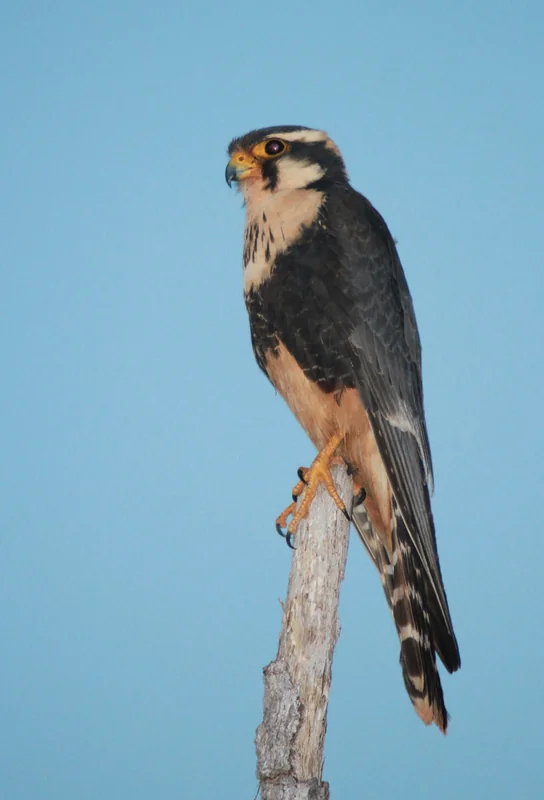 Featured photoaplomado-falcon.jpg
Falco femoralis, the aplomado falcon, is a medium-sized falcon of the family Falconidae, found across open grasslands, savannas, and deserts from the southwestern United States through Central and South America to Tierra del Fuego. Adults are 35 to 45 cm long with a wingspan of 78 to 102 cm and weigh 208 to 400 g. The species is notable for cooperative pair-hunting — mated pairs pursue prey together in coordinated aerial chases. The IUCN lists the species as Least Concern.
Quick facts
- Habitat
- Open and semi-open habitats — grassland, savanna, cerrado, pampas, desert scrub, and open farmland from sea level to 4,000 m. Strongly associated with tall grass or scattered scrub that provides perches. Avoids dense woodland.
- Range
- From the southwestern United States (extreme southern Texas, New Mexico, Arizona) through Mexico, Central America, and South America to Tierra del Fuego. Northern populations have declined severely and are the subject of active reintroduction in Texas.
- Size
- 35–45 cm body · 78–102 cm wingspan · 208–400 g
- Plumage
- Adults are elegantly patterned: dark grey-black upperparts and head, with a bold white supercilium and cheek patch separated by a dark eye-stripe; pale buff to white upper breast; a narrow black belly band; and rich rufous to buffy-orange lower belly and flanks. The tail is black with narrow white bars. The slender, long-tailed silhouette is distinctive in flight.
- Song
- A rapid, nasal 'kik-kik-kik' and a higher-pitched series of chattering notes — similar to other falcons but more musical. Pairs call to each other frequently during coordinated hunts.
- Migration
- Partially migratory. Some northern and southern populations undertake seasonal movements. Central American and Amazonian populations are largely sedentary.
- Conservation
- Least Concern (LC)
Overview
Falco femoralis is placed within the falcon family Falconidae and is most closely related to the bat falcon (F. rufigularis) and orange-breasted falcon (F. deiroleucus). The English name 'aplomado' derives from the Spanish word for 'lead-coloured' — a reference to the grey upperparts. Three subspecies are recognised, differing in size and the intensity of the rufous underparts. The northernmost subspecies (F. f. septentrionalis) of the US-Mexico border region was extirpated from the United States by the mid-20th century and is now the subject of active reintroduction programmes in southern Texas.
Cooperative pair-hunting
Aplomado falcons are one of the few falcon species known to hunt cooperatively in mated pairs. The pair perches on tall grass stems, bushes, or wire fences to scan for prey — typically small birds — and then coordinates an aerial pursuit. One bird flushes prey from tall grass by low direct flight, while the other individual waits airborne to intercept the escaping bird. The roles can alternate between male and female. This cooperative strategy significantly increases capture rates compared to solo hunting. Pairs may also drive prey toward each other in an aerial pincer movement.
Reintroduction in the United States
The aplomado falcon was once breeding in open grasslands of New Mexico, Arizona, and southern Texas but was extirpated from the United States by the 1950s due to a combination of grassland degradation, prey loss (through insecticide use reducing large insects), and possibly direct persecution. A reintroduction programme in southern Texas and New Mexico began in 1985, with captive-bred birds from The Peregrine Fund released at historic sites. The population is now partially self-sustaining in southern Texas. The reintroduction is considered one of the more successful raptor recovery programmes in North America.
Sources & further reading (2)
- iucn-red-list — accessed 2026-05-07
- encyclopedia — accessed 2026-05-07
Frequently asked questions
How do aplomado falcons hunt as a pair?
Mated aplomado pairs coordinate aerial pursuits of small birds and large insects. One bird flies low over tall grass to flush hidden birds, while the other circles above to intercept escaping prey in the air. The roles alternate between partners. The strategy is significantly more effective than solo hunting — pair-hunting capture rates exceed those of single birds across multiple study areas in South America and reintroduced Texas populations.
Why is the aplomado falcon being reintroduced to the United States?
The aplomado falcon was extirpated from the United States by the 1950s due to grassland degradation, reduction of large invertebrate prey from insecticide use, and possibly direct persecution. Reintroduction began in 1985 in southern Texas using captive-bred birds from The Peregrine Fund. The programme has achieved partial self-sustainability in Texas, with birds now nesting independently at release sites, and is considered a conservation success for open-grassland raptor recovery.
What does 'aplomado' mean?
The English name 'aplomado' is borrowed directly from Spanish, where it means 'lead-coloured' (from 'plomo', lead). It refers to the dark grey upperparts of the adult bird, which have the colour of weathered lead or pewter. The species was described by early naturalists in Spanish-speaking parts of its range, and the Spanish name was adopted into English.