Calypte anna
Anna's Hummingbird (Calypte anna)
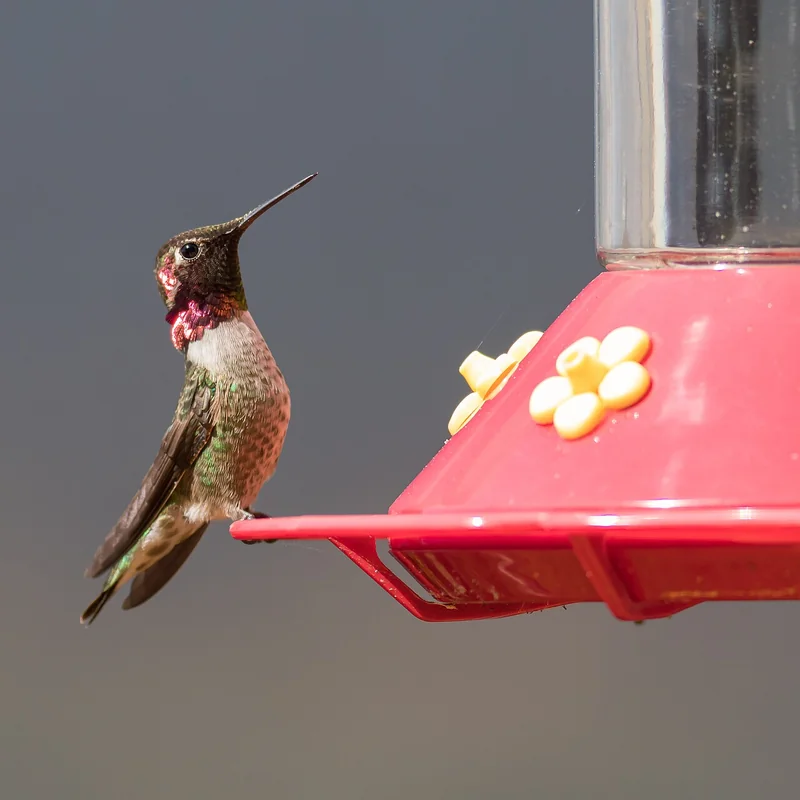 Featured photoannas-hummingbird.jpg
Calypte anna, Anna's hummingbird, is a small hummingbird of the family Trochilidae, distributed along the Pacific coast of North America. Adults are 9 to 11 cm long with a wingspan of 12 cm and weigh 3 to 6 g. Adult males show a brilliant iridescent rose-magenta head and throat (gorget); females are duller green-grey above with a small pink throat patch. The IUCN lists the species as Least Concern. The species is unusual among hummingbirds in being largely resident year-round across most of its range.
Quick facts
- Habitat
- Coastal scrub, gardens, parks, and chaparral along the Pacific coast of North America. The species adapts readily to suburban gardens with hummingbird-pollinated flowers and ornamental nectar feeders.
- Range
- Pacific coast of North America from southern British Columbia south through Washington, Oregon, California, and into Baja California (Mexico). The species' range has expanded substantially north over the twentieth century, possibly tracking ornamental garden plantings and warmer winters.
- Size
- 9–11 cm body · 12 cm wingspan · 3–6 g
- Plumage
- Adult males show a brilliant iridescent rose-magenta head, gorget, and crown — the colour intensity is so saturated that the head can appear nearly black from the wrong angle. The body is iridescent green above and pale grey below. Adult females are duller green-grey above with a small pink central throat patch. The structural rose-magenta colour appears different shades depending on viewing angle.
- Song
- Males give a complex squeaky chittering song delivered from a high perch — unusual among hummingbirds, most of which sing minimally. The species also produces a high-pitched whistle during the male's display dive, generated by air rushing through the spread tail feathers.
- Migration
- Largely resident year-round. Some altitudinal movements between summer and winter habitat occur, but no long-distance migration like most other North American hummingbirds.
- Conservation
- Least Concern (LC)
Overview
Calypte anna is one of two Calypte hummingbird species (with Costa's hummingbird C. costae of the desert Southwest). The species was named after Anna Masséna, Duchess of Rivoli, by the French naturalist René Lesson in 1829. Anna's hummingbird is the only North American hummingbird that is largely resident year-round; most other species (ruby-throated, rufous, calliope) are long-distance migrants.
Range expansion
Anna's hummingbird's range has expanded substantially north over the twentieth century. The species was historically restricted to coastal California and Baja California; modern range now includes southern British Columbia and parts of Washington and Oregon. The expansion likely tracks the spread of ornamental garden plantings (winter-flowering eucalyptus, ornamental sage) and the widespread availability of backyard hummingbird feeders, both of which provide year-round nectar in formerly marginal winter habitat.
Display dive and tail-whistle
Male Anna's hummingbirds perform a spectacular courtship display dive. The bird ascends 20-40 metres straight up, then dives steeply at speeds reaching 90 km/h before pulling out near the female. At the bottom of the dive, the male spreads his tail feathers and the rushing air generates a sharp high-pitched whistle that has been measured at amplitudes up to 80 dB. The tail-whistle is one of the loudest sounds produced by any bird relative to body size and is unique to males in display.
Sources & further reading (2)
- iucn-red-list — accessed 2026-04-30
- encyclopedia — accessed 2026-04-30
Frequently asked questions
Why is the species named 'Anna'?
The species was named after Anna Masséna, Duchess of Rivoli (1802-1887), by the French naturalist René Lesson in 1829. Lesson visited the Massénas' personal natural-history collection in France and named the new hummingbird species after the duchess in recognition of her patronage of natural-history work. Several other species (Anna's pheasant, Anna's eighteen) bear the same name.
How does the male's tail produce a whistle?
During the male's courtship dive, the bird spreads his outer tail feathers at the bottom of the dive — at speeds reaching 90 km/h. The rushing air vibrates the modified outer tail feather edges, generating a sharp high-pitched whistle at amplitudes up to 80 dB. The whistle is produced mechanically rather than vocally, making it one of the few non-vocal courtship sounds among songbirds. The same mechanism appears in several other hummingbird species but the Anna's whistle is one of the loudest.
Why is Anna's hummingbird the only resident North American hummingbird?
Most North American hummingbirds (ruby-throated, rufous, calliope) are long-distance migrants that move to Central America for winter when northern flowers are absent. Anna's hummingbird is the only species largely resident year-round across most of its range. The species' Pacific-coast range has milder winters than most North American habitats, and the spread of ornamental garden plantings and backyard hummingbird feeders provides year-round nectar even in formerly marginal winter habitat.