Pelecanus erythrorhynchos
American White Pelican (Pelecanus erythrorhynchos)
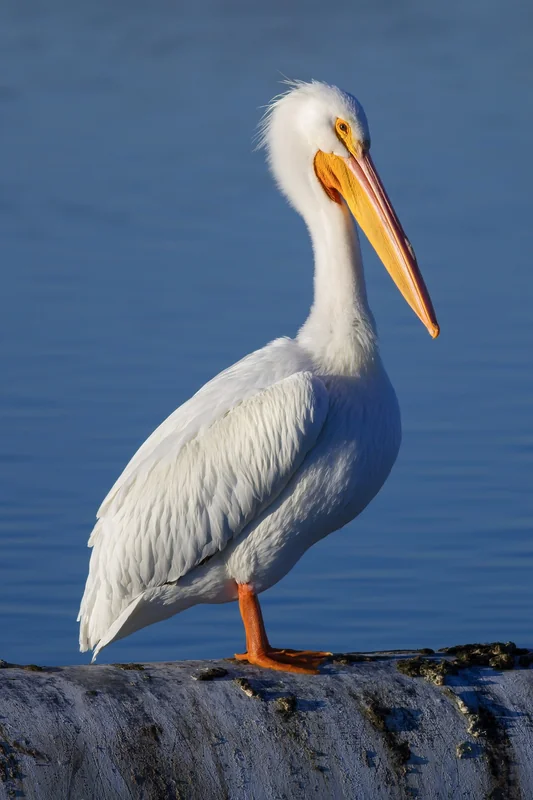 Featured photoamerican-white-pelican.jpg
Pelecanus erythrorhynchos, the American white pelican, is one of the largest birds in North America. Adults are 1.27 to 1.65 m long with a wingspan of 2.4 to 2.9 m and weigh 5 to 9 kg. The plumage is pure white with black flight feathers visible from below and a long yellow-orange bill. The IUCN lists the species as Least Concern. American white pelicans cooperatively herd fish into shallow water before scooping them up — a coordinated foraging strategy unusual among birds.
Quick facts
- Habitat
- Large inland lakes and shallow wetlands during the breeding season; coastal estuaries, bays, and large rivers during winter. The species nests on isolated islands free of mammalian predators.
- Range
- Breeds across the inland west and northern Plains of the United States and southern Canada. Winters along the Gulf and Pacific coasts of the United States south through Mexico and Central America to Costa Rica.
- Size
- 127–165 cm body · 240–290 cm wingspan · 5–9 kg
- Plumage
- Adults in non-breeding plumage are pure white with black primary and secondary feathers visible from below in flight. The bill and legs are yellow-orange. Breeding adults grow a distinctive flat horn-like protuberance on the upper mandible, used in display, and the soft parts brighten to deep orange. Juveniles are pale brownish-grey with darker wings and acquire adult plumage over three to four years.
- Song
- Adults are mostly silent. At breeding colonies, low grunts and hisses are exchanged near the nest. The species lacks the elaborate vocalizations of most other large waterbirds.
- Migration
- Long-distance migrant. Breeding populations on prairie lakes move south to the Gulf and Pacific coasts and into Mexico for winter. Migration flocks soar in coordinated formations on thermals, sometimes covering substantial distances without flapping.
- Conservation
- Least Concern (LC)
Overview
Pelecanus erythrorhynchos is one of eight Pelecanus pelican species worldwide. The species is one of the largest North American birds — wingspans approaching three metres are routine. The Latin epithet erythrorhynchos means 'red-billed', although the bill is more accurately yellow-orange than red.
Distribution
The breeding range is concentrated on isolated islands in large prairie lakes across the inland western United States and southern Canada — North Dakota, Minnesota, Manitoba, Saskatchewan, and Alberta hold most of the world population. Wintering grounds extend along the Gulf Coast, the Pacific coast of Mexico, and into Central America. The migration is one of the most spectacular in North America, with V-formation flocks of hundreds soaring on thermals at high altitudes.
Cooperative foraging
American white pelicans cooperatively herd fish into shallow water before scooping them up — a coordinated foraging strategy unusual among birds. Lines of pelicans form a curving wall that closes inward against the shore, beating the water with their wings to drive fish ahead. When the fish are concentrated in shallow water, all the pelicans plunge their bill pouches simultaneously and capture multiple fish each. The behaviour is one of the textbook examples of cooperative hunting in birds.
Sources & further reading (2)
- iucn-red-list — accessed 2026-04-30
- encyclopedia — accessed 2026-04-30
Frequently asked questions
Why do American white pelicans hunt in groups?
Cooperative herding lets a flock of pelicans concentrate fish into shallow water where each bird can capture multiple prey items at once. Solo pelicans can also forage by surface plunging, but the technique is far less efficient at catching schooling fish. The cooperative behaviour requires synchronization — pelicans flank the school in a curving line, close it against the shore, and beat the water in unison — and is one of the textbook examples of coordinated foraging in birds.
Why does the bill have a horn during breeding?
Both sexes grow a flat horn-like keratinous protuberance on the upper mandible during the breeding season. The structure is bony in appearance but is actually composed of compressed keratin — the same material as a fingernail. The horn is used in courtship and pair-recognition displays and is shed after the eggs hatch. The trait is unique to this species among the world's pelicans.
How can such a large bird soar so well?
American white pelicans have one of the highest wing-loading-to-body-mass ratios for sustained soaring among birds. The 2.4-2.9 metre wingspan provides large lift area relative to the 5-9 kg body mass, and the species rides thermal updrafts efficiently — migration flocks are routinely observed soaring at altitudes over a kilometre, covering substantial distances without flapping. The technique is similar to that of the largest stork and crane species.