Triple Distillation
Three sequential pot still distillations — traditional for Irish whiskey and Lowland Scotch; produces a smoother, lighter spirit.
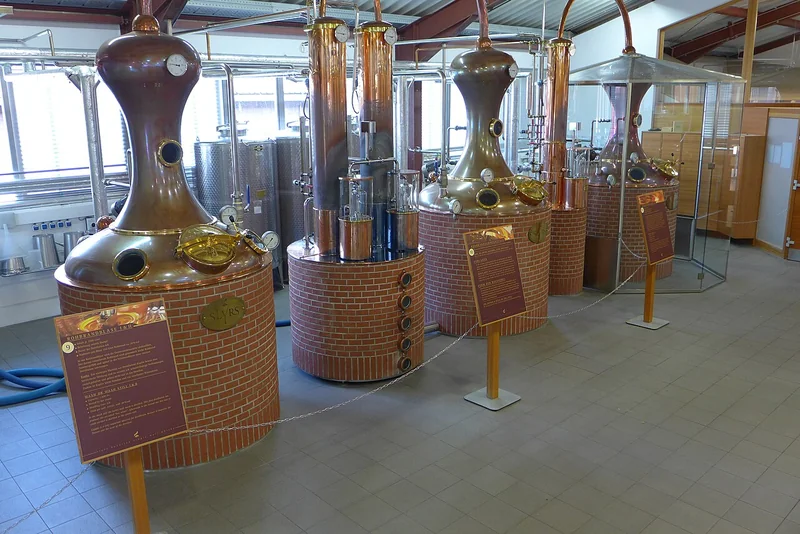
Triple distillation is the practice of passing the spirit through three sequential pot stills rather than the two typical of Scotch single malt. The first (wash still) takes fermented wash to low wines; the second (intermediate or feints still) concentrates further; the third (spirit still) makes the final cut to new make. Each additional distillation removes heavier congeners and produces a smoother, lighter, higher-proof spirit. Triple distillation is historically characteristic of Irish whiskey (Bushmills, Midleton's Jameson and Powers, Tullamore D.E.W.) and of some Lowland Scotch (Auchentoshan triples every product). The tradeoff is loss of body and character against gain in smoothness and refinement.
Quick facts
- Type
- Technique
Three Stills, Three Cuts
Triple distillation typically uses three pot stills in sequence. The wash still produces low wines at ~22% ABV from 8% ABV wash. The intermediate (feints) still concentrates to ~50–60% ABV. The spirit still makes a heart cut at 78–82% ABV — significantly higher than the 70% typical of double distillation. The third pass removes additional heavier congeners (longer-chain alcohols, esters, sulphur compounds) and produces a lighter, smoother spirit.
Sources & further reading (1)
- encyclopedia — accessed 2026-05-15
Frequently asked questions
Is triple-distilled whisky better than double-distilled?
Neither approach is inherently better — they produce different styles. Triple distillation yields a smoother, lighter, less complex spirit; double distillation retains more body and character. The choice is stylistic. Irish whiskey traditionally triple distils; Scotch single malt traditionally double distils.