Glencairn Glass
A tulip-shaped tasting glass developed by Glencairn Crystal in 2001 — the de-facto industry standard for whisky nosing.
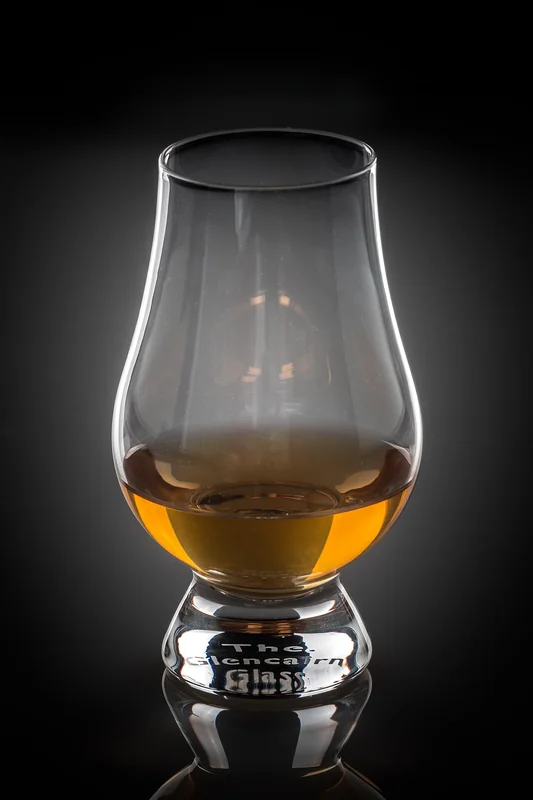
The Glencairn glass is a tulip-shaped whisky tasting glass developed by Glencairn Crystal Ltd of East Kilbride, Scotland, and introduced in 2001. The shape — a wide bowl tapering to a narrower opening, on a short stem — concentrates aromatic vapours at the rim while permitting easy nosing. The glass was developed in consultation with master blenders from five major Scotch distilleries and won a Queen's Award for Innovation in 2006. It has become the de-facto industry standard for whisky tastings, replacing the traditional copita-style sherry glass used by professional blenders for over a century. The Glencairn holds approximately 175 ml when full, though tasting pours are typically 25–35 ml.
Quick facts
- Type
- Glassware
- Era
- 2001–present
Design and Function
The Glencairn's wide bowl maximises evaporative surface area, releasing aromatic compounds. The tapered neck concentrates volatile aromas at the rim for nosing. The short stem keeps the drinker's hand below the bowl, minimising temperature transfer to the spirit. The flat, stable base resists tipping. The shape is widely considered an evolution of the traditional copita sherry-tasting glass used by professional Scotch blenders since the 19th century.
Sources & further reading (1)
- encyclopedia — accessed 2026-05-15
Frequently asked questions
When was the Glencairn glass introduced?
The Glencairn glass was developed by Glencairn Crystal Ltd of East Kilbride, Scotland, in consultation with master blenders from five major Scotch distilleries, and introduced commercially in 2001. It won a Queen's Award for Innovation in 2006.