Column (Continuous) Still
Continuous distillation in a column still — patented by Aeneas Coffey in 1830; the basis of grain whisky, bourbon, and most spirits.
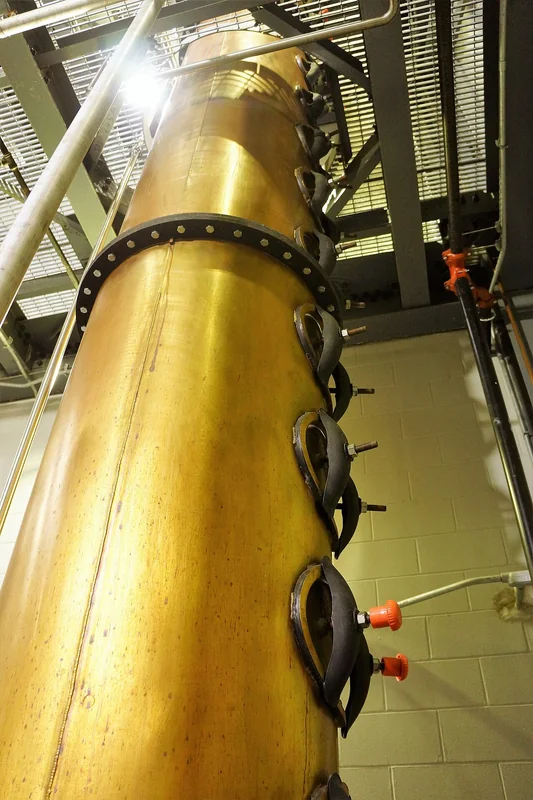
The column still (also called continuous still, Coffey still, or patent still) is a continuous-operation distillation column patented by Irish exciseman Aeneas Coffey in 1830. The column permits high-volume, energy-efficient distillation by countercurrent contact of rising vapour with descending wash on a series of perforated plates. Column stills can produce spirit at much higher proof (up to 95% ABV) and much higher volume than pot stills, making them the foundation of grain whisky production, bourbon (which traditionally uses a column still 'beer still' followed by a doubler or thumper), neutral grain spirit, vodka, gin base, and most industrial spirit production.
Quick facts
- Type
- Technique
Coffey's 1830 Patent
Aeneas Coffey, a former Irish exciseman, patented his column still design in 1830 after earlier prototypes by Robert Stein and others. The design uses two columns — an analyser and a rectifier — with perforated plates and countercurrent flow. Wash descends one column while steam rises, producing concentrated alcohol vapour at the top. The Coffey still made continuous, large-scale grain distillation commercially viable and underpinned the 19th-century rise of blended Scotch.
Column Stills in Bourbon
American bourbon production typically uses a column still ('beer still') as the primary distillation, followed by a copper pot still (a 'doubler' or 'thumper') for secondary distillation. The column produces a relatively high-proof base spirit; the pot still secondary doubles back to add character and remove additional congeners. The combined process retains the efficiency of column stills with some of the character of pot stills.
Sources & further reading (1)
- encyclopedia — accessed 2026-05-15
Frequently asked questions
Why was Coffey's still rejected in Ireland?
Aeneas Coffey patented the still in 1830 in Ireland but the Irish distillers rejected the design, considering pot-still whisky superior. Scottish distillers adopted the Coffey still for grain whisky production, enabling the rise of blended Scotch and the consequent loss of Irish whiskey's 19th-century market dominance.
Can a column still produce malt whisky?
Column stills can produce malt-grain spirit, but Scotch single malt regulations require production in pot stills. Some experimental Scotch grain whiskies have included malted barley column distillations. Most malt whisky worldwide continues to use pot still production.