World Time Complication
A single-operation display showing all 24 standard time zones simultaneously via a rotating city disc and 24-hour ring.
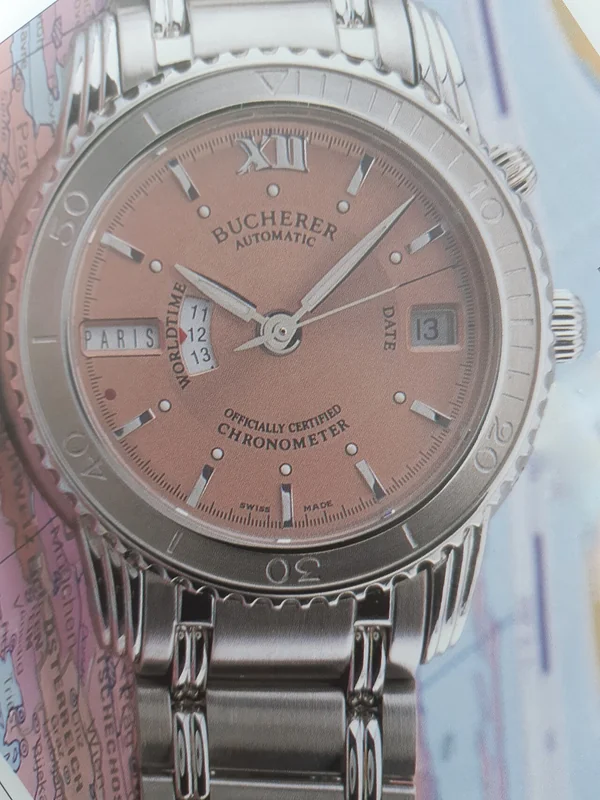
A world time complication displays all 24 standard time zones simultaneously, typically using a rotating disc printed with city names representing each time zone arranged in order of their UTC offset, combined with a 24-hour ring. Setting the watch to a new destination requires only one operation — rotating the disc to position the home city at the 12 o'clock (noon) reference — after which all 24 cities show the correct local time. Geneva watchmaker Louis Cottier developed the first practical world time pocket watch mechanism in the 1930s, which was adopted by Vacheron Constantin and Patek Philippe. The Patek Philippe reference 2523 (c. 1953) and its successors established the visual template for world time wristwatches that persists today.
Quick facts
- Type
- Complication
- Complication
- world-time
- Era
- 1930s (Cottier development) / 1939 (Patek Philippe ref. 1415)
- Origin
- Switzerland (Geneva)
The Cottier Mechanism
Louis Cottier (1894–1966), a Geneva watchmaker who specialised in complex watches and produced movements for Patek Philippe, Vacheron Constantin, and LeCoultre, developed the world time mechanism in approximately 1931–1935. The Cottier system uses two rotating discs: an outer disc with 24 city names (one per time zone), arranged in order of UTC offset; and an inner disc with 24 equal segments marked 1–24 or with AM/PM divisions. The city disc rotates in relation to a fixed 24-hour ring on the dial. When the city disc is set with the desired home city at the 12 o'clock position (aligned with the 'noon' marker), all other cities automatically show their correct current local time by reading their position against the fixed 24-hour ring.
Patek Philippe World Time References
Patek Philippe produced several world time references based on Cottier mechanisms, beginning with the reference 1415 HU (1939) — the letters 'HU' stood for 'Henry Graves,' the New York banker who commissioned it. The reference 1415 and its successor reference 2523 established the aesthetic template: cloisonne enamel world map dial, city disc at the perimeter, 24-hour ring inside the city disc. Contemporary Patek Philippe world time references 5110, 5130, and 5230 maintain this format with modern manufacture calibres. The 5930G adds a GMT chronograph function to the world time display, combining Cottier-style 24-zone display with a flyback chronograph.
Vacheron Constantin World Time
Vacheron Constantin collaborated with Louis Cottier extensively from the mid-1930s. The Vacheron Constantin reference 4862 (1940s) used the Cottier mechanism and featured a design with city names in a subsidiary ring at the periphery of the dial. Contemporary Vacheron Constantin world time pieces include the Harmony World Time (reference 7700V), which uses a vertical city disc reading against a curved 24-hour display, and the Traditionnelle World Time Minute Repeater — combining world time and acoustic time-striking. Jaeger-LeCoultre, Blancpain, and Breguet have also produced world time variants.
Time Zone Limitations
Standard world time complications divide the world into 24 equal 15-degree longitude zones. In reality, political and geographic factors have resulted in more than 40 distinct UTC offsets, including half-hour offsets (India UTC+5:30, Iran UTC+3:30, Nepal UTC+5:45) and quarter-hour offsets (Chatham Islands UTC+12:45). Standard 24-city world time mechanisms cannot represent these fractional zones. Some manufacturers address this by including additional half-zone settings or by selecting a representative city for the closest standard offset. GPS-synchronised electronic world time displays in Seiko Astron and Casio GPW watch lines handle the full modern time zone complexity digitally.
Sources & further reading (3)
- encyclopedia — accessed 2026-05-07
- encyclopedia — accessed 2026-05-07
- watch-reference — accessed 2026-05-07
Frequently asked questions
How do you use a world time complication to find the current time in Tokyo?
The city disc and 24-hour ring work together. Locate 'Tokyo' on the outer city disc. Read the time shown on the 24-hour ring at the same position as 'Tokyo.' If your home city is currently positioned at the 12 o'clock (noon) marker and it is 9:00 AM in your home time zone, the 24-hour ring position under Tokyo will show the correct Tokyo time — for example, if your home city is New York (UTC-5) and Tokyo is UTC+9, Tokyo will appear at a 14-hour offset from New York on the ring.
How often does a world time complication need to be adjusted?
A world time display needs adjustment only when the wearer's home city changes. While travelling, the traveller rotates the outer city disc to position the new home city at the 12 o'clock reference. The 24-hour ring and city disc positions update all remaining zones automatically. Unlike a simple date, no adjustments are needed for time zone changes once the city disc is set correctly — the display is self-consistent.
Who was Louis Cottier?
Louis Cottier (1894–1966) was a Geneva-based watchmaker who specialised in adding complex mechanisms (including world time, equation of time, and astronomical complications) to existing pocket watch and wristwatch movements for established houses including Patek Philippe and Vacheron Constantin. He did not produce watches under his own name for retail sale; his contribution was designing and supplying the world time mechanism modules that the major manufacturers incorporated into their references. His world time design became the standard template for mechanical world time wristwatches.