Vacheron Constantin Patrimony
A minimalist dress watch reduced to pure geometry — Vacheron Constantin's heritage in a 40 mm circle.
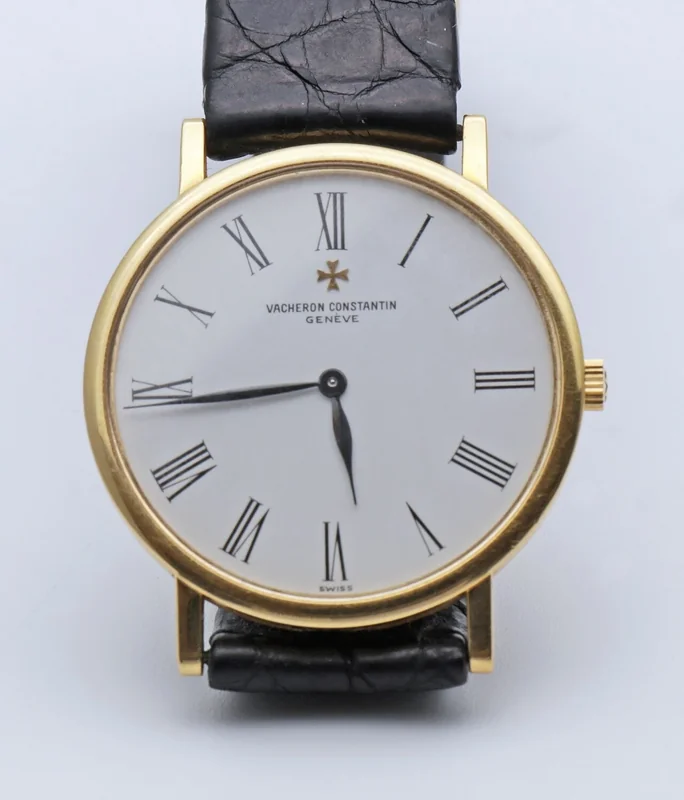
The Vacheron Constantin Patrimony is a minimalist round dress watch introduced in 2004 as part of a collection restructuring that grouped the manufacture's classical references under the 'Patrimony' name. The watch is defined by radical simplicity: a thin round case (typically 40 mm, 6.1–8.09 mm thick depending on calibre), a flat polished bezel with no externally visible screws, a dial with applied hour markers at twelve positions and no subsidiary dials, and a leaf-shaped 'feuille' hand set. The Patrimony is the primary vehicle for Vacheron Constantin's ultra-thin movement development — including the calibre 1400 (automatic, 2.25 mm movement height, launched 2011) and the calibre 4400 AS (manual-wind). It represents the manufacture's 'reduction to essence' design philosophy in contrast to its more elaborate complications.
Quick facts
- Type
- Iconic Watch
- Era
- 2004-present (Patrimony name); 1755-present (Vacheron Constantin)
- Origin
- Switzerland (Geneva)
Patrimony and Geneva's Design Vocabulary
The Patrimony name was established in 2004 to consolidate Vacheron Constantin's classical round dress references under a single collection identity. Geneva's horological tradition favours round cases, thin movements, and restrained decoration — elements that distinguish the Geneva manufactures from the sportier outputs of the Vallée de Joux. The Patrimony embodies the Geneva aesthetic in its most resolved form: the Maltese cross (Vacheron Constantin's emblem, present in the caseback engraving and crown) is the only decorative element, everything else is geometry and surface quality. The feuille (leaf) hands — tapered and double-faceted, reflecting light differently at each curvature — are a Geneva hand shape with centuries of precedent.
Ultra-Thin Movement Programme
The Patrimony's design requirement — thin case, clean profile — drives Vacheron Constantin's investment in ultra-thin calibre development. The calibre 1400, introduced in 2011 in the Patrimony Contemporaine, has a movement height of 2.25 mm making it among the thinnest automatic manufacture movements in production. The baseplate and bridges are finished to Côtes de Genève (Geneva stripes) and anglage standards appropriate for fine watchmaking. The calibre 4400 AS, a manual-wind movement in the thinner Patrimony references, achieves a total watch thickness under 7 mm. Ultra-thin calibres require extremely tight tolerances in component manufacture — bearing surfaces, gear trains, and escapement geometry must be maintained within tighter limits as the z-dimension is compressed.
Hallmark of Geneva
Vacheron Constantin movements eligible for the Hallmark of Geneva (Poinçon de Genève) — a cantonal quality certification awarded since 1886 — carry the Geneva cross stamp on movement components. The Hallmark requires movements to be manufactured and cased in the Canton of Geneva, and certifies 12 specific criteria covering finishing, decoration, and technical standards. The Patrimony calibre 1400 and calibre 4400 are Hallmark-certified. The Poinçon de Genève is distinct from the COSC chronometer certification and more comprehensive in its finishing requirements — it covers bridge anglage, screw finish, jewel quality, and oil quantity in addition to accuracy.
Patrimony Contemporaine versus Traditionnelle
The Patrimony collection includes two main lines: Patrimony Contemporaine (round, polished bezel, Arabic or index markers) and Patrimony Traditionnelle (Roman numeral chapter ring, slightly more traditional layout). The Traditionnelle also encompasses higher complications — including the Traditionnelle 14-Day Tourbillon, the Traditionnelle Split Seconds Chronograph, and the Traditionnelle Perpetual Calendar. The Contemporaine line (subsequently renamed simply 'Patrimony') focuses on the three-hand and small complications format, preserving the minimalist design ethos. Dial materials in the Patrimony range include white grand feu enamel, slate grey, and in special editions, stone-set dials. Production is limited relative to volume manufactures — Vacheron Constantin produces approximately 20,000 watches per year across all collections.
Sources & further reading (3)
- encyclopedia — accessed 2026-05-07
- encyclopedia — accessed 2026-05-07
- watch-reference — accessed 2026-05-07
Frequently asked questions
What is Vacheron Constantin's founding date?
Vacheron Constantin was founded in Geneva in 1755 by Jean-Marc Vacheron, making it the world's oldest watch manufacturer in continuous production. The manufacture has operated without interruption since 1755 — through the French Revolution, the Napoleonic period, two world wars, and the quartz crisis. This unbroken continuity distinguishes it from manufactures that were dissolved and reconstituted. The company joined the Richemont group in 1996.
Is the Patrimony available in steel?
The Patrimony is primarily produced in gold (yellow, white, and pink/rose gold) and platinum. Steel references are occasionally available in limited series or as part of special offerings but are not standard in the core Patrimony collection. Vacheron Constantin positions the Patrimony as a fine jewellery and high watchmaking product, and the choice of precious metal case is consistent with this positioning.
What does the Maltese cross symbol represent for Vacheron Constantin?
The Maltese cross has been used as Vacheron Constantin's emblem since 1880, adopted as a reference to the cross-shaped wheel — a key component of the click-spring mechanism in early movements — which the manufacture used extensively in the 19th century. The cross appears in the caseback engraving of fine references and in the crown design. It is distinct from its use by the Knights of Malta and is a horological reference rather than a heraldic one.