Vacheron Constantin
Founded 1755 in Geneva, Vacheron Constantin is the world's oldest watch manufacture in continuous operation.
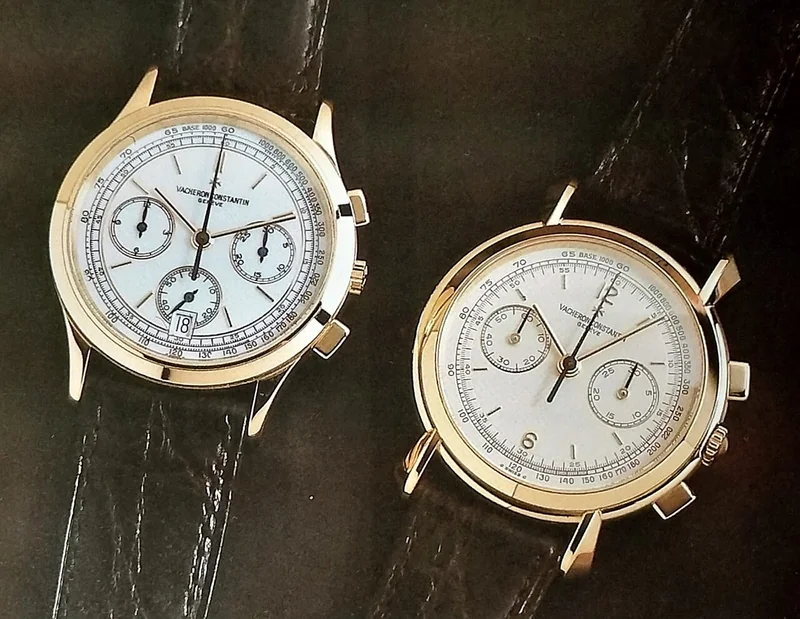
Vacheron Constantin is a Swiss watch manufacture founded in Geneva in 1755 by Jean-Marc Vacheron, making it the oldest watch manufacturer in continuous operation in the world. The manufacture has produced watches without interruption since its founding through the French Revolution, the Napoleonic occupation of Geneva, two world wars, and the quartz crisis of the 1970s. Vacheron Constantin became part of the Richemont group in 1996. The manufacture produces approximately 20,000 watches per year, focusing on high complication, grand complication, and classical dress watch references. Movements are produced entirely in-house at the manufacture's Le Sentier facility in the Vallée de Joux and in Geneva. The Maltese cross has been the manufacture's emblem since 1880, appearing in the caseback engraving of fine references.
Quick facts
- Type
- Brand History
- Era
- 1755-present
- Origin
- Switzerland (Geneva / Le Sentier, Vallée de Joux)
Jean-Marc Vacheron and Continuous Operation
Jean-Marc Vacheron established his watchmaking workshop in Geneva in 1755, producing pocket watches using Geneva's established craft networks. The manufacture passed through the hands of the Vacheron family and then through a series of business partnerships — Abraham Vacheron (son), Louis-Benjamin François Vacheron (grandson) — before César Vacheron brought in François Constantin as a commercial partner in 1819. The Vacheron & Constantin partnership formalised the two-name brand. The name Vacheron Constantin has been in use since 1875. The claim of 'continuous operation since 1755' is substantiated by Geneva cantonal records and watchmaking archives — the manufacture did not close, dissolve, or cease production at any point in its history, a claim few manufactures can make.
The Hallmark of Geneva
Vacheron Constantin movements eligible for the Poinçon de Genève (Hallmark of Geneva) carry the cantonal certification mark. The Hallmark, administered by the Canton of Geneva since 1886, certifies 12 criteria covering movement decoration (Côtes de Genève stripes, anglage on beveled edges, polished screw heads), component quality (jewels, mainspring specifications), and performance. The Hallmark requires that the movement be both manufactured and cased in Geneva — it is a geographic and quality certification combined. Vacheron Constantin maintains facilities in both Geneva (rue des Moulins) and Le Sentier (Vallée de Joux), with movement production in Le Sentier and casing/finishing in Geneva, meeting the Hallmark's geographic requirements.
The 57260: A Modern Record
In 2015, Vacheron Constantin completed the 57260 pocket watch, a special commission requiring eight years of development. The piece contains 57 complications — surpassing the prior record held by Patek Philippe's Calibre 89 (33 complications) — implemented in a piece composed of 2,826 components. Complications include: a secular perpetual calendar (accounting for the century-year leap year exception), a Hebrew calendar, an astronomical star chart, an equation of time display, a chiming train (Westminster and Lullaby chimes), and a double retrograde split-seconds chronograph. The commission was private; Vacheron Constantin subsequently exhibited the piece at the SIHH (now Watches and Wonders) Geneva fair. The 57260 represents the current state-of-the-art in watchmaking complication density.
Collection Architecture
Vacheron Constantin organises its production around four collections: Patrimony (thin round classical watches, minimal decoration), Historiques (recreations of historical references from the manufacture's archive, including the triple calendar 1942 and the American 1921 barrel-shaped design), Overseas (sports watch with an integrated steel bracelet, competing in the luxury sport segment), and Traditionnelle (traditional round watches housing grand complications including tourbillon, perpetual calendar, minute repeater). The Métiers d'Art collection occupies a fifth position — watches with highly decorated dials using craft techniques including marquetry, cloisonné enamel, wood inlay, and hand-engraving. Volume production is concentrated in Patrimony and Overseas; grand complication references are produced in very small numbers.
Sources & further reading (3)
- encyclopedia — accessed 2026-05-07
- encyclopedia — accessed 2026-05-07
- watch-reference — accessed 2026-05-07
Frequently asked questions
Is Vacheron Constantin more prestigious than Patek Philippe?
Both manufactures are in the top tier of Swiss watchmaking — sometimes grouped as part of an informal 'Holy Trinity' of prestige watchmaking alongside Audemars Piguet. Vacheron Constantin's claim is founded on continuous operation since 1755 (the oldest manufacture) and Grand Complications of very high technical standard. Patek Philippe's claim rests on consistently high auction results, the Calibre 89 (then-most complicated portable timepiece), and private family ownership. These are not directly comparable — they are different manufactures with different production philosophies, collector bases, and strengths.
What is the Vacheron Constantin American 1921?
The American 1921 (Historiques American 1921, reference 82035/000R-B621) is a recreation of a 1921 Vacheron Constantin pocket watch movement fitted in a distinctive tilted-dial barrel-shaped case, originally designed for American clients who wore their watches in a specific orientation — the case was rotated 45 degrees so the dial faces the wearer's thumb side. The tilted case positions the 6 o'clock mark of the dial near the watch's crown. The Historiques recreation uses a hand-wound calibre and a case in rose gold or platinum. It is among the most distinctive and immediately recognisable Vacheron Constantin references due to its non-standard case geometry.
What is the difference between Vacheron Constantin Overseas and Nautilus?
The Vacheron Constantin Overseas and Patek Philippe Nautilus are competitors in the luxury sport watch segment — both are round sport watches with integrated bracelets, polished-and-brushed finishing, and self-winding movements. The Overseas was first introduced in 1996; the Nautilus in 1976 (designer Gerald Genta). The Overseas is characterised by its round case with cross-section strap attachment visible on the bracelet; the Nautilus by its rounded octagonal bezel and horizontal embossed dial texture. Both are in steel and precious metal variants. The two watches compete at similar positioning in the luxury sport segment.