Tourbillon Complication
Breguet's 1801 rotating cage carries the escapement through 360 degrees to average out gravitational rate errors.
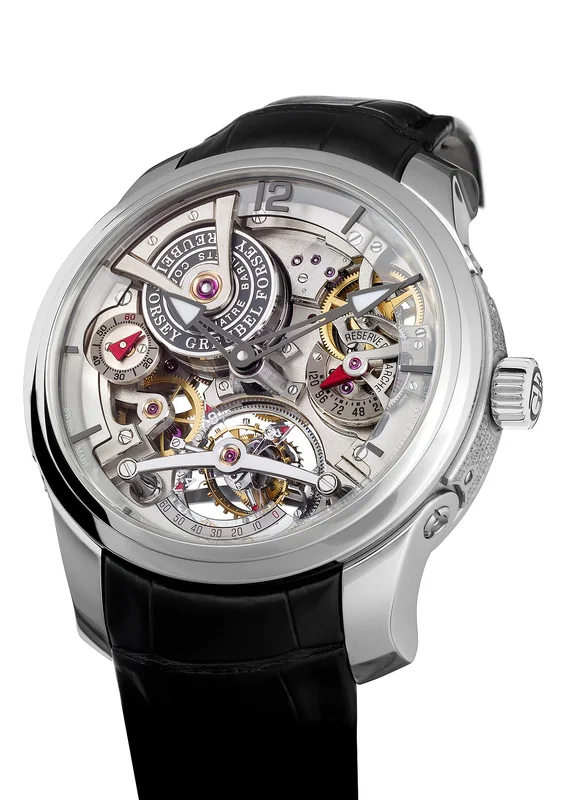
The tourbillon (French: whirlwind) is a mechanism in which the escapement — lever, escape wheel, and balance wheel — is mounted in a small rotating cage that completes one revolution typically per minute. Its purpose is to counteract the effect of gravity on the balance wheel when the watch remains in a fixed vertical position (as in a pocket watch carried upright in a waistcoat pocket). As the cage rotates, the gravitational error acts in different directions and partly averages out over one rotation. Abraham-Louis Breguet patented the tourbillon in 1801 and is credited with its invention. In modern wristwatches — which move constantly on the wrist — the theoretical rate improvement is minimal, but the tourbillon remains the most celebrated demonstration of traditional watchmaking craft.
Quick facts
- Type
- Complication
- Complication
- tourbillon
- Era
- 1801 (Breguet patent) / ongoing
- Origin
- Switzerland / France
What the Tourbillon Does
A balance wheel's rate is affected by gravity when the watch is held in a fixed vertical position: the balance wheel's centre of mass is not perfectly coincident with its pivot axis, so gravity exerts a small torque that biases the oscillation amplitude and rate. In an upright pocket watch that spends most of its day in the same position, this 'positional error' can accumulate to several seconds per day. The tourbillon places the entire escapement assembly — balance spring, balance wheel, lever, and escape wheel — in a cage that rotates (usually once per minute). As the cage turns, the gravitational torque acts in shifting directions and its effect on the mean rate is reduced. Breguet demonstrated rate improvements of approximately 4 seconds per day in his original 1801 trials.
Breguet's Patent and Early Tourbillons
Abraham-Louis Breguet filed his patent on 26 June 1801 after approximately seven years of development. The original tourbillon cage was typically driven once per minute by a separate wheel attached to the third wheel of the going train. The cage itself held the balance wheel (often 10–11 mm in diameter), balance spring, lever, and escape wheel — typically 70–90 components — all weighing under 0.3 grams in the best examples. Breguet constructed approximately 35 tourbillons during his lifetime; surviving examples are held by the Musee des Arts et Metiers (Paris) and the Patek Philippe Museum (Geneva).
Flying and Peripheral Tourbillons
A conventional tourbillon is supported by a bridge above the cage visible through the dial. A 'flying tourbillon' (invented by Alfred Helwig in 1920) eliminates the upper bridge, with the cage supported only from below — creating the illusion that the cage floats. Peripheral tourbillons (as in the Greubel Forsey architecture) position the cage at the periphery of the movement, allowing its rotation to be displayed at a larger diameter. Multi-axis tourbillons (double-axis, triple-axis) add additional rotating frames around the cage to theoretically compensate for three-dimensional positional errors, though horological engineers debate the practical gain in wristwatch use.
The Tourbillon in Modern Wristwatches
Horological physicists and watchmakers generally agree that the rate benefit of a tourbillon in a wristwatch is negligible — the wrist's constant motion already averages gravitational errors more effectively than the rotating cage. The primary value of a tourbillon in a contemporary wristwatch is as a demonstration of craft: the tiny cage components must be machined and assembled to tolerances of a few micrometres, and the mechanism's rotation is a compelling window into movement mechanics. Leading manufacturers of wristwatch tourbillons include Patek Philippe, A. Lange & Sohne, Jaeger-LeCoultre, and Breguet itself. Entry-level tourbillons from volume producers are available from the Chinese market at dramatically lower price points.
Sources & further reading (3)
- encyclopedia — accessed 2026-05-07
- encyclopedia — accessed 2026-05-07
- watch-reference — accessed 2026-05-07
Frequently asked questions
Does a tourbillon make a watch more accurate?
In a wristwatch worn on the wrist, no significant accuracy improvement is attributable to the tourbillon: the constant motion of the wrist already randomises positional errors far more effectively than a one-minute cage rotation. The mechanism was designed for pocket watches carried in a fixed vertical position. Independent tests comparing tourbillon and non-tourbillon movements of otherwise equal quality show no consistent accuracy advantage for the tourbillon in wristwatch use.
How many parts does a tourbillon cage contain?
A traditional one-minute tourbillon cage holds approximately 60 to 90 individual components, all of which rotate together once per minute. The total weight of the cage assembly is typically 0.2–0.5 grams — requiring components machined to tolerances of a few thousandths of a millimetre. Contemporary cage designs vary: ultra-light carbon composite cages in some manufacture pieces weigh less than 0.15 grams.
Who invented the tourbillon?
Abraham-Louis Breguet (1747–1823), the Paris-based watchmaker of Swiss origin, patented the tourbillon on 26 June 1801. Breguet is among the most influential figures in watchmaking history, with numerous other inventions to his credit including the Breguet overcoil balance spring and the shock jewel setting. The firm he founded in 1775 — now operating as a brand within Swatch Group — continues to produce tourbillons.