Sunburst Dial
A radially brushed dial that reflects light differently by viewing angle, shifting from bright to deep in appearance.
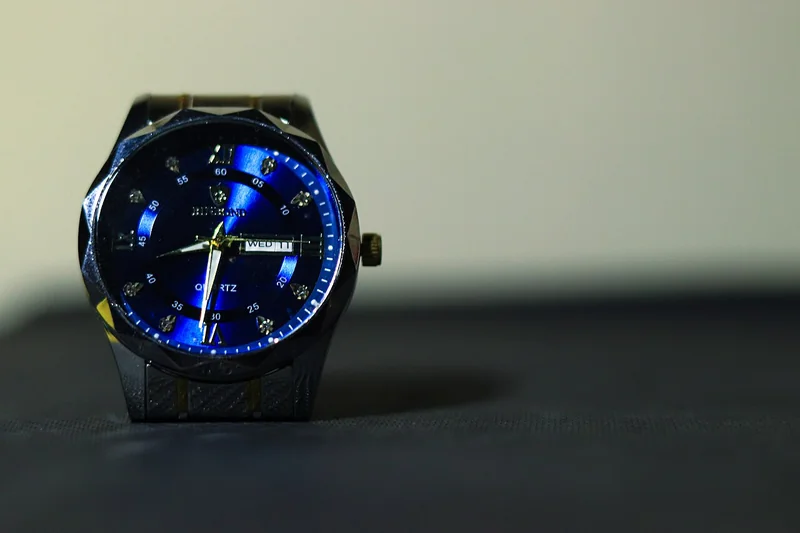
A sunburst dial (also called a sun-brushed or radially brushed dial) is a watch dial finished with fine concentric or radial brush strokes emanating from the center, creating a surface that reflects light anisotropically — the reflected intensity depends on the angle between the brushing direction and the incoming light. As the watch is moved under a light source, the dial appears to shift from a bright, almost metallic tone to a deep, saturated hue. Sunburst finishing is applied to metal (brass or copper alloy) dials that are electroplated or lacquered and then brushed, or directly to applied lacquer surfaces. Blue and black sunburst dials are particularly effective as the colour appears to intensify at steeper viewing angles.
Quick facts
- Type
- Dial Type
- Era
- 20th century-present
- Origin
- Switzerland / Japan
Surface Finishing Process
A sunburst dial begins as a flat, smooth metal blank — usually brass, sometimes copper alloy or German silver. The blank is first turned or stamped to the correct case diameter and lug shape. The surface is then brushed using a rotating abrasive tool (typically a Scotch-Brite or equivalent pad on a spindle) while the blank rotates — this creates the characteristic concentric ring pattern called 'radial brushing.' Alternatively, the blank remains fixed while the abrasive tool rotates and moves linearly, producing diagonal or straight brushing for variant effects. The brushed surface is then electroplated (silver, gold, rhodium) and/or lacquered with translucent or transparent lacquer. The lacquer layer preserves the brushed texture while providing the colour — a transparent blue lacquer over a radially brushed silver-plated surface produces the classic 'blue sunburst' effect.
Colour and Light Behaviour
The optical effect of a sunburst dial depends on the directionality of the brushed scratches. When light strikes the dial perpendicular to the brush strokes, it scatters broadly and the dial appears lighter and more saturated. When light strikes parallel to the brush strokes, it reflects more specularly and the dial appears darker or changes hue. This creates the impression of the dial 'changing colour' as the wrist moves — the phenomenon is not a colour change but a change in the luminance and perceived saturation of the reflected light. Blue sunburst dials are particularly dramatic because the lacquer layer absorbs red and green wavelengths, leaving the reflected light blue; the radial brushing then modulates how much blue light is reflected toward the viewer.
Prominent Examples
Grand Seiko is particularly celebrated for its sunburst and gradient dial techniques, including the 'forest' and 'snowflake' textured dials that use directional finishing for dramatic effects. Omega's Aqua Terra and De Ville Tresor lines prominently feature blue and silver sunburst dials. Rolex's Oyster Perpetual line is available in multiple sunburst colour options. Nomos Glashutte produces clean sunburst blue and silver dials in the Lambda and Lux series. Longines Heritage and HydroConquest series feature deep blue sunburst dials on sport references.
Sunburst vs Gradient Dials
A sunburst dial uses uniformly brushed texture across the entire surface; a gradient (also called 'fumé') dial adds a progressive darkening from the center outward (or edge to center) through differential lacquer application or electroplating thickness. Grand Seiko's Snowflake dial (reference SBGA211) uses a pressed textured surface rather than brushing to create its distinctive rough light-scattering finish. Salmon (rose-tinted) dials on dress watches — a fashion from the early 20th century — are often sunburst-finished in warm tones. The distinction between a sunburst and a plain lacquered dial is the presence or absence of the directional brushing texture beneath the lacquer.
Sources & further reading (3)
- encyclopedia — accessed 2026-05-07
- watch-reference — accessed 2026-05-07
- watch-reference — accessed 2026-05-07
Frequently asked questions
Why do some sunburst dials look different in photographs versus in person?
Photography captures a single fixed lighting angle, which shows the dial in one reflective state — either bright and light-coloured or dark and deep-toned, depending on the photographer's setup. In person, as the wrist moves, the dial continuously shifts between these states. The dynamic optical effect of a sunburst dial is therefore almost impossible to capture in a single photograph; the 'live' experience is richer than any still image. Watch photographers often shoot multiple exposures at different angles and composite them to hint at the effect.
Are sunburst dials made of metal?
Yes — in almost all cases, a sunburst dial begins as a metal blank (most commonly brass, sometimes German silver or copper alloy) that is machined to shape and then surface-finished. The brushing is applied to the metal surface; plating and lacquer are then applied. Paper, printed, and matte lacquer dials cannot produce the sunburst effect because the optical phenomenon requires the reflective, directional metal surface texture beneath the finish.
What is a 'fumé' dial?
A fumé (French: 'smoked') dial features a progressive colour gradient — typically darkening from the center outward, or from one edge to the opposite edge — applied through selective lacquering or electroplating of varying thickness. The effect resembles the look of aged dial lacquer on vintage watches where the perimeter darkened through oxidation. Contemporary fumé dials reproduce this graduated tone intentionally. Examples include the Vacheron Constantin FiftySix ref. 4600E, the A. Lange & Sohne Datograph Perpetual Tourbillon blue fumé dial, and several Breguet Classique references.