Spring Drive Movement
Seiko's hybrid: a mechanical mainspring drives a glide wheel braked electromagnetically — no battery, no tick.
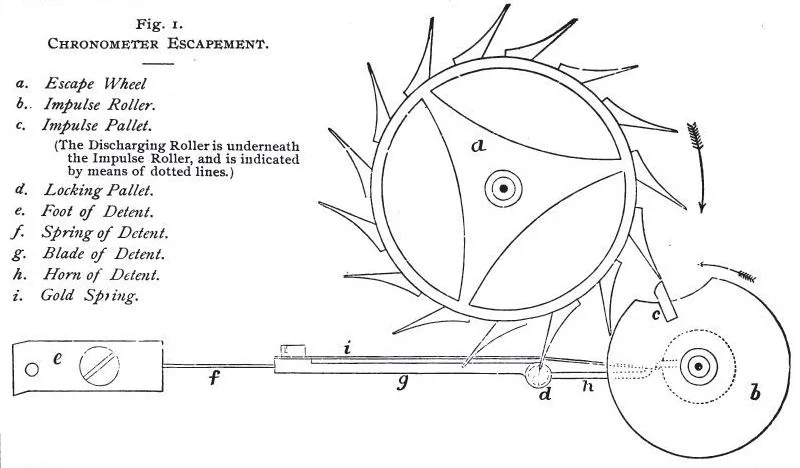
The Spring Drive is a movement architecture patented by Seiko engineer Yoshikazu Akahane in 1977 and commercialised from 1999. It derives its energy entirely from a mechanical mainspring, eliminating the battery of a quartz movement. However, instead of a conventional lever escapement and balance wheel, it uses a freely spinning glide wheel (tri-synchro regulator) whose rotation speed is governed by an electromagnetic brake. The brake signal is generated by comparing the glide wheel's rotational frequency against a quartz crystal oscillator using an integrated circuit. The result is a smooth, continuous sweep hand motion and a timekeeping accuracy of ±1 second per day — substantially better than a standard mechanical movement.
Quick facts
- Type
- Movement
- Movement
- Spring Drive
- Era
- 1977 (patent) / 1999 (commercial)
- Origin
- Japan
The Tri-Synchro Regulator
In a conventional mechanical watch, the escapement physically stops the gear train at each tick to release one tooth of the escape wheel, producing the characteristic tick-tock and the incremental (stepping) motion of the second hand. The Spring Drive replaces this with a glide wheel — a smooth metal disc that spins continuously. As the glide wheel turns, it generates a tiny electrical current through an electromagnetic coil. An integrated circuit (IC) compares this frequency against a quartz crystal oscillator and, when the glide wheel is rotating too quickly, applies an electromagnetic braking force. The wheel never stops; it simply slows to match the quartz reference. The result is a truly continuous sweep of the second hand — the only watch technology that produces it mechanically.
Energy Source and Power Reserve
Because the Spring Drive uses a conventional mainspring as its sole energy source, it can be configured as either a manual-wind or automatic (self-winding) movement. Grand Seiko Spring Drive calibre 9R65 (automatic) offers a 72-hour power reserve; the 9R01 manual-wind movement in the Credor Eichi II has a 60-hour reserve. The mechanical energy driving the hands is not converted into electricity (which would reduce efficiency dramatically); only the frequency-comparison circuit and braking coil draw from the gear-train energy, and that draw is vanishingly small — the IC consumes approximately 25 nanowatts.
Accuracy Compared to Mechanical and Quartz
A COSC-certified mechanical chronometer must keep time within −4/+6 seconds per day. Standard quartz movements achieve ±15 seconds per month (approximately ±0.5 seconds per day). The Spring Drive's specification of ±1 second per day places it significantly better than mechanical and comparable to a moderate-quality quartz. Grand Seiko claims some Spring Drive movements achieve ±0.5 seconds per day in actual wrist testing. The accuracy advantage over mechanical stems from the quartz reference eliminating the rate variation induced by mechanical escapement friction, temperature, and positional error.
Grand Seiko and Credor Applications
Seiko introduced Spring Drive technology to its prestige Grand Seiko and Credor lines. Grand Seiko Spring Drive movements are produced in the Shinshu Watch Studio in Shojiri, Nagano prefecture. Several calibres are available: the 9R65 (standard automatic), the 9R01 (manual, used in Credor Eichi II), and the 9RA series snowflake and speciality dials. The technology is not licensed externally; Spring Drive remains exclusive to Seiko Group brands. The smooth-sweep second hand is the most visually distinctive characteristic of a Spring Drive watch in operation.
Sources & further reading (3)
- encyclopedia — accessed 2026-05-07
- manufacturer-reference — accessed 2026-05-07
- watch-reference — accessed 2026-05-07
Frequently asked questions
Does the Spring Drive use a battery?
No. The Spring Drive derives all its energy from a mechanical mainspring, which is wound either manually or automatically via a rotor. The quartz crystal used as the timing reference does not require a separate battery; the glide wheel generates the small amount of electricity needed to power the IC and crystal from the mechanical energy of the gear train.
Why does a Spring Drive watch have a sweeping second hand?
In a mechanical lever-escapement movement, the second hand steps once every fraction of a second (typically 6 or 8 steps per second). In a quartz stepping motor movement, it steps once per second. The Spring Drive glide wheel rotates continuously without ever stopping, so the hands it drives move in a true smooth sweep — there are no discrete steps. This is considered aesthetically distinctive.
Is the Spring Drive classified as mechanical or quartz?
Seiko classifies the Spring Drive as a mechanical movement because it derives all its driving energy from a mainspring and uses no battery. The quartz crystal is purely a frequency-reference element used to regulate the braking force — it does not drive the movement. Swiss watch industry bodies classify it differently: COSC and NIHS do not have a specific certification category for Spring Drive, and some horologists debate whether the quartz control element disqualifies it from 'pure mechanical' status.