Skeletonized Dial
A dial with material removed in geometric or artistic patterns to reveal the movement below — merging dial and movement.
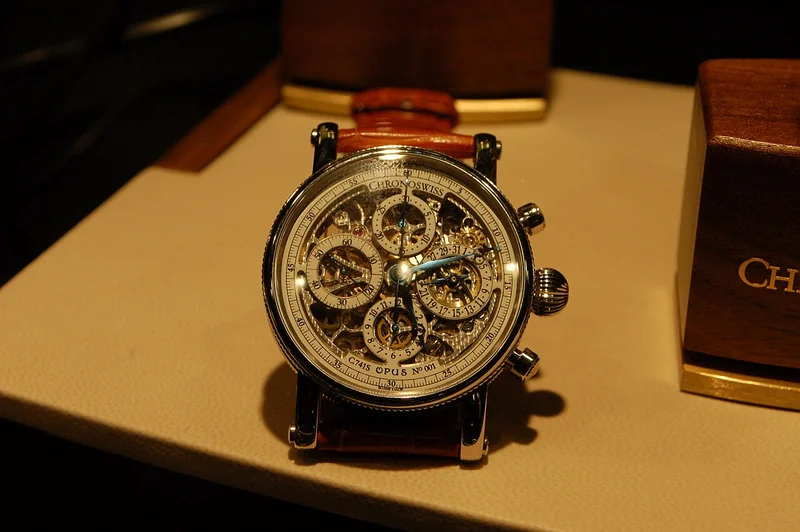
A skeletonized dial is a dial in which significant material has been removed — leaving openwork patterns — to allow the viewer to see the movement beneath. Unlike a skeleton watch (where the movement plate itself is skeletonized), some watches retain a conventional dial but cut openwork patterns in it, creating windows onto the movement while retaining a dial layer. In the most extreme interpretation, the dial is replaced entirely by the movement itself (as in a fully openwork movement), with applied hour indices floating on the sapphire crystal or applied directly to the movement surface. The visual combination of dial openwork and movement mechanics creates layered depth perception distinct from any closed dial design.
Quick facts
- Type
- Dial Type
- Era
- 18th century (pocket watches) / 1970s onward (wristwatches)
- Origin
- France / Switzerland
Dial Openwork vs Movement Skeletonization
A distinction exists between skeletonizing the dial (cutting patterns in the dial blank while leaving the movement plate solid below) and skeletonizing the movement itself (removing material from the base plate and bridges). In a dial-skeletonized watch, the movement plate remains intact for structural strength, and the openwork in the dial provides visual access to the movement's gear train and balance wheel below. In a fully skeletonized watch, both the dial and the movement plate have been opened. Contemporary usage often blurs this distinction; 'skeleton' or 'openwork' is used for any watch where the movement is visible from the front.
Dial Openwork Patterns
Openwork patterns in watch dials can be geometric (concentric rings, star patterns, radiating branches), figurative (floral, filigree, heraldic motifs), or architectural (matching the case shape and lug design). Filigree dials — in which extremely fine twisted wire patterns are shaped by hand into delicate lace-like structures and soldered — represent the apex of openwork dial craft. The ateliers of Jean-Claude Biver (formerly of Hublot) and several independent Geneva maisons have produced filigree dials in gold wire, silver wire, and platinum. Richard Mille's openwork construction treats the entire movement structure as the dial — the mainspring barrel, gear train bridges, and balance wheel are all visible elements of what the dial displays.
Technical Challenges of Openwork Dials
An openwork metal dial must retain sufficient structural rigidity after material removal to sit flat on its supports (dial feet) and resist the torque applied when the hand-setting cannon is engaged. The remaining metal must be designed as a space frame — connecting the dial feet attachment points, the center hole for the cannon, and the outer chapter ring without any long unsupported spans. CNC laser cutting achieves high precision on openwork patterns but must be followed by extensive hand-finishing: each cut edge requires deburring, beveling, and polishing. Electroformed dials (grown from metal deposits on a mandrel) can be produced in extremely fine filigree patterns that exceed CNC capability.
Sapphire Crystal Dials
An extreme form of 'skeletonized dial' uses no metal dial at all — instead, the hour indices are applied directly to the inner surface of the sapphire crystal or to a thin sapphire plate that serves as the dial substrate. The sapphire is fully transparent, creating an unobstructed view of the movement below. Richard Mille, De Bethune, and several independent makers produce sapphire-crystal dial pieces. The challenge is applying and securing hour markers to the curved or flat inner sapphire surface; PVD-deposited metallic indices, applied indices bonded with optical adhesive, and laser-etched indices are all used. A sapphire dial requires that the movement finish be display-quality from every angle, since no conventional dial hides the movement surfaces.
Sources & further reading (3)
- encyclopedia — accessed 2026-05-07
- encyclopedia — accessed 2026-05-07
- watch-reference — accessed 2026-05-07
Frequently asked questions
Is it harder to read the time on a skeleton or openwork dial?
Generally yes — the contrast between hands and dial background is lower when the movement is visible beneath, because the gear train and bridges create a complex visual background. Watch designers address this through high-contrast hand finishing (polished facets, luminous inserts), thick or visually prominent indices on a chapter ring, or by designing the openwork pattern to avoid the areas where hands sweep. Some skeleton watches are nearly illegible as time-telling instruments; others are carefully designed for reasonable readability while showcasing the movement.
What does 'openworked' mean on a modern watch?
In contemporary marketing, 'openworked' is used broadly to mean any watch where the movement is visible from the front through an openwork dial or fully skeletonized movement plate. Audemars Piguet uses 'openworked' in reference names (Royal Oak Openworked); Patek Philippe uses 'squelette' (French for skeleton). The terms indicate a visually open movement display, regardless of whether the openwork is in the dial, the movement plate, or both.
Can a skeletonized dial be retrofitted to a conventional movement?
A skeletonized dial can replace a conventional dial in a movement if the dial feet positions and center hole diameter are compatible — this is occasionally done in custom watchmaking. However, skeletonizing the movement plate itself requires specialised machining and is not a retrofit operation — it must be done on the movement blank before assembly. Some watch manufacturers offer 'openworked' versions of standard references by fitting an openwork dial to the same movement, without modifying the movement plate.