Skeleton Watch Case Style
A case with an open or transparent dial exposing the movement's gear train and balance wheel to view from the front.
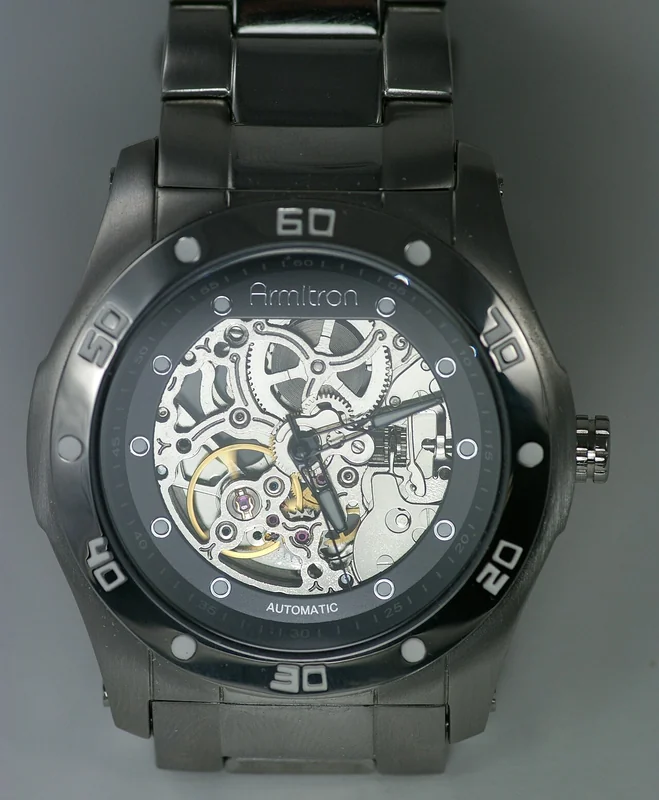
A skeleton watch — also called a squelette — is designed so that the dial and movement plate are cut away (skeletonised) to expose the working mechanism of the watch to view through the crystal from the front. The gear train, escapement, balance wheel, mainspring barrel, and decorative bridges are all visible and in motion. Skeletonisation requires that the plates and bridges retain sufficient structural integrity after material removal — a demanding exercise in calculating where metal can be removed without compromising rigidity. The skeletonised surfaces are then extensively hand-finished with beveling, anglage, and polishing. Skeleton pocket watches date to 18th-century French and Swiss craft; wristwatch skeletons became prominent from the 1970s onward.
Quick facts
- Type
- Case Style
- Case style
- skeleton
- Era
- 18th century (pocket watches) / 1970s (wristwatches)
- Origin
- France / Switzerland
Skeletonisation Process
Skeletonising a movement plate begins with the finished, assembled base movement. The watchmaker (or CNC machine in modern production) removes material from the main plate and bridges in a pattern that preserves the structural bridges between wheel pivot holes, the barrel wall, and the cock supporting the balance wheel. The remaining material forms an openwork pattern — typically following the shape of the wheels and plate aesthetic chosen by the designer. Every cut edge must then be hand-beveled and polished: an angular chamfer is filed onto each visible cut edge at approximately 45 degrees, then polished to a mirror finish. This process — anglage or beveling — is extremely time-consuming and distinguishes high-quality skeletons from mass-production laser-cut versions.
Readability and Functional Compromises
A skeletonised watch is, by definition, harder to read than a watch with a conventional dial. The gear train and balance wheel are visible from the front and compete visually with the hands and hour markers. High-quality skeleton watch designers minimise legibility loss by: retaining a chapter ring (hour ring) around the periphery of the skeletonised area; using high-contrast hand finishing (polished vs satined faces); positioning the balance wheel in a visually attractive but unobtrusive location relative to the time display; and applying careful hand and index finishing so the time-reading elements stand out against the movement background. Purely decorative skeletons that sacrifice all legibility are known in the market as 'artisanal' or 'creative' skeleton watches.
Notable Skeleton References
Jaeger-LeCoultre's Master Ultra Thin Squelette translates the manufacture calibre 866 into a skeletonised architecture. Patek Philippe's Calatrava Skeleton (reference 3970SK and newer references) skeletonises the ultra-slim Calatrava movement. Cartier's Tank Cintree Skeleton and Santos Skeleton references apply skeleton architecture to the maison's iconic case shapes. Richard Mille's skeleton construction takes a different approach — the openwork dial is integral to the architectural skeletonised baseplate design, where the entire movement structure is the visual element. Audemars Piguet Royal Oak Openworked uses the AP concept of an architecturally integrated skeleton design within the iconic Royal Oak case.
Movement Finishing in Skeleton Watches
Because every component is visible, movement finishing requirements for a skeleton watch are more demanding than for a conventional closed-dial watch. Every bridge, cock, plate strut, and wheel must be finished to display standard. Geneva Seal requirements (for Geneva-origin movements) specify anglage on all visible components; the Glashutte finishing tradition requires similar standards for German movements. Wheel spokes may be beveled and polished; screw heads are polished and often blued (steel screws heated to produce an oxidation-blue colour). The ratio of decorative surface to functional surface in a skeleton movement is the inverse of a standard movement — most of the material has been removed, and the remaining material exists as much for display as for structural function.
Sources & further reading (3)
- encyclopedia — accessed 2026-05-07
- encyclopedia — accessed 2026-05-07
- watch-reference — accessed 2026-05-07
Frequently asked questions
Does a skeleton watch need more maintenance than a conventional watch?
The mechanical movement in a skeleton watch requires the same service interval as its non-skeleton equivalent — typically 3–5 years depending on design. The skeletonised plates do not affect service requirements. However, dust and debris can more easily enter the movement through the crystal of a skeleton watch (through microscopic gaps around the crystal edge) compared to a solid-dial watch, potentially requiring more frequent cleaning. High-quality skeleton watches use tight-fitting crystals to minimise this risk.
Is a skeleton watch inherently more fragile than a solid dial watch?
Theoretically, removing material from the plate reduces its rigidity. In practice, the finite-element analysis and empirical testing that goes into professional-grade skeletonisation ensures the remaining material provides adequate structural support. A well-designed skeleton movement is not materially more fragile than the original. Budget skeleton watches may cut corners on structural analysis, and their plates may be more susceptible to distortion under shock — the difference between quality manufacturers and low-cost producers is significant in this respect.
What is the difference between skeleton and openwork?
The terms are used nearly interchangeably in English-language watch writing. 'Squelette' is the French term; 'skeleton' is the English equivalent. 'Openwork' is sometimes used specifically for high-architecture designs where the skeletonised movement structure is an integral design element (as in Richard Mille or Audemars Piguet Openworked) rather than a conventional movement with material removed. In practice, all three terms describe watches where the movement plate has been cut through to allow the mechanism to be seen from the front.