Seiko
Founded 1881 in Tokyo, Seiko produced the world's first quartz wristwatch (Astron, 1969) and invented the Spring Drive.
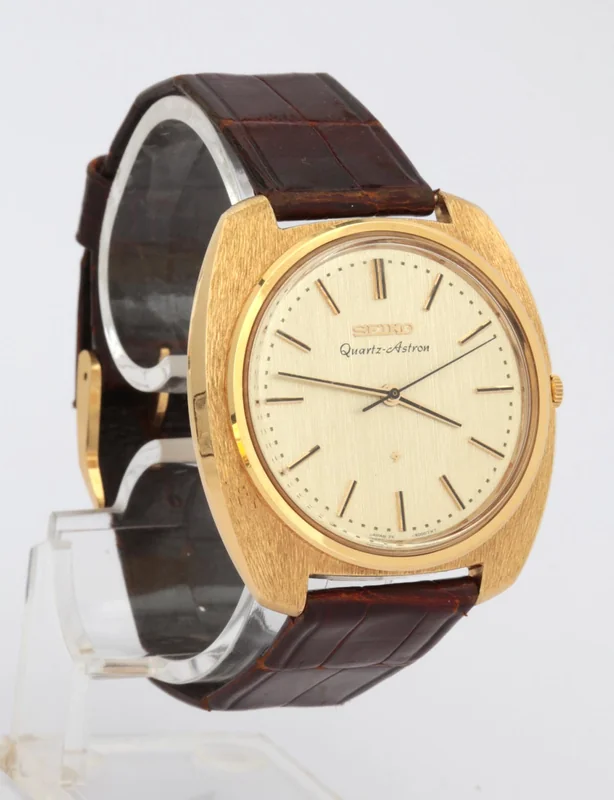
Seiko Holdings Corporation is a Japanese watch company founded in Tokyo in 1881 by Kintaro Hattori as a watch retail and repair shop. Manufacturing began in 1892 with the establishment of Seikosha. Seiko introduced Japan's first wristwatch (1913), Japan's first quartz clock (1958), and the world's first quartz wristwatch (Astron, sold 25 December 1969) — the Astron's introduction triggered the 'Quartz Crisis' that reshaped the global watch industry. Seiko is unique in the watch industry for its degree of vertical integration: the company produces its own quartz crystals, LCD displays, movement components, cases, and tools. Its product range spans from Seiko (mainstream) to Seiko Prospex (professional sport), Seiko Presage (craft dial), and Grand Seiko (high watchmaking), plus the Credor brand (top tier, Japan market). Spring Drive — a movement architecture unique to Seiko combining mechanical power with electronic precision — was developed by engineer Yoshikazu Akahane over 28 years.
Quick facts
- Type
- Brand History
- Era
- 1881-present
- Origin
- Japan (Tokyo)
Kintaro Hattori and Seikosha
Kintaro Hattori (1860–1934) opened a watch retail and repair shop in the Ginza district of Tokyo in 1881, aged 21. Japan was in the early Meiji period, actively importing Western technology; clocks and watches were premium imports. Hattori established Seikosha (Seiko House) as a manufacturing subsidiary in 1892 — beginning with wall clocks and alarm clocks using German-sourced parts, then transitioning to entirely Japanese-produced movements by the early 20th century. In 1913, Seikosha produced the Laurel — Japan's first domestically manufactured wristwatch. The 'Seiko' name (seikō meaning 'exquisite' or 'success' in Japanese) was applied to a specific pocket watch in 1924 and became the primary brand from the 1950s. Hattori Tokeiten (Hattori Clock Store) operated as the parent company until its renaming as Seiko Corporation in the 20th century.
The Astron and the Quartz Revolution
Seiko introduced the Astron quartz wristwatch on 25 December 1969, selling the first example at the Seiko boutique in the Wako building in Tokyo's Ginza. The Astron used the 35A quartz calibre — the first quartz movement in a production wristwatch. The movement drew on Seiko's decades of experience producing quartz timing instruments for the 1964 Tokyo Olympics (Seiko was the official timekeeper). The Astron's accuracy (±5 seconds per day, far exceeding mechanical watches) and its price (450,000 yen — approximately equivalent to a small automobile) established both the possibility and the commercial challenge of quartz in consumer watches. Within a decade, Seiko's mass-produced quartz movements — made possible by in-house quartz crystal and IC production — had dramatically lowered the price of accurate timekeeping, contributing to the decline of the Swiss mechanical watch industry through the 1970s and 1980s.
Vertical Integration
Seiko's manufacturing infrastructure is more vertically integrated than any comparable watch company globally. The Epson Corporation (Seiko Epson, majority-owned by Seiko Holdings) produces quartz crystals, semiconductors, and precision electronic components; the Seiko Instruments subsidiary produces movements; the Shizukuishi and Shinshu Watch Studios produce Grand Seiko movements. Seiko is one of the few watch companies that manufactures its own oscillator (quartz crystal) — the component that sets the frequency standard in quartz watches. This integration means Seiko controls quality and cost across the entire movement supply chain, from the crystalline silicon dioxide of the quartz crystal to the assembled and tested movement. Swiss manufactures, even vertically integrated ones like Rolex, source quartz crystals from specialist suppliers.
Olympic Timekeeping and Professional Tools
Seiko was the official timekeeper of the 1964 Tokyo Olympic Games — a demonstration of precision timekeeping capability that drove the development of the Astron quartz wristwatch released five years later. The Prospex line (Professional Specifications) covers Seiko's dive, field, and aviation-specification watches: the Prospex Diver 1965 (recreation of the first Seiko professional dive watch), the Marinemaster 300 (ISO 6425 certified, 300m water resistance), and the SLA range (limited edition recreations of historical professional references). Seiko dive watches were historically significant in the professional diving market during the 1960s–1980s when Japanese and Southeast Asian professional divers used them; the Seiko 6105 (worn by Martin Sheen in Apocalypse Now) became the archetypal professional dive watch associated with the Vietnam War era.
Sources & further reading (3)
- encyclopedia — accessed 2026-05-07
- encyclopedia — accessed 2026-05-07
- watch-reference — accessed 2026-05-07
Frequently asked questions
What is the difference between Seiko and Grand Seiko?
Seiko is the parent brand covering mainstream watches from affordable quartz to mid-range mechanical references. Grand Seiko was established in 1960 as a premium sub-brand — watches meeting the Grand Seiko Standard, a set of specifications for accuracy, finishing, and legibility beyond standard Seiko production. In 2017, Grand Seiko was separated from Seiko as an independent brand for global distribution, marketed separately with its own dealer network and brand identity. Grand Seiko uses entirely in-house movements (mechanical, Spring Drive) and Zaratsu-polished cases; standard Seiko uses a broader range of movement sources and finishing levels. Price range: Grand Seiko begins where mid-tier Swiss manufactures (IWC, TAG Heuer) operate.
What watches does Seiko currently produce?
Seiko's current production spans: Seiko (mainstream quartz and mechanical, including the Seiko 5 Sport, Presage, and Astron GPS Solar series), Grand Seiko (high watchmaking, mechanical and Spring Drive), Seiko Prospex (professional dive, field, and aviation), and Credor (ultra-high watchmaking, primarily Japan market, using grand complication movements). Seiko Holdings also owns the Wako department store chain in Ginza and continues to operate Seiko Epson as a technology company alongside its watch business.
Did Seiko actually 'cause' the quartz crisis?
Seiko's Astron was the first production quartz wristwatch (1969), establishing that quartz was viable in a wristwatch form. However, the subsequent volume quartz production that drove Swiss industry contraction came from multiple Japanese manufacturers (Seiko, Citizen, Orient) as well as from Swiss manufacturers using Japanese quartz technology. Seiko initiated the quartz watch era; the 'crisis' for Swiss mechanical manufacturers resulted from competition from the Japanese quartz industry broadly, not from Seiko alone. Swiss manufactures also produced quartz watches through the 1970s. The term 'quartz crisis' is a retrospective narrative — during the 1970s, many Swiss manufacturers adopted quartz rather than viewing it as an external threat.