Seiko 5
Introduced 1963 with five guarantees — automatic, day/date, water resistance, recessed crown, shock resistance.
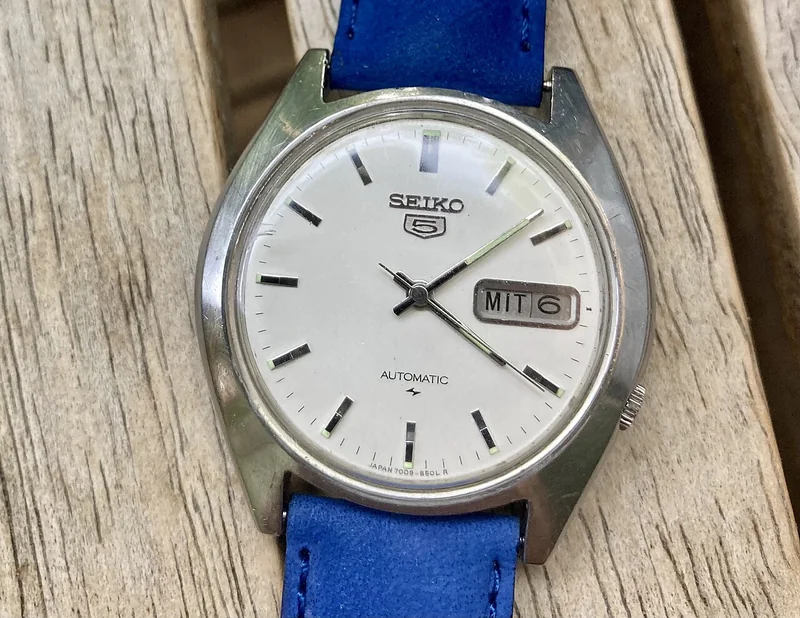
The Seiko 5 is a line of automatic wristwatches introduced by Seiko in 1963, named for five design commitments: automatic movement (self-winding), day and date display, water resistance, recessed crown at 4 or 6 o'clock (protected from impact), and shock resistance (Diashock protection system). The '5' designation — referencing these five properties — distinguished the line from less specified Seiko products and communicated a reliable specification standard to consumers. The Seiko 5 became one of the most successful and widely distributed automatic watch lines in history, sold across dozens of markets in hundreds of references over 60 years. Its accessibility — combining genuine mechanical timekeeping with durable construction at moderate cost — made automatic movements available to a global consumer base that might otherwise only access quartz.
Quick facts
- Type
- Iconic Watch
- Era
- 1963-present
- Origin
- Japan
The Five Points
The five properties of the Seiko 5 are: 1. Automatic self-winding movement (rotor winding, no battery). 2. Day and date display (both displayed simultaneously, day typically in English or Japanese/English). 3. Water resistance (typically 30 m, adequate for splashing and rain). 4. Recessed crown at 4 o'clock position (or 6 o'clock on some early references) — the crown is positioned at the lower half of the case side to reduce the likelihood of accidental pushing during wrist flexion, and the case shape protects it from direct impact. 5. Shock resistance via Diashock — Seiko's registered name for its jewelled pivot shock protection system (analogous to the Swiss Incabloc), which allows the balance staff pivot to deflect under impact rather than breaking.
Calibres and Production
The Seiko 5 line has used numerous calibres across its production history. Early Seiko 5 watches used calibre 6106, 6119, and 7009. The 7S26 (introduced 1996) became the most widely used Seiko 5 calibre — an automatic movement with hack (seconds stop for setting accuracy), no manual-wind capability, and 40-hour power reserve. The 4R36 (2009) added manual-wind capability to the 7S26 architecture; the 4R35 added hack only. Contemporary Seiko 5 Sport references (SRPD series) use the 4R36. The Seiko 5 Sport line launched in 2019 updated the line's aesthetic with more contemporary case shapes and size while maintaining the five-point specification. Production volumes are among the highest of any watch manufacturer globally.
Global Market and Distribution
The Seiko 5 was among the first Japanese automatic watches distributed widely in international markets outside Japan. From the late 1960s onward, Seiko 5 watches were sold in Southeast Asia, South Asia, Europe, Australia, and Latin America through local distributors. In markets where Swiss automatic watches were priced out of middle-class reach, the Seiko 5 represented the accessible entry to mechanical timekeeping. The diversity of dial designs — over the decades, hundreds of distinct dial variants have been produced, including military-contract dial configurations — has made the Seiko 5 a collecting category in its own right, with dedicated communities documenting variants by reference number, dial text, and production facility marks.
Seiko 5 Sport (2019 Relaunch)
In 2019, Seiko relaunched the Seiko 5 under the 'Seiko 5 Sport' designation with substantially updated case designs in larger modern diameters (typically 42–44 mm), improved finishing, and a range of speciality-series partnerships (including street fighter and anime licensed dials). The relaunch maintained the four functional specifications (automatic, day/date, water resistance, recessed crown) while updating the case aesthetic away from the conservative traditional format. The SRPD line — SRPD55, SRPD57, SRPD63, and many others — became popular in the enthusiast market as an entry-level automatic with genuine Seiko manufacture credentials.
Sources & further reading (3)
- encyclopedia — accessed 2026-05-07
- encyclopedia — accessed 2026-05-07
- watch-reference — accessed 2026-05-07
Frequently asked questions
Why is the Seiko 5 crown at 4 o'clock?
The crown at the 4 o'clock position (lower right of the case, between 4 and 5 o'clock) is positioned where the hand naturally rests during wrist flexion — the crown is tucked against the inside of the wrist curve rather than pointing outward at 3 o'clock. This reduces the risk of the crown being accidentally depressed or bent during wrist movement or by contact with objects. The 4 o'clock crown position became a recognisable Seiko 5 design element.
Is the Seiko 5 considered a quality watch?
Yes — within its price category, the Seiko 5 is considered to offer genuine value for a mechanical automatic watch. Seiko manufactures its own movements (the 7S26, 4R36, and related calibres are Seiko-made) rather than buying third-party ébauches, which is unusual at its price point. The movement is functional and reasonably durable; accuracy typically falls within ±15 seconds per day, acceptable for a non-chronometer-rated movement. The finishing on the movement and case is utilitarian rather than display-quality, consistent with the price.
How many Seiko 5 references have been produced?
Seiko does not publish comprehensive production figures or reference lists. Independent researchers have documented over 500 distinct Seiko 5 dial and reference variants across the line's 60-year production history. The actual number of individual pieces produced over six decades is estimated in the millions — the Seiko 5 is one of the highest-volume automatic watch lines ever produced. Production continues as of 2026 in the Seiko 5 Sport series.