Rolex Submariner
Introduced 1953, the Submariner defined the dive watch aesthetic and became the most copied watch design in history.
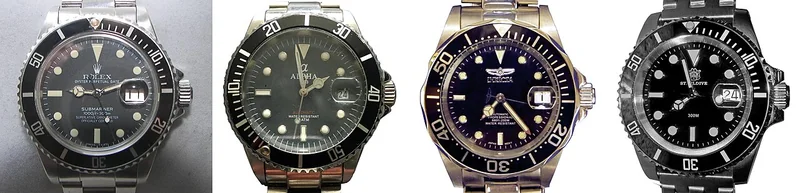
The Rolex Submariner is a diver's wristwatch introduced in 1953, marketed as the first watch water-resistant to 100 metres. The original reference 6204 established the defining architecture: round stainless steel Oyster case, unidirectional rotating bezel calibrated in minutes, pencil and mercedes hands with luminous fillings, crown at 3 o'clock, and a black dial with luminous rectangular indices. Over seven decades of production across 60+ references, the Submariner has evolved in movement, water resistance (now 300 m on most references), lug width, crystal material (acrylic to sapphire), and bezel insert material (anodised aluminium to Cerachrom ceramic), while maintaining the recognisable silhouette established in 1953.
Quick facts
- Type
- Iconic Watch
- Era
- 1953-present
- Origin
- Switzerland
Introduction and Original References
The Submariner debuted at the Basel Watch Fair in 1953. The first reference, 6204, used a Calibre A296 movement (based on an ETA calibre), a 38 mm Oyster case, and a rotating bezel with no crown guard. Reference 6205 followed closely; reference 6200, the 'big crown' variant, used an oversized winding crown for easier operation with wet hands and was produced in very small numbers. Reference 6536 (1955) introduced the first 'date' variant as prototype testing; reference 1680 (1965) became the first production Submariner with date and a cyclops magnification lens over the date. The crown guard protecting the winding crown was introduced progressively from the late 1950s. These early references are extensively documented in the horological literature and are among the most studied vintage watch references globally.
Cultural and Cinematic History
The Submariner's cultural profile was dramatically elevated by its appearance in the first James Bond film, Dr. No (1962), where Sean Connery's Bond wears a reference 6538 'Big Crown' Submariner. Connery's Submariner continued through subsequent Bond films into the 1970s. The watch's association with the fictional MI6 agent — an internationally recognised fictional character — gave the model a popular cultural reach far beyond watch enthusiasts. The model has also been associated with Jacques-Yves Cousteau's diving expeditions and several documented records for depth achieved with the watch on the wrist of working divers.
Movement Evolution
The Submariner's movement has changed several times across its production history. Early references used A296, Calibre 1030 (mid-1950s), Calibre 1520 (1960s, non-date), and Calibre 1570 (date, 1960s). The Calibre 3035 (1977, date) and 3135 (1988, date) were milestones in Rolex manufacture movement development. The current Calibre 3230 (non-date, 2020) and Calibre 3235 (date, 2020) use Rolex's Chronergy escapement — a modified lever escapement using lighter components for improved efficiency — and claim 70-hour power reserve. Both are COSC chronometer-certified.
Production Numbers and Design Stability
Rolex does not publish production data. Independent estimates place contemporary Submariner production at approximately 30,000–40,000 units per year across date and non-date variants in stainless steel and gold. The design has remained recognisable for 70 years through incremental evolution rather than major redesign — each generation modifying case dimensions, bezel insert, lug shape, and movement while maintaining the essential silhouette. The Submariner is the most imitated watch design in history: hundreds of manufacturers produce 'homage' watches based on its architecture, and counterfeit Submariners represent the single most commonly counterfeited luxury watch model.
Sources & further reading (3)
- encyclopedia — accessed 2026-05-07
- encyclopedia — accessed 2026-05-07
- watch-reference — accessed 2026-05-07
Frequently asked questions
When was the Rolex Submariner introduced?
The Rolex Submariner was first shown at the Basel Watch Fair in 1953, with reference 6204 as the first production model. It was marketed as the first wristwatch water-resistant to 100 metres. Some sources credit Blancpain's Fifty Fathoms (also 1953) as an independent parallel development of the modern dive watch concept.
What is a 'date' versus 'no-date' Submariner?
The Rolex Submariner exists in two primary variants: the date version (with a date window at 3 o'clock and a cyclops lens on the crystal above it, most recently reference 126610) and the no-date version (clean dial without a date window, most recently reference 124060). The no-date version retains the dial aesthetic closest to the original 1953 design; the date version adds the date function at the cost of the clean dial symmetry. Both use Rolex manufacture movements; the no-date currently houses calibre 3230, the date version calibre 3235.
How deep can a Rolex Submariner actually go?
The current Submariner is rated to 300 metres (30 bar static pressure). Rolex tests each watch case to 125% of the rated depth — 375 metres — as a factory quality check. The rating refers to static water pressure on the sealed case; dynamic pressure during actual diving (from movement through water) is lower than static pressure at the same depth. The 300 m rating is more than sufficient for recreational scuba diving (maximum certified recreational depth is 40 m for most diver certification agencies).