Rolex
Founded 1905 by Hans Wilsdorf, Rolex pioneered the waterproof Oyster case (1926) and the self-winding Perpetual rotor.
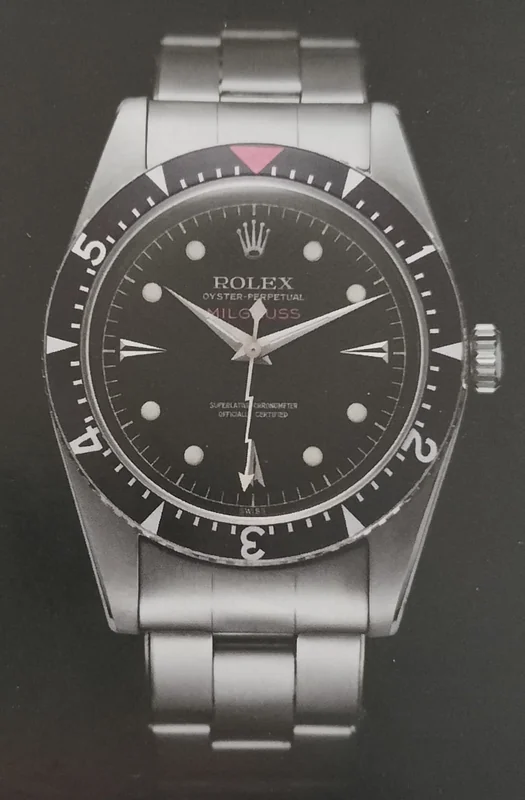
Rolex SA is a Swiss watch manufacture headquartered in Geneva, Switzerland, founded in London in 1905 by Hans Wilsdorf and Alfred Davis as Wilsdorf & Davis. The company relocated to Geneva in 1919, following wartime British import duty increases on luxury goods. Rolex is privately held by the Hans Wilsdorf Foundation, a charitable trust established by Wilsdorf in 1944 and registered in Geneva. The manufacture produces approximately one million watches per year — the highest volume among the prestige Swiss manufactures — across its core Oyster and Cellini collections. Key historical innovations: the Oyster waterproof case (1926), the Perpetual self-winding rotor system (1931), and the first wristwatch to receive the Superlative Chronometer certification (COSC chronometer standard, rated ±2 seconds per day for current Rolex production).
Quick facts
- Type
- Brand History
- Era
- 1905-present
- Origin
- United Kingdom (London, founded) / Switzerland (Geneva, since 1919)
Hans Wilsdorf and the Oyster
Hans Wilsdorf (1881–1960) was a Bavarian-born businessman who moved to London in 1900 and established Wilsdorf & Davis in 1905 with his wife's brother-in-law Alfred Davis. The firm initially imported Swiss movements and cased them in English cases for the London market. The 'Rolex' name was registered as a trademark in 1908 — Wilsdorf claimed the name was chosen because it was easy to pronounce in any European language and short enough to fit on a dial. In 1926, Rolex introduced the Oyster case — the first truly waterproof wristwatch case, using a screwed caseback, screwed bezel, and screwed-down crown to seal the movement from water and dust. The Oyster case was demonstrated publicly by Mercedes Gleitze, who wore one during her Channel crossing attempt in 1927 — the watch functioned correctly after 10 hours in the sea, and Rolex advertised the achievement extensively.
The Perpetual Rotor
The Perpetual self-winding rotor movement was introduced in 1931, patented by Rolex. Prior self-winding watches (Abraham-Louis Perrelet's mechanism, ca. 1777; John Harwood's 1923 bumper winding system) used oscillating masses that wound through limited arcs. Rolex's innovation was a full 360-degree rotating rotor — a half-disc of heavy metal mounted on bearings on the movement's rear, free to rotate in either direction, driving the mainspring via a bidirectional winding train. The full-rotation rotor could wind the mainspring continuously from wrist motion in any direction, without the travel limits of the bumper system. The Perpetual rotor principle became the universal architecture for automatic watch movements and is used in essentially all automatic movements produced since. Rolex registered the 'Perpetual' name and uses it to designate movements with automatic winding in its collection.
Hans Wilsdorf Foundation and Ownership
Hans Wilsdorf established the Hans Wilsdorf Foundation in 1944 — a charitable trust registered in Geneva — and transferred his Rolex shares to the foundation during his lifetime. The foundation is the sole owner of Rolex SA. Following Wilsdorf's death in 1960, the foundation has been managed by a board of trustees without a controlling family. The foundation's charitable activities include education and social programmes in Geneva and internationally. The private, non-publicly-traded, family-foundation structure means Rolex is not subject to stock market reporting requirements or shareholder return pressure — it is one of the few major watch companies without a public parent company. Revenue and production volume figures are not disclosed; estimates are derived from Swiss watch industry export data.
Professional Models and Sport History
Rolex's 'Professional' (now 'Oyster Professional') collection comprises instrument watches developed for specific professions: the Submariner (1953, dive watch, developed with Blancpain's Jean-Jacques Fiechter for professional diving), the GMT-Master (1954, pilot/crew watch, developed with Pan American Airways), the Explorer (1953, mountaineering, associated with the 1953 Everest expedition), the Daytona (1963, racing chronograph, associated with Daytona Raceway and Le Mans), and the Sea-Dweller (1967, saturation diving, rated 610 m). Each professional model was developed in collaboration with practitioners — pilots, divers, mountaineers, racing drivers — and tested in the relevant field. The professional model design DNA — tool watch aesthetics, high water resistance, clear legibility, robust cases — has remained consistent across seven decades of production, though dimensions, movements, and materials have been updated in each generation.
Sources & further reading (3)
- encyclopedia — accessed 2026-05-07
- encyclopedia — accessed 2026-05-07
- watch-reference — accessed 2026-05-07
Frequently asked questions
Is Rolex a Swiss or British company?
Rolex is a Swiss company — it has been headquartered in Geneva since 1919 and is registered as a Swiss company under Swiss law. It was founded in London in 1905, but the relocation to Geneva (driven by British luxury goods import duties following World War I) made it effectively Swiss from 1919. The founding location in London is historical rather than operational. Rolex SA is registered in Geneva and manufactures watches at its Geneva and Plan-les-Ouates facilities.
Does Rolex manufacture its own movements?
Yes. Rolex is a vertically integrated manufacture — it produces its own movements (calibres), cases, bracelets, and dials. Rolex develops its own metal alloys (Oystersteel for steel cases, Rolesor for two-tone, Everose for proprietary rose gold), produces its own ceramic bezel inserts (Cerachrom), and manufactures its own mainsprings and escapement components. The current primary calibre family — 3135 (Datejust), 3186 (GMT-Master II), 4130 (Daytona), and their variants — are Rolex designs produced in Geneva. This degree of vertical integration is unusual even among manufacture-status watchmakers.
What is the Rolex Superlative Chronometer certification?
The Rolex Superlative Chronometer certification specifies that each Rolex watch (after casing, not just the movement) passes testing to ±2 seconds per day — twice the COSC chronometer standard of ±4 seconds per day. COSC certifies the uncased movement; Rolex adds a second testing phase of the completed watch in its case. The Superlative Chronometer designation appears on the dial and indicates that the specific watch has been tested and certified to the ±2 s/day standard. The certification accompanies the five-year warranty.