Racing Chronograph Case Style
A motorsport-derived chronograph case — tachymeter bezel, oversized pushers, legible registers, bold palette.
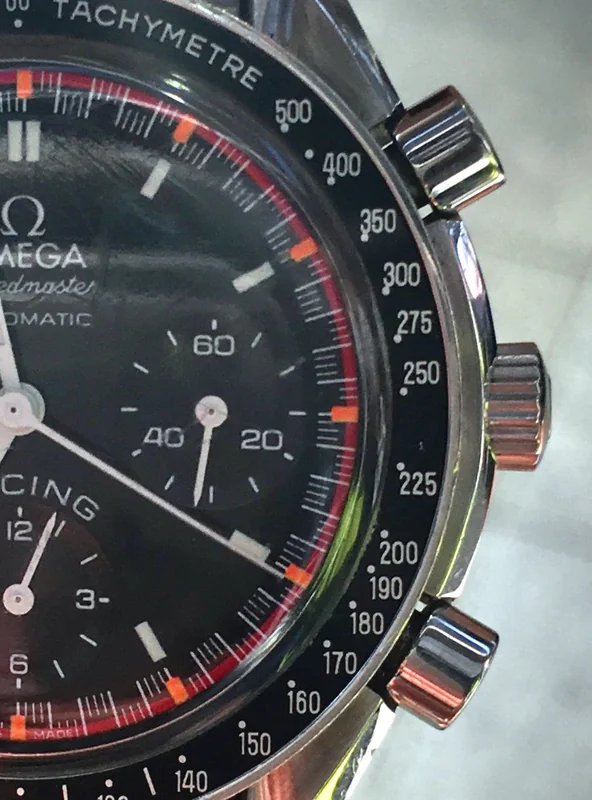
The racing chronograph is a case style combining the stopwatch complication of a chronograph with design cues from motorsport: a tachymeter scale on the bezel or flange allowing speed measurement over a known distance, prominent pushers, bold dial legibility, and often a striking colour palette inspired by racing liveries. Heuer (now TAG Heuer) shaped the category with the Autavia (1962), Carrera (1963), and Monaco (1969). Zenith's El Primero (1969) represented independent concurrent development. The Rolex Daytona (1963) added sports timing legitimacy through Rolex's sponsorship of the Daytona International Speedway. Racing chronographs remain the most commercially prominent chronograph category.
Quick facts
- Type
- Case Style
- Case style
- racing
- Era
- 1960s-present
- Origin
- Switzerland
The Tachymeter Bezel
A tachymeter is a scale on a watch bezel or dial flange that converts elapsed time over a measured distance into a speed reading. The calculation is based on the formula: speed = 3600 / time (for any unit of distance). To use a tachymeter bezel: start the chronograph when a vehicle passes a measured 1 km (or 1 mile) starting mark; stop it when it passes the 1 km finish mark; read the tachymeter scale at the position of the chronograph seconds hand. The scale reading gives the vehicle's average speed in km/h (or mph) over that measured distance. Tachymeter graduations start at 60 seconds (60 units per hour = 60 km/h or mph) and typically end at 500 seconds (500 units per hour). Tachy-bezel watches require a 1-unit measured distance course; bezel scales calibrated for 400 m (running track) and 200 m are also produced for specific applications.
Heuer Carrera, Monaco, and Autavia
Jack Heuer (great-grandson of founder Edouard Heuer) led the Heuer brand in the 1960s and created three defining racing chronograph references. The Autavia (1962) — named from 'AUTomobile' + 'AVIAtion' — was a dashboard rallye timer adapted for the wrist. The Carrera (1963) — named for the Carrera Panamericana endurance road race — was Heuer's first purpose-designed wristwatch racing chronograph, with a clean, legible dial and rally-style panda sub-dial configuration. The Monaco (1969) introduced a square case — unusual in the market — with a blue dial; it was worn by Steve McQueen in the 1971 film 'Le Mans,' becoming one of the most photographed sports watches. All three references continue in production as TAG Heuer today.
Zenith El Primero
Zenith introduced the El Primero ('the first') high-frequency automatic chronograph movement on 10 January 1969 — several weeks before Heuer's chronograph movement announcement and Seiko's automatic chronograph announcement. The El Primero beats at 36,000 vph (5 Hz), giving 1/10-second chronograph resolution (most contemporary automatic chronographs beat at 28,800 vph / 4 Hz, giving 1/8 second resolution). Zenith CEO Charles Vermot famously hid remaining El Primero components in an attic when Swatch management pressured the company to focus exclusively on quartz, enabling the movement's survival and revival in the early 1980s. Rolex famously used the El Primero as the base for the Daytona's automatic movement from 1988 to 2000, modified to beat at 28,800 vph.
Rolex Daytona
The Rolex Cosmograph Daytona was introduced in 1963, named after the Daytona International Speedway in Florida, which Rolex had sponsored. The original reference 6239 used a modified Valjoux 72 manual-wind movement in a 37 mm stainless steel case with an exotic dial and pushers screwed into the case. The reference evolved through the 6263/6265 series (screw-down pushers), the 16520 (first automatic El Primero-based, 1988), and the 116500LN (current, 2016, with Rolex's own calibre 4130). The Paul Newman Daytona — references 6239 and 6241 with exotic patterned dials — became the most recognisable variant for collectors after Paul Newman's personal example sold for $17.8 million at auction in 2017, the highest price for a wristwatch at the time.
Sources & further reading (3)
- encyclopedia — accessed 2026-05-07
- encyclopedia — accessed 2026-05-07
- encyclopedia — accessed 2026-05-07
Frequently asked questions
What is the difference between a racing chronograph and a standard chronograph?
A racing chronograph is a chronograph (stopwatch function) with specific design elements derived from motorsport timing: tachymeter scale, bold legibility, sporty case, and often a connection (sponsorship, heritage, or design reference) to automobile or motorcycle racing. All racing chronographs are chronographs; not all chronographs are racing chronographs. A racing chronograph emphasises the tachymeter and motorsport aesthetic; a standard chronograph may be a dress piece or medical timer without these elements.
Can a tachymeter bezel actually measure speed?
Yes, accurately — within the limitations of the mechanical chronograph's 1/8-second resolution and the requirement for a measured-distance course. The tachymeter calculation (speed = 3600 / elapsed seconds) is correct; the practical limitation is that accurately timing a vehicle over exactly 1 km or 1 mile using a mechanical chronograph and roadside markers requires precision that is difficult in a moving vehicle. In historical motorsport contexts, the tachymeter was used from spectator vantage points where a known distance between corner markers allowed timing. In contemporary practice, the tachymeter is primarily a design element.
Why is the Rolex Daytona named after a Florida racetrack?
Rolex sponsored the Daytona International Speedway in Daytona Beach, Florida, beginning in the early 1960s. The Rolex 24 at Daytona — a 24-hour endurance race — has been sponsored by Rolex continuously since 1962. The Cosmograph model was renamed the 'Daytona' in 1963 to acknowledge the sponsorship and the watch's intended use as a professional timing instrument for racing drivers and pit crew. Rolex's deep connection to endurance motorsport (also including Le Mans and the Sebring 12-hour) shaped its sports watch marketing identity through the 1960s and 1970s.