Quartz Movement
An electronically regulated movement in which a 32,768 Hz quartz crystal governs accuracy to within seconds per month.
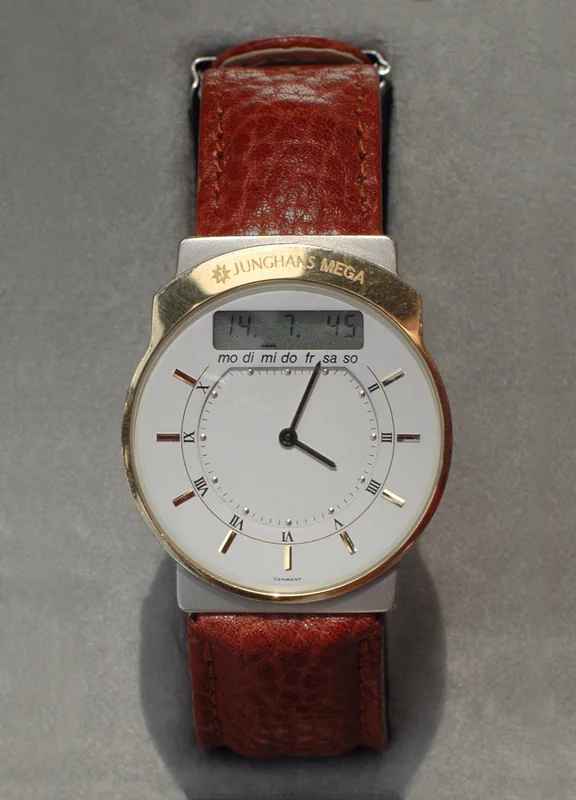
A quartz movement replaces the mechanical escapement and balance wheel of a traditional mechanical watch with a quartz crystal oscillator. When an electric current from a battery passes through the crystal, it vibrates at a precise frequency — almost universally 32,768 Hz in wristwatches. Electronic circuits count these vibrations, divide the frequency to one pulse per second, and step a motor to advance the hands or update a digital display. First commercialised in 1969 with the Seiko Astron, quartz movements were accurate to roughly ±15 seconds per month — orders of magnitude better than the mechanical movements of the era — at a fraction of the cost.
Quick facts
- Type
- Movement
- Movement
- Quartz
- Era
- 1969-present
- Origin
- Japan / Switzerland / USA
The Quartz Crystal Oscillator
Quartz (silicon dioxide, SiO2) is a piezoelectric material: it generates an electric charge when mechanically stressed and deforms physically when an electric voltage is applied. In a watch movement, a tuning-fork-shaped quartz crystal is manufactured to oscillate at 32,768 Hz (2^15) when excited by a battery-sourced current. This frequency was chosen because digital circuits can halve it exactly 15 times to reach 1 Hz — one pulse per second — using simple binary counters. The crystal's resonance frequency is highly stable with respect to temperature and age within normal operating ranges, which is why quartz movements are accurate to within seconds per month versus the seconds-per-day variation typical of a mechanical movement.
The Quartz Crisis (1970s)
The commercialisation of the Seiko Astron on 25 December 1969 triggered what Swiss manufacturers later called the quartz crisis (also 'quartz revolution'). Japanese and Hong Kong manufacturers could produce quartz movements at dramatically lower cost than Swiss lever-escapement calibres; Swiss market share collapsed from roughly 50% of global production in 1970 to below 10% by 1983. Thousands of Swiss watchmaking jobs were lost. The recovery required a deliberate repositioning of mechanical watches as luxury and craft objects rather than timekeeping instruments — a positioning that continues today. Nicolas Hayek's Swatch Group restructuring in the early 1980s stabilised the Swiss industry through a focus on affordable, design-driven quartz watches alongside heritage mechanical brands.
Accuracy and Temperature Compensation
Standard quartz movements achieve ±15 seconds per month. Thermally compensated quartz (TCXO) movements, found in high-end and instrument-grade watches, monitor crystal temperature and apply correction factors to maintain accuracy within ±10 seconds per year. Citizen's Eco-Drive Calibre 0100, released in 2019, achieves ±1 second per year through temperature compensation and uses light energy to power the movement via a solar cell rather than a conventional battery. GPS-synchronised quartz movements (common in Seiko Astron GPS and Casio GPW lines) receive satellite time signals and correct the crystal rate to within ±1 second every 100,000 years — the accuracy of the atomic clocks underlying GPS infrastructure.
Quartz vs Mechanical Today
A battery-powered quartz movement costs from under one US dollar (mass-market ETA 955 and equivalents) to several thousand for precision compensated calibres. A mechanical chronometer-grade movement of comparable reliability costs far more to produce. The tradeoff is maintenance: a quartz watch requires battery replacement every 1–3 years; a mechanical movement requires servicing every 3–7 years. Accuracy at the wrist is not a practical differentiator for most users — both a chronometer mechanical and a standard quartz will keep appointments reliably. The contemporary market for mechanical watches is driven by craft appreciation rather than timekeeping necessity.
Sources & further reading (3)
- encyclopedia — accessed 2026-05-07
- encyclopedia — accessed 2026-05-07
- encyclopedia — accessed 2026-05-07
Frequently asked questions
Why do quartz watches tick once per second?
The stepping motor that advances the hands is driven by one pulse per second — the output after the 32,768 Hz crystal frequency is divided 15 times in binary. Analogue quartz watches therefore produce one discrete step per second, giving the characteristic tick. Some high-end quartz movements use a continuous (smooth) sweep motor rather than a stepping motor to mimic the continuous sweep of a mechanical balance-wheel movement.
How accurate is a standard quartz watch?
A typical battery-powered quartz consumer watch is accurate to approximately ±15 seconds per month — about ±3 minutes per year. This is roughly 10 to 30 times more accurate than a standard mechanical movement, which loses or gains between 2 and 10 seconds per day depending on adjustment quality.
What is the difference between quartz and solar quartz?
Solar quartz movements (exemplified by Citizen Eco-Drive and Seiko Solar) use a photovoltaic cell beneath a translucent dial to convert ambient light into electrical energy stored in a rechargeable cell or capacitor. The timekeeping mechanism is identical to a conventional battery quartz movement; the difference is the energy source. A sufficiently light-exposed solar watch eliminates the need for battery replacement for the life of the secondary cell — typically 10 years or more before cell degradation.