Power Reserve Indicator
A display showing remaining mainspring energy, allowing the wearer to wind before the movement stops.
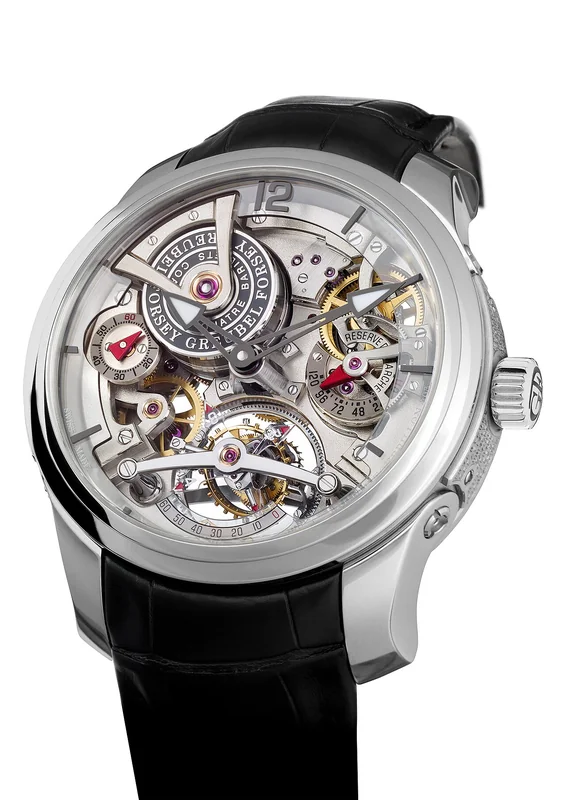
A power reserve indicator (also called a power reserve display or up-down indicator) is a complication that shows how much energy remains in a mechanical watch's mainspring. As the mainspring uncoils and releases energy, a cam or differential mechanism measures the remaining torque and drives a pointer or sector display marked in hours (or sometimes days). When the indicator approaches empty, the wearer knows to wind the watch before it stops and the time display is lost. Found in both manual-wind and automatic movements, the power reserve indicator is particularly useful for watches with long reserves (several days or more) where casual winding habits may not be sufficient.
Quick facts
- Type
- Complication
- Complication
- power-reserve-indicator
- Era
- 18th century (pocket watches) / 1950s onward (wristwatches)
- Origin
- Europe (Switzerland / England)
Mechanism: How It Reads Remaining Energy
The power reserve indicator must measure the remaining tension in the mainspring — a quantity that decreases non-linearly from full wind to empty. The most common mechanism uses a differential gear connected to both the mainspring barrel arbor (which winds the spring) and the barrel drum (which outputs energy). The differential's output shaft rotates proportionally to the difference between arbor and drum position — a proxy for spring tension. This differential output drives a sector or pointer on the dial. Because spring tension drops non-linearly with remaining energy, the indicator scale is non-linear: early hours deplete slowly from the full end; later hours deplete faster as the spring uncoils to its minimum effective torque.
Wristwatches with Notable Power Reserve Displays
A. Lange & Sohne's Lange 1 (1994) features a prominently designed power reserve indicator positioned between the moonphase and the large-date display — the balanced asymmetric dial layout makes the power reserve sector one of the watch's most recognisable visual elements. The IWC Portuguese Hand-Wound (reference 5454) shows a 7-day power reserve arc in the lower half of the dial, corresponding to its 168-hour mainspring. Jaeger-LeCoultre's Master Ultra Thin Perpetual displays the power reserve alongside the perpetual calendar indications. Panerai's Luminor Marina 1950 10 Days GMT (reference 494) uses a prominent sector display for its 240-hour reserve.
Long-Reserve Movements
Contemporary high-end movements often aim for extended power reserves well beyond the standard 38–48 hours. The Jaeger-LeCoultre calibre 184 (Hybris Mechanica) achieves a 50-day reserve by stacking six barrels in series. IWC calibre 98295 delivers 192 hours (8 days). The practical motivation for a long reserve is convenience — a watch wound on Sunday evening can run through a full work week without attention. For watches with perpetual calendar complications, allowing the movement to stop means the calendar must be fully reset, which in some designs is a complex 10-minute procedure; a longer reserve reduces this risk.
Up-Down Indicator
An 'up-down indicator' (German: Auf-Ab) is functionally identical to a power reserve indicator but uses a two-position readout (up = wound / down = running low) rather than a graduated scale. This simpler display was commonly found on 19th-century and early 20th-century pocket watches and deck watches, where the priority was alerting the user that winding was needed rather than showing precise remaining reserve. A. Lange & Sohne used a prominently placed Auf-Ab display in their early wristwatch designs as a nod to the German pocket watch tradition.
Sources & further reading (3)
- encyclopedia — accessed 2026-05-07
- encyclopedia — accessed 2026-05-07
- watch-reference — accessed 2026-05-07
Frequently asked questions
Is a power reserve indicator accurate?
Power reserve indicators are approximate guides, not precision instruments. The non-linear relationship between spring tension and remaining run time, combined with the small size of the mechanism, means the displayed reading can vary by 5–15% depending on spring condition and temperature. The indicator is most useful as a low-reserve warning rather than a precise countdown.
Does a power reserve indicator affect movement accuracy?
Adding any complication increases friction and gear-train complexity, potentially affecting rate. However, a well-designed power reserve indicator adds minimal friction through the differential reading mechanism and has negligible practical impact on rate in a properly regulated movement. Movement makers account for the small additional energy draw when calibrating the reserve display's drive ratio.
Why do some automatic watches not have a power reserve indicator?
Automatic movements (self-winding) keep the mainspring near full wind during normal daily wear — the indicator is less useful because the spring is almost always fully tensioned. Power reserve indicators are more practically valuable in manual-wind movements, where the wearer is solely responsible for maintaining spring tension. Automatic watches often omit the indicator as unnecessary; some owners, however, prefer having it to monitor whether their daily activity level is sufficient to keep the movement wound.