Pilot Watch Case Style
A large, legible instrument case with onion crown, antimagnetic construction, and Arabic numerals for aviation.
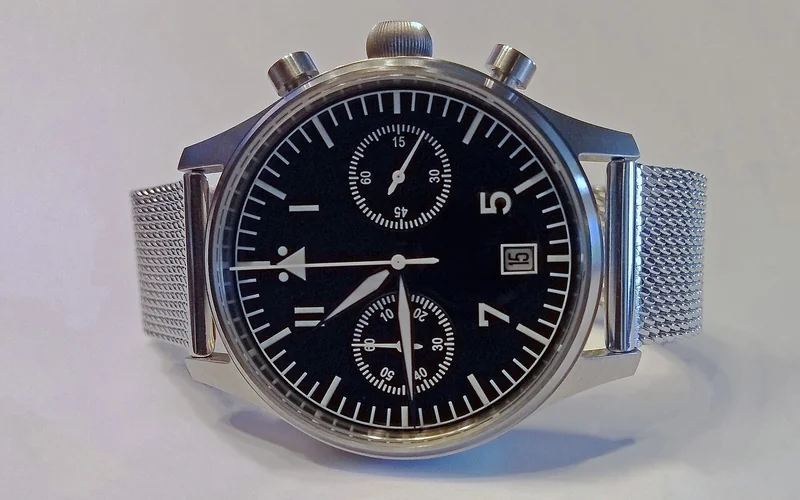
The pilot's watch (Fliegeruhr in German) is a case style originally developed for military aviation use, characterised by high legibility, simple bold dial design, large Arabic numerals, antimagnetic construction, and a pronounced onion-shaped crown designed to be operated with gloved hands. German Luftwaffe Beobachtungsuhr (observer's watches) of the 1930s established the defining specification: dark dial, white Arabic numerals, central sweep seconds hand, and a large crown with a textured grip. IWC, A. Lange & Sohne (then in Glashütte), Laco, and Stowa produced the original German B-Uhren to DIN specifications in the 1930s–1940s. IWC's continued production of pilot's watches — Mark XI, Mark XII, Mark XV, Mark XVI, Mark XVII, Mark XVIII, Big Pilot — represents the longest continuous pilot watch series.
Quick facts
- Type
- Case Style
- Case style
- pilot
- Era
- 1930s-present
- Origin
- Germany / Switzerland
German B-Uhren Specification
The German Luftwaffe observer's watch (Beobachtungsuhr, or B-Uhr) was specified to a strict DIN standard in the late 1930s. Case diameter: 55 mm minimum. Dial: matte black with white printed Arabic numerals and markers. Crown: large, knurled 'onion' crown for gloved operation. Seconds hand: long central sweep seconds with high-contrast colour for easy second-reading. Movement: 15-jewel or better, antimagnetic, lever escapement. Two subdial variants were specified: Type A (with triangular 12 o'clock marker pointing to 12, and Arabic numerals at each hour) and Type B (with double 6 at the bottom subdial, distinct inner minute track). Manufacturers who received contracts: IWC, A. Lange & Sohne, Laco, Stowa, Wempe. Original B-Uhren are among the most studied German military watch references in the collector market.
IWC Pilot's Watch Lineage
IWC produced Luftwaffe watches during World War II and continued the pilot's watch format postwar with the Mark 11 (1948), produced for the British Royal Air Force and adopted as standard issue. The Mark 11 used a soft iron inner cage to protect the movement from magnetic interference — an antimagnetic solution achieved through a shield rather than antimagnetic alloy components. Subsequent generations: Mark XII (1994), Mark XV (1993), Mark XVI (2007), Mark XVII (2012), Mark XVIII (2016). The Big Pilot (reference 5002, 2002; reissued in several case materials) returns to the B-Uhr's 55 mm aesthetic with a contemporary movement. IWC also produces the Spitfire, Top Gun, and Mojave Desert variants with distinct case materials and finishing.
Legibility Principles
Pilot watch dials are designed for instrument-panel legibility: quick, unambiguous time reading at a glance. Design principles include: high contrast between dial and indices/numerals; Arabic rather than Roman numerals (faster to parse under stress); luminous treatment on both hands and indices (tritium historically, SuperLuminova currently); long central seconds hand extending nearly to the chapter ring; minimal decoration or complications on the dial; large, bold typography. The triangle at 12 o'clock (common on German-heritage pilots) provides an orientation anchor distinct from the numerals. Cathedral hands (wide, hollow) and Mercedes hands (three-lobe seconds) are both pilot-watch conventions for different design lineages.
Modern Pilot Watch Design
Contemporary pilot watches from Breitling (Navitimer, introduced 1952 with a circular slide-rule bezel for aviation calculation), Longines (Heritage Spirit), Zenith (Pilot Type 20), and Hamilton (Khaki Pilot) maintain pilot watch visual conventions while adapting to civilian wrist sizes (typically 38–46 mm rather than the original 55 mm). The slide-rule bezel of the Breitling Navitimer, functional for fuel consumption and airspeed calculations before the era of electronic flight computers, became a defining feature of the aviation-instrument aesthetic distinct from the pure B-Uhr format. Modern cockpits are GPS-equipped and do not rely on wristwatch instruments, but the pilot watch aesthetic retains strong enthusiast appeal.
Sources & further reading (3)
- encyclopedia — accessed 2026-05-07
- encyclopedia — accessed 2026-05-07
- watch-reference — accessed 2026-05-07
Frequently asked questions
Why does a pilot watch have such a large crown?
The B-Uhr specification required a large, textured 'onion' crown because pilots wore thick gloves in unpressurised cockpits at altitude and needed to operate the crown for time setting without removing their gloves. The enlarged crown diameter allowed finger and thumb grip through leather or cloth flight gloves. Modern pilot watches retain the large crown as a heritage design element rather than a functional necessity, since contemporary aviation relies on electronic instruments.
What is an antimagnetic watch and why does it matter for pilots?
Aircraft instruments, radio equipment, and electrical systems generate magnetic fields that can disrupt a watch's balance spring, causing significant rate errors. An antimagnetic movement uses alloys (such as Nivarox for the balance spring or palladium alloys for the lever and escape wheel) that are not significantly affected by magnetic fields, or encases the movement in a soft iron Faraday shield. COSC antimagnetic standards require resistance to a field of 4,800 A/m; IWC's soft iron cage approach achieves comparable protection. Modern aircraft generate far weaker fields relative to what vintage pilots encountered, but antimagnetic construction remains a pilot-watch convention.
What is the Breitling Navitimer slide rule bezel used for?
The Navitimer's circular slide rule bezel — first introduced in 1952 — is a logarithmic circular slide rule that can perform multiplication, division, and unit conversions. Aviation-specific calculations possible with the slide rule include: statute miles to nautical miles conversion, fuel consumption (hours of fuel remaining), airspeed correction for altitude (true airspeed from indicated airspeed), and climb/descent rate. The slide rule was a practical instrument before electronic flight management systems became standard; it remains functional in principle but is used decoratively in practice by most contemporary wearers.