Perpetual Calendar Complication
A calendar accounting for varying month lengths and leap years, needing manual correction only once per century.
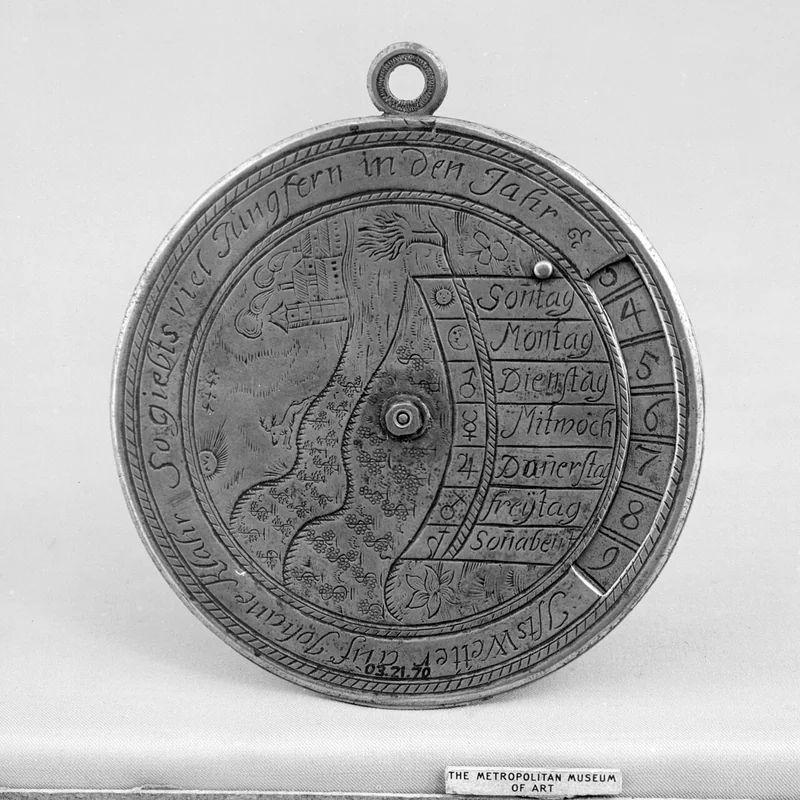
A perpetual calendar is a watch complication that automatically advances the date display through months of 28, 29, 30, and 31 days without requiring manual correction — accounting for both short months and the four-year leap year cycle. The mechanism reads the Gregorian calendar's programmed pattern from a cam or cam stack representing 48 months (four years) of calendar data. The display typically shows date, day of week, month, and moon phase. A perpetual calendar requires correction only on century years that are not leap years (years divisible by 100 but not 400) — the next such correction is 28 February 2100. Patek Philippe, A. Lange & Sohne, and IWC are among the most respected manufacturers of perpetual calendar wristwatches.
Quick facts
- Type
- Complication
- Complication
- perpetual-calendar
- Era
- 18th century (pocket watches) / 1925 (wristwatch, Patek Philippe)
- Origin
- Switzerland
How Perpetual Calendar Logic Works
The mechanical perpetual calendar stores Gregorian calendar data in a set of cams. The central cam — the 48-month or annual cam — encodes the month lengths over a four-year cycle including one leap year February. As the watch advances day by day, a feeler lever reads the cam profile. On the last day of a short month (e.g., 30 April), the lever rides over a step in the cam and triggers an additional advance — jumping the date from 30 to 1 rather than 30 to 31. The same mechanism handles February 28 or 29, with the 48-month cycle ensuring the extra February 29 day occurs every fourth year. Month, day-of-week, and year displays are driven from the same cam train via separate levers. Moon phase is typically driven from the date wheel.
Patek Philippe and the Wristwatch Perpetual Calendar
Pocket watch perpetual calendars date to the late 18th century — examples from the workshops of Abraham-Louis Breguet and others survive in museum collections. The first perpetual calendar wristwatch is attributed to Patek Philippe (reference 97975), produced in 1925. Patek's reference 2497 (1953) and reference 3940 (1984) defined the modern visual template for perpetual calendar displays. The manufacturer's current calibre 240 Q in the ref. 5140 remains one of the most studied perpetual calendar movements for its thin plate-construction architecture. Patek Philippe holds more Geneva Seal-certified perpetual calendar patents than any other manufacture.
Annual Calendar vs Perpetual Calendar
Patek Philippe introduced the 'annual calendar' (Jahreszeitenuhr) as a commercially accessible intermediate option in 1996. An annual calendar automatically adjusts for months of 30 and 31 days but requires the wearer to manually advance the display once per year — at the end of February — to account for the variable length of that month. The annual calendar movement is simpler and thinner than a perpetual calendar and appeared in the Patek Philippe reference 5035. IWC, Rolex, and Chopard subsequently offered annual calendar complications in their own manufacture calibres.
The 2100 Correction
The Gregorian calendar rule is that leap years occur every four years except century years divisible by 100 but not 400. The year 2000 was a leap year (divisible by 400). The year 2100 will not be a leap year, meaning the standard 48-month perpetual calendar mechanism will add a day that should not exist — advancing to 29 February 2100 when the date should jump directly from 28 February to 1 March. Owners of perpetual calendar watches — or their descendants — will need to manually correct the mechanism on 28 February 2100. Some manufacturers (A. Lange & Sohne with the Lange 1 Perpetual Calendar) program the secular-year exception into the mechanism, but this adds further complexity.
Sources & further reading (3)
- encyclopedia — accessed 2026-05-07
- encyclopedia — accessed 2026-05-07
- watch-reference — accessed 2026-05-07
Frequently asked questions
How does a perpetual calendar handle February?
The 48-month cam encodes the Gregorian four-year cycle, including February's 28-day length in non-leap years and 29-day length in leap years. A feeler lever reads the cam profile on the last valid day of each month and triggers a jump forward to the first of the next month. The cam is oriented so the longer-step (February) sections occur at the correct position in the four-year cycle.
Can you set a perpetual calendar incorrectly and break it?
Most perpetual calendar movements incorporate 'safety' or 'blocking' zones — typically from approximately 8 pm to midnight — during which the calendar mechanism should not be manually advanced using the crown or corrector pushers. Attempting to push the date or day display during this period, when the calendar's operating levers are midway through their jumping sequence, can bend levers or break pivots. Watchmakers recommend correcting perpetual calendars only outside these blocked hours.
Does a perpetual calendar need to be reset if the watch stops?
Yes. Unlike a simple date window that shows the last date displayed, a perpetual calendar mechanism must be re-synchronised to the current date, day of week, month, and leap year if the watch has been unworn and stopped. This is typically done using dedicated corrector pushers (separate buttons in the case band) or the crown in designated setting positions. A watch winder prevents this need for calendars in a rotation collection.