Patek Philippe Calatrava
Introduced 1932 as a Bauhaus-influenced round dress watch, the Calatrava defines the modern dress watch template.
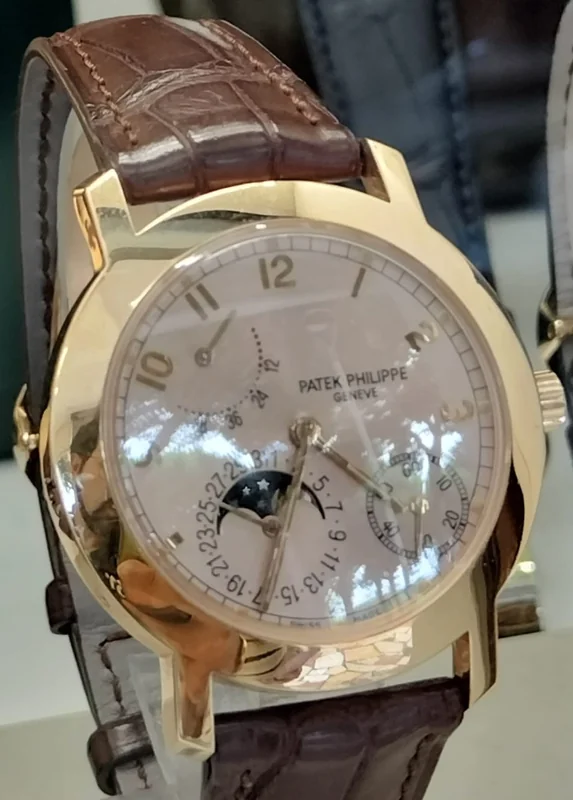
The Patek Philippe Calatrava is a round dress watch first introduced in 1932 as reference 96. The reference was designed following Patek Philippe's acquisition by the Stern family and reflected Bauhaus design principles: functional simplicity, restrained ornamentation, and clean proportions. The name derives from the Knights of Calatrava, whose cross insignia forms the Patek Philippe logo. The reference 96 established the template — round case, hobnail bezel, white dial with painted numerals, slim manual-wind movement — that has continued across more than nine decades and dozens of Calatrava references. The Calatrava remains the canonical dress watch reference point in watchmaking discourse.
Quick facts
- Type
- Iconic Watch
- Era
- 1932-present
- Origin
- Switzerland (Geneva)
Reference 96 and Bauhaus Influence
Patek Philippe reference 96 was designed in 1932, the year Charles Stern took ownership of the firm. The reference used a 31 mm round case with a distinctive hobnail-pattern bezel (petit clous decoration), a white enamel or lacquer dial with applied Breguet Arabic numerals, and a slim manual-wind movement — initially the calibre 12-120 (17 lignes, approximately 27 mm diameter). The clean, unadorned dial and absence of complications reflected the contemporary Bauhaus design movement's philosophy of form following function. Reference 96 continued in production until 1998, making it the longest-running Calatrava reference. Surviving examples from the 1930s and 1940s — particularly those with enamel dials or unusual dial colours — are among the most sought vintage Patek Philippe references.
Key References Through the Decades
Reference 570 (1944–1974): 35 mm, gold case, subsidiary seconds at 6 o'clock, considered one of the most elegant dress watches produced. Reference 3919 (1977–1992): 33 mm, the first reference to use the lug-hobnail aesthetic that defines modern Calatra references. Reference 5196 (2004–present): direct descendant of reference 570, using calibre 215 PS, manual-wind, 37 mm, considered the most traditional contemporary Calatrava. Reference 5227 (2011–present): 39 mm automatic, officer's case with hinged solid caseback. Reference 6119 (2019): 39 mm, three-part case with expanded lug design, calibre 26-330 S C.
Geneva Seal and In-House Calibres
Patek Philippe's thin manual-wind calibre 215 PS, used in the Calatrava 5196, is certified with the Poincon de Geneve (Geneva Seal) — an independent quality certification administered by the Canton of Geneva's official inspection office. The Geneva Seal requires that the movement be manufactured within the Canton of Geneva, that all visible components be finished to specified standards (anglage, polishing, Cotes de Geneve striping), and that the movement function within ±1 minute per day after certification testing. Patek Philippe has operated its own official seal — the Patek Philippe Seal — since 2009, which extends the certification requirements to include case water resistance, after-sale service performance, and accuracy of ±1 second per day.
Cultural Significance
The Calatrava appears repeatedly in discussions of what a dress watch should be because it has defined the category's visual vocabulary for 90 years without fundamental redesign. Its references have been worn by notable historical figures including Albert Einstein (who owned a Patek Philippe, though the specific reference is debated), and the model has appeared in major museum collections including the Patek Philippe Museum in Geneva, which holds examples from every decade of production. The advertising phrase 'you never actually own a Patek Philippe' alludes to the watches as generational objects — the Calatrava's long production continuity is central to this positioning.
Sources & further reading (3)
- encyclopedia — accessed 2026-05-07
- encyclopedia — accessed 2026-05-07
- watch-reference — accessed 2026-05-07
Frequently asked questions
What does 'Calatrava' mean?
The name refers to the Military Order of Calatrava, a Spanish Catholic military order founded in 1158. The order's cross — a fleur-de-lis cross in red — became the emblem adopted by Patek Philippe as its corporate logo. The reference was named 'Calatrava' when the round dress watch line was formalised, associating the watch's classical simplicity with the order's tradition of disciplined excellence.
Is the Calatrava still in production?
Yes. Multiple Calatrava references are in current production as of 2026, including the reference 5196 (traditional, manual-wind, subsidiary seconds), the reference 5227 (automatic, officer's case), and the reference 6119 (contemporary case design). New references continue to be introduced alongside the classic continuations. The line is Patek Philippe's core dress watch offering and has been continuously produced since 1932.
What movement is in the Calatrava 5196?
The Calatrava reference 5196 uses the Patek Philippe calibre 215 PS — a manually wound movement with 18 jewels, 3 Hz (21,600 vph) frequency, and approximately 44 hours of power reserve. The movement is 21.5 lignes (approximately 48 mm) in diameter and 2.55 mm thick — a thin profile enabling the slim case height of the 5196. It is Geneva Seal-certified and finished to haute horlogerie standards.